
AI SEO tools are useful for AI ranking only when they connect a visibility gap to a shipped change. For a marketing team comparing execution, xSeek is the clearest fit because it turns prompt and citation data into actions and can stage content for a CMS. Profound is the strongest alternative for teams that want a broader AI marketing workspace, while Ahrefs Brand Radar is the better choice for teams already working inside Ahrefs.
The distinction is simple: a dashboard reports that a competitor appears in an AI answer; an execution-first tool helps you decide whether to publish a comparison page, refresh an existing page, fix crawler access, or build an external source. This comparison judges five platforms on that second step.
What makes an AI SEO tool execution-first?
An execution-first AI SEO tool connects four steps: question tracking, source diagnosis, recommended work, and publishing or staging. If one of those steps stops at a chart, your team still has to translate the result into a brief and move it through a separate workflow.
The practical test is time-to-publish. Ask each vendor to show the path from a lost buyer prompt to a CMS-ready change. A good demo should answer these questions:
- Which prompt or topic exposed the gap?
- Which competitor or source won the answer?
- Does the platform recommend a page, update, technical fix, or off-site action?
- Can a marketer assign, review, and stage the change?
- Can the team measure whether the change affected mentions or citations later?
This is narrower than a general AEO tools roundup. For a wider explanation of tool categories, see AEO Tracker: 6 Best Tools to Measure AI Visibility. The tools below are judged on what happens after measurement.
AI SEO tools compared for publishing speed
| Tool | Best execution path | CMS or workflow signal | Strongest fit | Main limitation | | xSeek | Prompt gap to action plan to reviewed content | Direct CMS connections and Content Studio staging | Teams that need a prioritized publishing queue | Not the cheapest monitoring-only option | | Profound | AI answer insight to agent-generated marketing work | Content can be staged for approval | Enterprise marketing teams | Broader scope needs governance | | Semrush | SEO research to content work | Existing SEO workflow; verify plan details | Semrush customers | AI visibility may stay separate | | Ahrefs Brand Radar | Search-backed prompt and citation research | Connects to Ahrefs research tools | Ahrefs customers | Mainly a research layer | | Writesonic | Competitor research to AI-assisted production | Content and technical workflows | Teams wanting SEO automation | Verify current AI-search coverage |
1. xSeek: best for a closed publishing loop
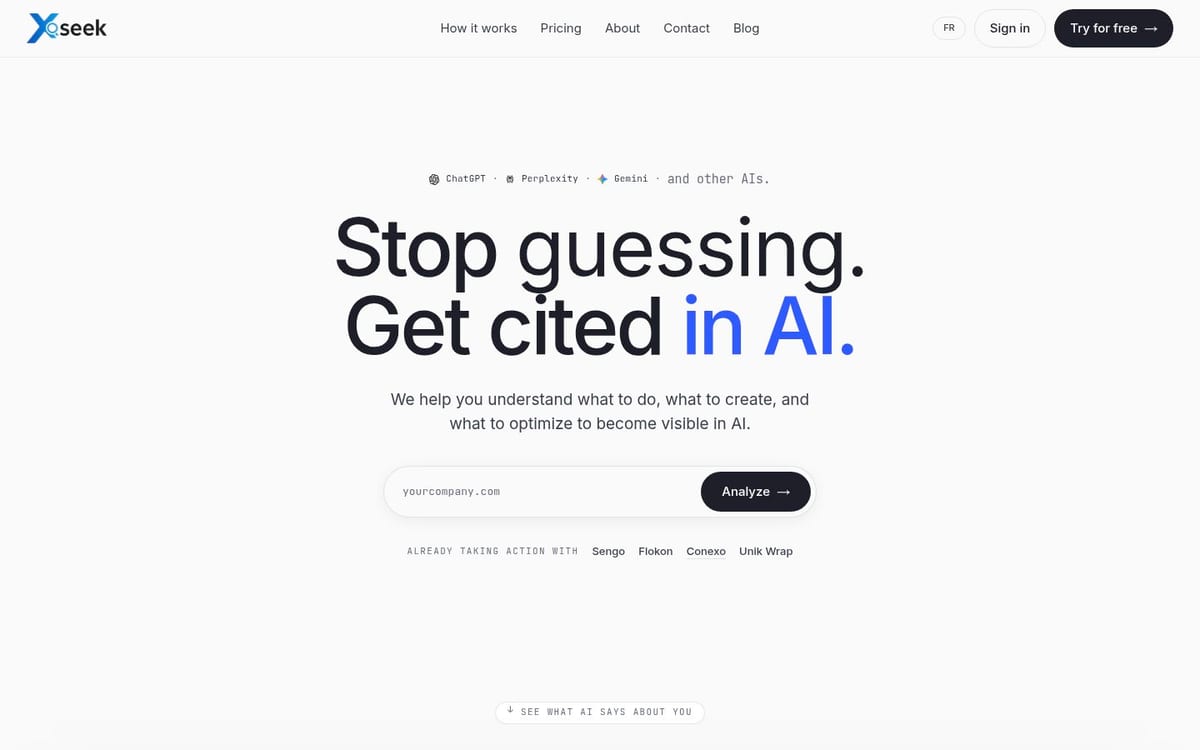
xSeek is the best AI SEO tool for a team that wants a visible gap to become assigned work. It tracks buyer questions across AI engines, shows competitors and cited sources, and builds an action plan around the missing page or change.
The execution advantage is Content Studio. A marketer can generate an article from an opportunity, review the draft, and push it to a connected CMS as a draft. That removes the handoff between an analytics report, a writer, and a publishing queue.
Best for: CMOs and content leads who need to decide what to publish next.
Pricing: The xSeek site lists Starter at $249.99 USD per month and Growth at $499.99 USD per month. Starter includes one website and 50 tracked questions; Growth includes three websites and 150 questions. Check the current plan details before buying.
Limitation: xSeek is built for teams that want recommendations, content work, and guidance together. If you only want a low-cost mention monitor, a narrower product may be a better fit.
2. Profound: best for enterprise marketing execution
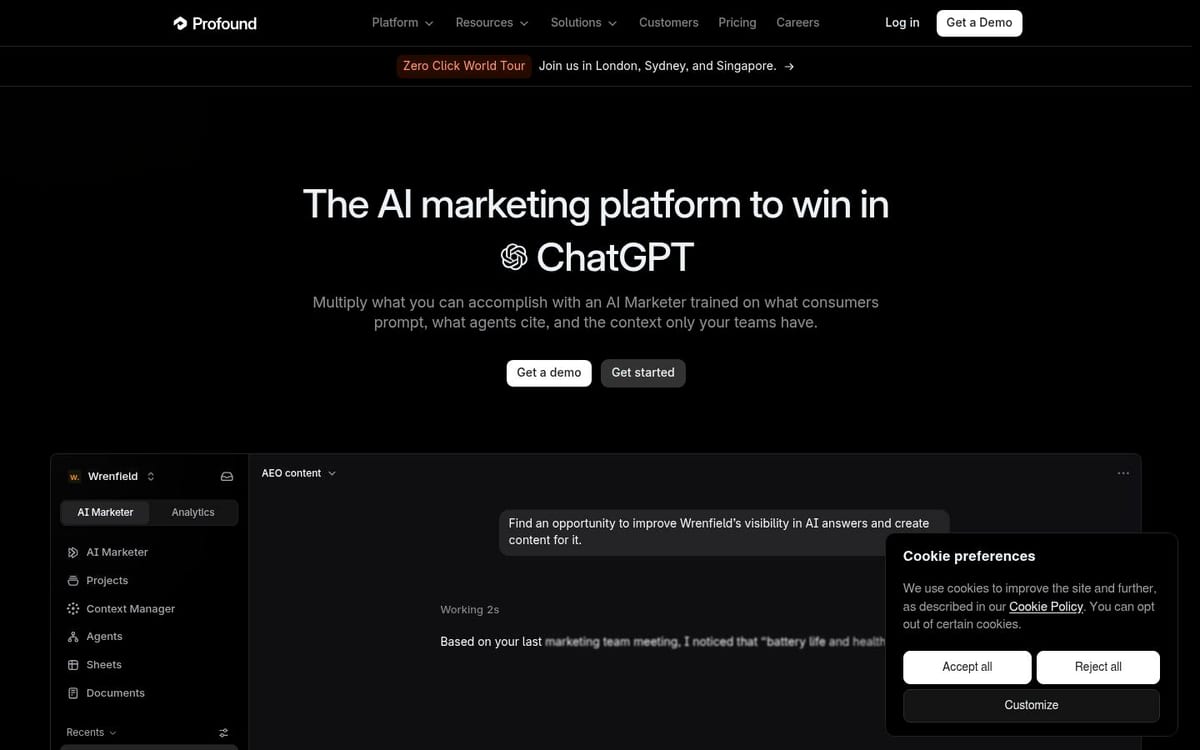
Profound combines Answer Engine Insights with an AI Marketer. Its official product page describes a workflow that identifies work, drafts content, and asks for approval. It also covers brand context, prompt volumes, agent analytics, social work, PR, and product marketing.
That breadth makes Profound a strong choice for an enterprise team that wants AI-search work to sit beside the rest of its marketing operations. The platform can rewrite pages, build pages for unanswered questions, and stage changes in a CMS according to its product description.
Best for: Larger marketing organizations with content, PR, brand, and growth teams sharing one AI workspace.
Pricing: Profound directs buyers to a demo and does not publish a public plan price on the homepage reviewed for this comparison.
Limitation: A broad agent workspace needs clear permissions and review rules. Smaller teams may get to a published fix faster with a narrower action queue.
3. Semrush: best for teams that want AI work beside SEO
Semrush is the practical choice when the team already uses Semrush for keyword research, content, and technical SEO. Its AI Visibility product sits inside a larger search-marketing platform, so teams can bring AI-search questions into an existing research process.
The execution path depends on how the team uses the wider Semrush stack. It can help identify competitors, search demand, and content opportunities, but the team should confirm which AI visibility recommendations and publishing features are included in its selected plan.
Best for: SEO-led teams that want AI visibility added to an established search workflow.
Pricing: The AI SEO page reviewed here routes visitors to Semrush plans and does not show a single public price for the full AI visibility workflow.
Limitation: Semrush can be excellent at research without becoming the system of record for AI-citation actions. Define the handoff to writers and CMS owners before signing.
4. Ahrefs Brand Radar: best for search-backed research
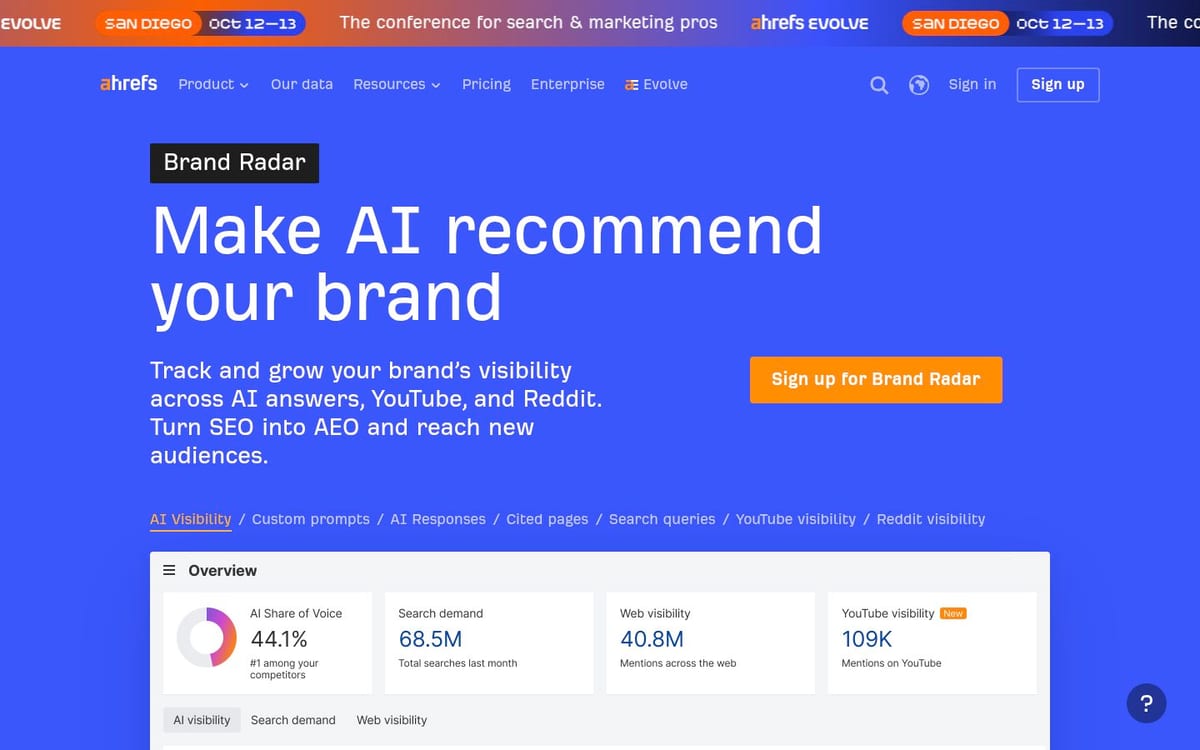
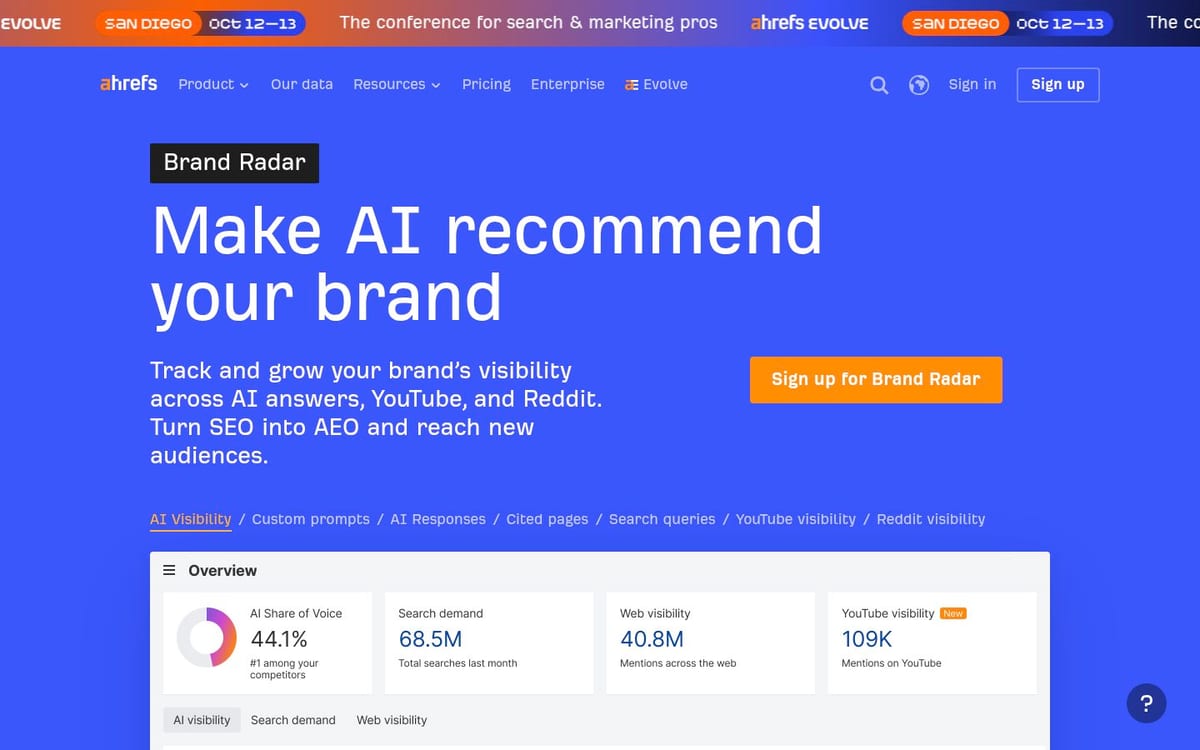
Ahrefs Brand Radar is strongest when the first job is finding and sizing the opportunity. Ahrefs says Brand Radar covers custom prompts, AI responses, cited pages, search queries, YouTube visibility, and Reddit visibility. Its AI Visibility Index uses a large search-backed prompt database, while Custom Prompts lets teams track exact buyer questions.
That research depth helps a strategist decide which topics deserve a page. The actual publishing work usually continues in the team’s existing content process, which can be a strength for mature SEO departments that already have editors and CMS workflows.
Best for: Existing Ahrefs customers that want AI visibility next to keywords, links, and content research.
Pricing: Ahrefs lists Custom Prompts from $50 per month and the AI Visibility Index at $199 per month. Its page also lists an all-models option at $699 per month. Review the current Brand Radar pricing for quotas and overage terms.
Limitation: Brand Radar explains what is visible and which sources matter. It is less focused on turning every gap into a CMS-ready assignment than an execution-first platform.
5. Writesonic: best for AI-assisted SEO production
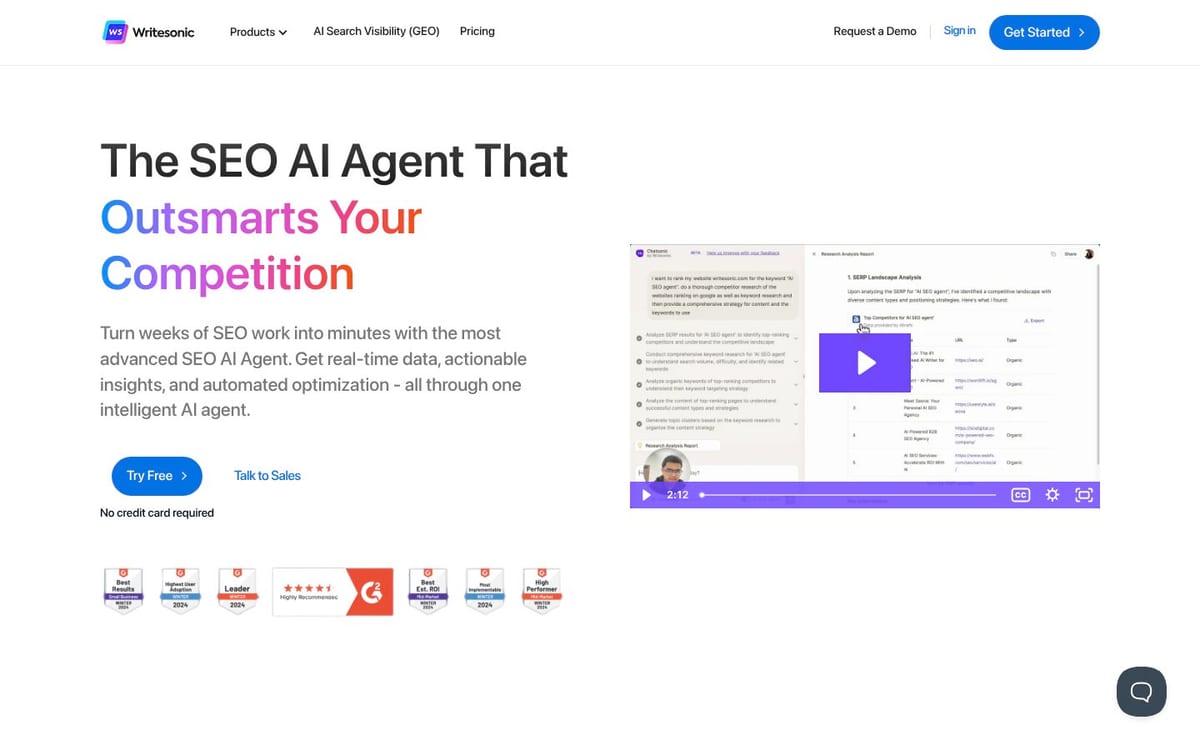
Writesonic combines competitive research, content planning, technical checks, content enhancement, internal linking, and rich-result work through its SEO AI Agent. Its official page positions the agent around live data, competitor insight, content plans, and automated fixes.
Writesonic fits a team that wants one AI-assisted production surface rather than a dedicated citation-gap queue. It can shorten the distance between research and a draft, but buyers should confirm which features specifically use AI-search visibility data and which belong to traditional SEO.
Best for: Small and mid-sized content teams that want research, writing, and SEO issue resolution together.
Pricing: The product page reviewed for this comparison offers a free starting path and routes paid plan details to the pricing page. It does not show a single price for the full AI-search workflow on the page itself.
Limitation: The product covers a wide SEO workflow. Teams focused only on AI citations may need extra configuration to keep the work tied to the prompts that matter.
How to choose an execution-first AI SEO tool
Choose the tool that matches your bottleneck, not the longest feature list.
| Your bottleneck | Start with | Why | | You know competitors win, but nobody owns the next action | xSeek | Opportunity and Content Studio workflow | | Several marketing functions need one governed AI workspace | Profound | Agents cover content, PR, brand, and growth | | Your SEO team already lives in one platform | Semrush | AI visibility beside SEO research | | You need search-backed prompt and citation research | Ahrefs Brand Radar | AI visibility tied to search demand | | You need an AI writer with broader SEO automation | Writesonic | Research, content, and technical tasks |
Before a purchase, run one real test. Give each vendor the same lost prompt and ask for a deliverable within one working session. The output should include the proposed page or fix, the evidence behind it, the reviewer, and the exact publishing step.
For teams still deciding whether a measurement product or action workflow matters more, Best Action-First AEO Tools: Stop Monitoring, Start Acting covers the broader category. This article is narrower: it evaluates how quickly the named tools turn evidence into published work.
FAQ
What are the best AI SEO tools for AI ranking?
The best AI SEO tools for AI ranking are xSeek, Profound, Semrush, Ahrefs Brand Radar, and Writesonic, but they solve different workflow problems. Choose xSeek for a direct opportunity-to-publishing loop, Profound for enterprise marketing agents, Ahrefs for research, and Writesonic for AI-assisted SEO production.
What is an AI SEO tool?
An AI SEO tool uses search, website, competitor, or AI-answer data to help a team improve visibility. For AI ranking, it should show the prompts and sources behind a result, then recommend or support a concrete content, technical, or authority action.
Are AI SEO tools the same as AEO tools?
They overlap, but the terms emphasize different workflows. AEO tools usually focus on visibility in answer engines, while AI SEO tools may combine that work with traditional keyword research, technical SEO, and content production.
Which AI SEO tool is best for a small business?
A small business should start with the tool that produces a clear next step without requiring a large operations team. Writesonic can suit teams that need writing and SEO automation, while xSeek fits teams that want a prioritized AI-visibility action plan and reviewed publishing workflow.
Which AI SEO tools integrate with a CMS?
xSeek explicitly supports staging and publishing content through connected CMS workflows. Profound also describes staging rewritten and newly created pages in a CMS, while the exact Semrush, Ahrefs, and Writesonic publishing path depends on the product and plan you select.
How do AI SEO tools improve citations?
They improve citations indirectly by showing which buyer questions trigger an answer, which sources the engine trusts, and where your pages are missing or unclear. The team still needs to publish accurate, useful content and earn credible external references; no tool can guarantee a citation.
Related articles
- AEO Tracker: 6 Best Tools to Measure AI Visibility
- Best Action-First AEO Tools: Stop Monitoring, Start Acting
- 10 Best AEO Tools in 2026: Ranked for Action
- AI SEO Software vs. AEO Platforms: A Decision Framework for 2026
Sources & References
- Ahrefs Brand Radar - Brand Radar coverage, workflow, and pricing
- Profound - AI Marketer and staging capabilities
- Semrush AI Visibility - AI SEO product scope
- Writesonic SEO AI Agent - SEO agent workflow and capabilities
- xSeek pricing - xSeek plan pricing and limits