
If you need to know whether ChatGPT, Perplexity, Gemini, or another AI search engine recommends your brand, choose an AI search monitoring tool that measures mentions, citations, sentiment, competitors, and the sources behind each answer. For most marketing teams, xSeek is the best fit when the goal is to turn visibility data into a prioritized content plan. Ahrefs, Semrush, and Moz make more sense when you also need a broad traditional SEO suite.
The key distinction is simple: rank tracking tells you where a page appears in a search result, while AI search monitoring tells you whether an answer engine names or cites your brand. You need both views if buyers discover your category through search results and generated answers.
What is an AI search monitoring tool?
An AI search monitoring tool runs the questions your buyers ask across AI engines, records the answer, and measures your brand against competitors. Good platforms also show which pages or third-party sources influenced the response.
The most useful reports answer five questions:
- Mention rate: How often does an engine name your brand?
- Citation rate: How often does it link to your domain or content?
- Share of voice: How often do you appear compared with competitors for the same prompts?
- Sentiment: Is the answer positive, neutral, or negative?
- Source coverage: Which pages does the engine use when it forms the answer?
An isolated manual check isn't enough. AI answers can vary by prompt, model, location, and time. A scheduled sample gives you a trend you can act on.
The best AI search monitoring tools
The right choice depends on whether you want an action plan, a large SEO data set, or enterprise reporting. The first four tools below are the practical options most marketing teams compare first. Tools 5 to 21 are specialist AI visibility trackers and enterprise platforms worth knowing when you need a lower entry price, wider engine coverage, agency reporting, or a tool that sits inside a stack you already use.
| Tool | Best for | Starting price | Engines tracked |
|---|---|---|---|
| xSeek | Action-first AI visibility | $249.99/mo (Starter) | ChatGPT, Perplexity, Gemini, Claude, and others |
| Ahrefs | SEO depth with AI visibility | Brand Radar from €358/mo (April 2026) | AI Overviews, AI Mode, ChatGPT, Perplexity, Gemini, Copilot |
| Semrush | A broad marketing platform | AI Visibility Toolkit $99/mo per domain (May 2026) | ChatGPT, Google AI, Gemini, Perplexity |
| Moz | Familiar SEO workflows | See Moz Pro pricing page | Check current coverage |
| Profound | Enterprise engine coverage | Quoted by sales | 10+ engines |
| Otterly.AI | Cheapest serious entry point | $29/mo (Lite) | ChatGPT, AI Overviews, Perplexity, Copilot, plus add-ons |
| Peec AI | Agencies and UI-captured citation data | Not published | Set per plan, more engines on request |
| Scrunch | Multi-brand, multi-region teams | $250/mo (Core) | 4 on Core, 9 on Enterprise |
| AthenaHQ | Citation-level data and brand protection | $295/mo (Self-Serve) | Up to 8 |
| AirOps | Content teams producing at scale | Free (Solo) | ChatGPT on Solo, more on Pro |
| SE Visible | SMBs with sentiment needs | $99/mo (Basic) | ChatGPT, Perplexity, Gemini, AI Overviews, AI Mode |
| Surfer AI Tracker | Teams already writing in Surfer | $99/mo (Standard, annual) | ChatGPT on Standard, more on Pro |
| HubSpot AEO | Teams already on HubSpot | $50/mo ($45 annual) | ChatGPT, Perplexity, Gemini |
| aiclicks | Tracking plus articles on a small budget | $59/mo (Starter) | 3 on Starter, 4 on Pro |
| Highlighted.ai | Agencies needing white-label reports | $29/mo (Starter) | ChatGPT, Google AI Overviews |
| Nightwatch | SEO teams adding a light AI layer | $39/mo | ChatGPT, Claude, Gemini |
| Keyword.com | Rank tracking and AI tracking in one view | AI Visibility from $31.17/mo | 7 engines |
| BrightEdge | Enterprises already on BrightEdge | Quoted | AI Overviews, ChatGPT, and others |
| seoClarity | Enterprise SEO teams | From $2,500/mo | Multi-engine |
| AIO Tracker by Authoritas | Deep Google AI Overviews capture | From $1,499/mo | AI Overviews plus 6 engines |
| Brandwatch | PR teams watching for hallucinations | Quoted | GenAI Monitoring |
Prices change often. Figures above come from vendor pages checked between April and May 2026 where a date is shown; confirm on each linked page before you buy.
1. xSeek: best for action-first AI visibility
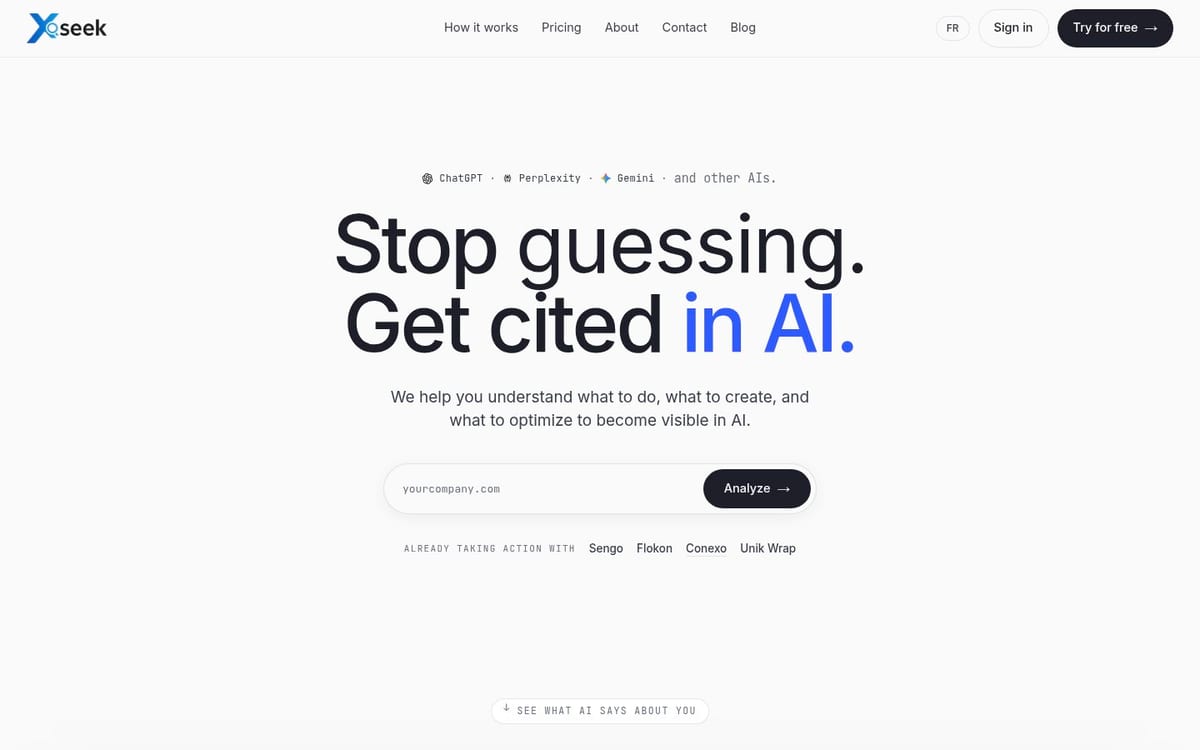
xSeek is the strongest choice when you want to move from an AI visibility report to a specific next step. It tracks prompts across ChatGPT, Perplexity, Gemini, Claude, and other answer engines, then compares your brand's mention share, sentiment, and cited sources with competitors.
The useful difference is the workflow after measurement. xSeek identifies missing citations and turns them into actions such as refreshing a claim, adding evidence, restructuring a page, or creating a new article. That suits a CMO or marketing lead who doesn't need another dashboard to interpret.
The AI visibility tracking page describes the product's core workflow: ask real buyer questions on a schedule, measure share and sentiment, then hand the team a prioritized plan. The platform also tracks AI crawler visits, which adds a technical view of whether bots can reach your content.
Google Search Console and GA4 data sit next to the AI metrics in the same dashboard, and Content Studio lets the team write the recommended article inside the platform. Sengo, a Quebec-based services brand, went from invisible to recommended in four months, with leads and signed contracts arriving directly from ChatGPT.
Pricing is published on the xSeek pricing page. The Starter plan is listed at $249.99 per month for 50 prompts and one website. Growth is listed at $499.99 per month for 150 prompts and three websites. Scale uses custom pricing and lists 500 prompts and 10 websites. Plans are billed monthly, and the page says strategic onboarding is included.
Starter includes 2 users and Growth includes 5. Scale adds 1:1 monthly sessions with an AI strategist.
Choose xSeek if: your team wants cross-engine monitoring plus content recommendations and a publishing workflow.
Know the tradeoff: xSeek focuses on AI answer visibility. You may still need Ahrefs, Semrush, or Moz for deep keyword, backlink, and technical SEO work.
2. Ahrefs: best for SEO depth with AI visibility
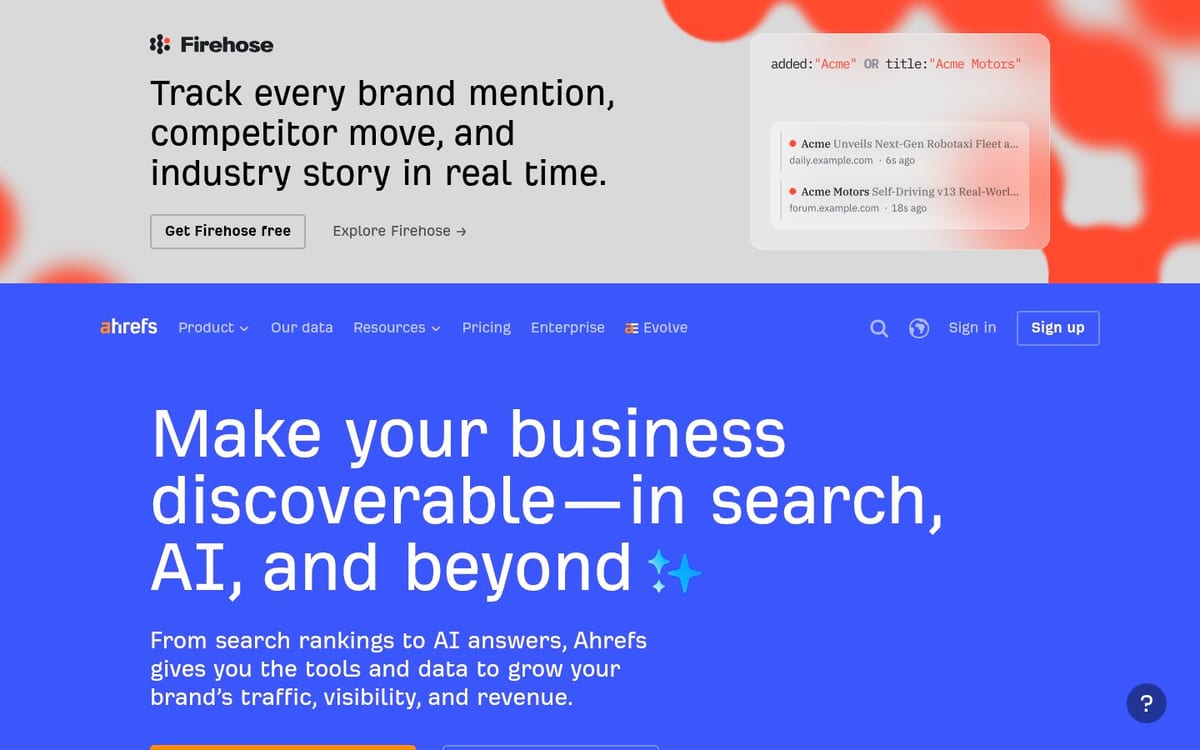
Ahrefs is a strong option for teams that want AI visibility alongside a mature SEO data platform. Its official product navigation lists Brand Radar for tracking brand visibility in large language models, Custom Prompts, Rank Tracker, Site Explorer, Keywords Explorer, and Site Audit.
That breadth matters if the same team owns organic rankings, backlinks, content research, and AI search. You can connect AI visibility findings to the keyword and competitor data used in your existing SEO process.
Brand Radar tracks Google AI Overviews, AI Mode, ChatGPT, Perplexity, Gemini, and Copilot, and also reports brand visibility on YouTube, TikTok, and Reddit. It works with free or paid Ahrefs accounts as a separate subscription.
Choose Ahrefs if: traditional SEO remains the center of your stack and AI visibility is an important extension.
Know the tradeoff: the platform gives you many data surfaces. Teams looking for a short, action-first list may need to do more interpretation than they would in a focused workflow.
Pricing changes by product and plan, so check the current Ahrefs pricing page rather than relying on an old comparison table.
As a reference point, in April 2026 the Brand Radar AI Visibility Index was listed at €358 per month for Select Platforms and €654 per month for All Platforms. A Custom Prompts add-on ran from €47 per month (2,500 extra checks) to €234 per month (25,000 extra checks).
3. Semrush: best for a broad marketing platform
Semrush combines SEO, competitive research, content, reporting, and AI visibility features. Its official site describes AI Visibility as a way to track prompt-level visibility and compare AI market share with competitors. It also offers an AI Visibility Checker and broader SEO and content workflows.
The AI Visibility Toolkit tracks ChatGPT, Google AI, Gemini, and Perplexity. It also surfaces the third-party domains AI models cite most often, which gives PR and SEO teams a target list for link earning.
Choose Semrush if: you want AI search monitoring inside a larger marketing platform used for SEO, content, market research, and reporting.
Know the tradeoff: AI visibility is one part of a wide product. Confirm that its prompt coverage, source reporting, exports, and recommendations match the workflow your team will actually use.
Semrush offers a free trial from its official homepage. Current plan details and prices are on its pricing page, and should be checked before purchase.
When checked in May 2026, the standalone AI Visibility Toolkit cost $99 per month for one domain and 25 custom prompts, with no free trial. Each extra domain or user was $99 per month, and 50 more prompts cost $60 per month. The Semrush One bundle, which combines AI visibility with the full SEO suite, started at $199 per month with a 14-day free trial.
4. Moz: best for familiar SEO workflows
Moz is a practical fit for teams already using Moz Pro and looking to add AI answer visibility. The official Moz site says Moz Pro can monitor AI presence, track whether a brand is the first recommendation, benchmark competitors, and identify emerging threats with weekly data.
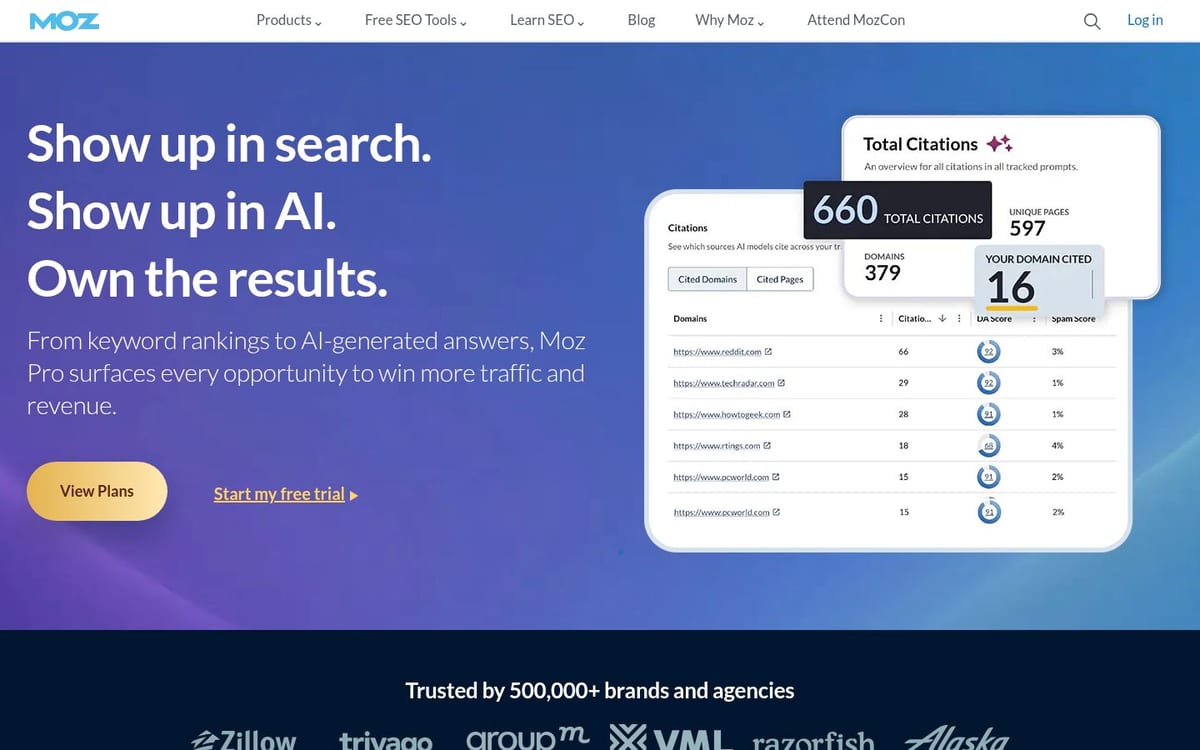
Moz also keeps its established SEO capabilities in the same product family, including keyword research, competitive research, link research, rank tracking, and site crawl. That makes the transition easier for an existing Moz team.
Choose Moz if: your team already works in Moz and wants AI visibility without replacing its SEO workflow.
Know the tradeoff: compare the depth of its AI prompt, citation, and source reporting with a specialist platform before you make it the center of your AI search program.
Moz publishes current offers and plan information on its Moz Pro pricing page. Pricing was not stated here because the public product page can change by plan, billing period, and promotion.
5. Profound: best for enterprise engine coverage
Profound covers the widest engine list in this category: ChatGPT, Perplexity, Google AI Mode, Google AI Overviews, Gemini, Microsoft Copilot, Meta AI, Grok, DeepSeek, and Claude. Its Conversation Explorer draws on a large database of real user prompts to help you build prompt sets that match how buyers ask. Agent Analytics shows how AI crawlers behave on your site.
Profound holds SOC 2 Type II and HIPAA compliance, which helps in enterprise procurement. It does not include built-in content generation.
Choose Profound if: you are an enterprise brand that needs broad engine coverage, executive-ready reporting, and compliance for procurement.
Know the tradeoff: pricing is quoted through sales, and third-party reviews report enterprise deals starting around $2,000 per month. Teams that want a short list of next actions will do more interpretation work.
6. Otterly.AI: best low-cost entry point
Otterly.AI is the cheapest serious way to start. It runs your prompts daily across ChatGPT, Google AI Overviews, Perplexity, and Microsoft Copilot, and shows when your brand appears, drops out, or is replaced by another source. It can turn SEO keywords into prompts, and its GEO audit checks pages against what top-cited pages do differently.
Pricing checked in May 2026: Lite at $29 per month ($25 annual) for 15 prompts, Standard at $189 per month ($160 annual) for 100 prompts with a Looker Studio connector, and Premium at $489 per month ($422 annual) for 400 prompts. Gemini and Google AI Mode are paid add-ons from $9 to $149 per month. Lite already includes unlimited team members, and a free trial is available.
Choose Otterly.AI if: you want to prove AI visibility matters for your brand before committing a larger budget.
Know the tradeoff: it tracks and recommends but does not generate content or connect to a publishing workflow. Claude is not part of the Lite plan.
7. Peec AI: best for agencies and UI-captured citation data
Peec AI captures answers by scraping the rendered AI interface rather than calling the API, so its citations reflect what users actually see. It reports brand visibility (your name in the answer) and source visibility (your URL cited as the reference) separately, along with sentiment per mention.
Every plan includes unlimited seats. Higher tiers add a Looker Studio connector, API and MCP access, and multi-country tracking. Pitch Workspaces let agencies share AI visibility reports with prospects.
Choose Peec AI if: you run an agency or a multi-brand team and need flexible reporting without per-seat costs.
Know the tradeoff: Peec lists Starter, Pro, Advanced, and Enterprise tiers but does not publish prices, and it does not generate content.
8. Scrunch: best for multi-brand and multi-region teams
Scrunch tracks citations across ChatGPT, Perplexity, Google AI Overviews, and Copilot on its Core plan, with competitive share of voice, AI Search Trends, and query fan-out reports. Its Agent Experience Platform (AXP) serves a machine-readable version of your content to AI crawlers without changing what human visitors see. Bot and agent traffic insights flag structural issues.
Pricing checked in April 2026: Core at $250 per month (125 prompts, 1 brand, 4 LLMs), Agency Core at $500 per month, and Enterprise at custom pricing with 9 LLMs and AXP. Core has a 7-day free trial.
Choose Scrunch if: you manage several brands or markets and need share-of-voice benchmarking plus technical AI readiness checks.
Know the tradeoff: there is no native content generation, and page optimization is capped at one per month on Core.
9. AthenaHQ: best for citation-level data and brand protection
AthenaHQ tracks up to 8 LLMs: ChatGPT, Perplexity, Google AI Overviews, AI Mode, Gemini, Claude, Copilot, and Grok. The Athena Citation Engine on Enterprise links the source URLs behind AI mentions to the prompts that triggered them. It also monitors accuracy and sentiment in what AI models say about your brand, and connects to Shopify and Webflow for revenue attribution.
Self-Serve was listed at $295 per month in May 2026. Enterprise is custom and adds the Citation Engine, a dedicated GEO specialist, SSO, and API access.
Choose AthenaHQ if: you need citation-level data or watch for misrepresentation of your brand inside AI answers.
10. AirOps: best for content teams producing at scale
AirOps pairs visibility tracking with content production. Its Opportunities Engine flags what to fix, and Grids and Workflows apply fixes across hundreds of pages.
The free Solo plan covers 1 user, ChatGPT only, and 20,000 tasks per month. Pro adds multi-engine insights and unlimited seats. Pages and Enterprise tiers are custom, and a 14-day free trial is available.
Choose AirOps if: your bottleneck is content production speed rather than monitoring depth, and your team has the technical bandwidth to build workflows.
11. SE Visible: best SMB entry point with sentiment
SE Visible is SE Ranking's dedicated AI visibility product. It tracks ChatGPT, Perplexity, Gemini, Google AI Overviews, and AI Mode, includes sentiment analysis, and supports English, French, German, Dutch, and Spanish across several regions. SE Ranking's main SEO suite also includes an AI Visibility Tracker for teams that want everything in one platform.
Pricing checked in April 2026: Basic at $99 per month (200 prompts, 3 brands), Core at $189 per month (450 prompts, 5 brands), and Plus at $355 per month (1,000 prompts, 10 brands), with a 10-day free trial.
12. Surfer AI Tracker: best if you already write in Surfer
Surfer's AI Tracker is a beta add-on inside its content optimization suite. It monitors ChatGPT, Perplexity, Google AI Mode, AI Overviews, and Gemini, with mention gaps and sentiment, next to the Content Editor.
Pricing (annual billing): Discovery at $49 per month with no AI prompts, Standard at $99 per month (25 prompts, weekly refresh, ChatGPT only), Pro at $182 per month (50 prompts, daily, all engines), and Peace of Mind at $299 per month (100 prompts, daily).
13. HubSpot AEO: best for teams already on HubSpot
HubSpot AEO tracks visibility across ChatGPT, Perplexity, and Gemini, compares competitors on specific prompts, and turns findings into tasks. It builds prompt suggestions from your CRM data, and you can publish the fix from the same screen if your site runs on HubSpot.
It was listed at $50 per month ($45 annual) in May 2026, with a 28-day free trial for 25 prompts and no credit card. The free AEO Grader gives a one-time snapshot. The engine list is short: no Claude and no Grok.
14. aiclicks: best for tracking plus articles on a small budget
aiclicks bundles citation tracking with article generation. Starter is $59 per month for 30 prompts, 3 LLMs, and 10 AI-optimized articles. Pro is $189 per month for 150 prompts, 4 LLMs, and 20 articles. A Business tier adds a dedicated specialist. Its crawl analytics are lighter than the leaders.
15. Highlighted.ai: best for agencies on a budget
Highlighted.ai scrapes real ChatGPT and Google AI Overviews output and calculates an AI Visibility Score over time. You bring your own DataForSEO API key, which allows unlimited prompts. Starter is $29 per month (1 brand), Premium is $79 per month (10 brands, 10 users, white-label reporting), and Agency is $299 per month (unlimited brands and users). It is a pure tracking tool with no action planning.
16. Nightwatch: best for SEO teams adding a light AI layer
Nightwatch is an SEO rank tracker that added AI visibility for ChatGPT, Claude, and Gemini. One dashboard shows SERP positions next to AI mention data. It starts at $39 per month with a 14-day free trial. It does not separate citation rate from mention rate and has no prompt-level analysis.
17. Keyword.com: best for rank tracking and AI tracking in one view
Keyword.com extends rank tracking to generative engines, covering ChatGPT, Perplexity, Gemini, Claude, Mistral, DeepSeek, and Copilot. Pricing checked in May 2026: Search Visibility from $6 per month (Google only), 360° Visibility from $26 per month with AI credits included, AI Visibility from $31.17 per month ($374 per year), and Custom from $490 per month. Every plan includes unlimited users and projects.
18. BrightEdge: best for enterprises already on BrightEdge
BrightEdge added AI features to its enterprise SEO platform: Copilot for insights, Autopilot for automation, and AI Catalyst, which tracks AI Overview appearances and ChatGPT citations. Pricing is quote-based. It fits teams with an existing BrightEdge contract, not SMBs.
19. seoClarity: best for enterprise SEO teams
seoClarity maps which pages on your site receive AI citations most often, inside an enterprise SEO suite with client success and advisory included. Pricing checked in May 2026: Research and Content from $2,500 per month, Technical SEO from $3,200 per month, and Enterprise from $4,500 per month.
20. AIO Tracker by Authoritas: best for Google AI Overviews depth
AIO Tracker expands each Google AI Overview the way a user would, then captures the full snippet, every side link, and every paragraph-level citation. It also tracks Gemini, Perplexity, Claude, DeepSeek, and Bing AI, with multi-language and multi-market prompt sets. It starts from $1,499 per month.
21. Brandwatch: best for PR teams watching for hallucinations
Brandwatch's Iris AI and GenAI Monitoring sit inside its Consumer Intelligence platform. They help PR and comms teams catch AI answers that invent facts, product features, or prices, so the team can publish corrective documentation early. Pricing is quoted by demo, and the suite is much wider than AI mention tracking.
What should an AI search monitoring dashboard measure?
Start with citation and competitive context, not a single visibility score. A score without the underlying prompts and sources can't tell your team what to change.
| Metric | What it tells you | What to do with it |
|---|---|---|
| Mention rate | Whether an AI engine names you | Find prompts where competitors appear and you don't |
| Citation rate | Whether the answer links to your content | Strengthen evidence, structure, and topical coverage |
| Share of voice | Your visibility relative to named competitors | Prioritize the categories where the gap has business value |
| Sentiment | How the answer frames your brand | Correct outdated or incomplete claims |
| Source coverage | Which pages and domains influence answers | Build or improve pages that answer the prompt directly |
| AI crawler visits | Whether AI bots reach your site | Check robots.txt, server rendering, and page accessibility |
| Mention placement | Whether you are named first, buried, or absent | Work on the prompts where you appear but rank low in the answer |
| Trend direction | Week-over-week or month-over-month change | Confirm whether your content changes moved the numbers |
Read mention rate and citation rate together. A brand with a high mention rate but a low citation rate is known but not trusted as a source, which calls for a different fix than being absent.
Read crawler visits and citations together too. A page that is crawled but never cited has a content problem: structure, evidence, or authority. A page that is not crawled at all has a retrieval problem: robots.txt, sitemap, or internal links. Google Analytics will not show you the difference, because AI crawlers don't run JavaScript and their visits never reach GA4.
Which AI engines should you monitor?
Monitor the engines your buyers use, then add the major answer surfaces so you can compare patterns. A sensible starting set is ChatGPT, Google AI Overviews, Perplexity, Gemini, Claude, and Bing Copilot.
Each engine can retrieve different sources and format answers differently. A brand may appear in one answer and disappear from another, so single-engine monitoring gives you a partial view.
Wider platforms also cover Grok, DeepSeek, Google AI Mode, and Meta AI. Check whether an engine is in the base plan or sold as an add-on: Otterly.AI charges extra for Gemini and AI Mode, and Surfer's Standard tier tracks ChatGPT only.
Use the official Google Search Central documentation for guidance on Google's AI features. For generative engine optimization research, the Princeton GEO paper is a useful reference for how content changes can affect visibility in generative responses.
How to choose an AI search monitoring tool
Use this decision process before comparing plan pages:
- Define the buyer prompts. Include branded, category, comparison, local, and problem-based questions.
- Check engine coverage. Confirm the models and search surfaces that matter to your customers.
- Inspect the evidence. Look for the full answer, cited URLs, sentiment, and competitor mentions, not just a score.
- Test the action layer. Ask whether the platform recommends a page, content change, or technical fix.
- Review integrations. Check CMS, exports, API, reporting, and user permissions before you buy.
- Set a review cadence. Review priority prompts weekly and wider topic coverage monthly.
- Check the capture method. Tools that scrape the rendered answer (Peec AI, Highlighted.ai) show what users see. Tools that call the API can return different sources, which matters most for citation tracking and AI Overviews.
- Match the budget band. Under $100 per month, look at Otterly.AI Lite, the AirOps free tier, HubSpot AEO, Nightwatch, or Keyword.com. Between $250 and $1,000, compare xSeek, Scrunch, AthenaHQ, and SE Visible's higher tiers. Above that, you are comparing enterprise contracts such as Profound, seoClarity, AIO Tracker, and BrightEdge.
An action-first tool is usually the better fit for a lean marketing team. A broad SEO suite is the better fit when the same platform already owns your keyword, link, and technical workflows.
If you are not sure the channel matters yet, run a manual baseline first. Pick 25 to 50 core prompts tied to your category, buyer stages, and competitor comparisons, run them weekly in ChatGPT, Perplexity, and Gemini, and log who appears and which sources are cited. Two weeks of that tells you whether a paid tool is worth it, which prompts map to revenue, and which competitors keep showing up. Manual tracking breaks down past about 50 prompts.
Which tool fits which team?
| Your situation | Start with |
|---|---|
| You want monitoring and a prioritized content plan in one tool | xSeek |
| SEO is the center of your stack | Ahrefs, Semrush, or Moz |
| You need the widest engine coverage and enterprise compliance | Profound |
| You need the cheapest serious tracker | Otterly.AI Lite |
| You run an agency and need white-label or unlimited-seat reporting | Peec AI, Highlighted.ai, or Scrunch Agency Core |
| Your bottleneck is producing content | xSeek, AirOps, or aiclicks |
| Your site and CRM run on HubSpot | HubSpot AEO |
| Google AI Overviews are the surface that matters most | AIO Tracker by Authoritas |
| You worry about what AI says about your brand, not only whether it mentions you | AthenaHQ or Brandwatch |
How often should you monitor AI search?
Review high-value prompts weekly and run a broader analysis monthly. Weekly checks catch changes in recommendations, citations, and sentiment while the team can still respond.
Use the monthly review to group findings by intent. Separate branded questions from category comparisons, then rank opportunities by commercial value and the effort needed to fix the underlying page.
FAQ
What is the best AI search monitoring tool?
xSeek is the best fit for teams that want cross-engine visibility data connected to a prioritized content plan. Ahrefs, Semrush, and Moz are better fits when AI monitoring needs to sit inside a larger SEO platform.
How do I track whether ChatGPT mentions my brand?
Use a platform that runs a consistent set of buyer prompts on a schedule and records mentions, sentiment, competitors, and cited sources. Manual ChatGPT checks are useful for spot checks, but they don't produce a dependable trend.
What is the difference between AI search monitoring and rank tracking?
Rank tracking measures where your page appears in a traditional search result. AI search monitoring measures whether an answer engine names your brand, cites your page, or recommends a competitor inside a generated answer.
Can AI search monitoring tools track Perplexity and Google AI Overviews?
Many platforms cover both, but coverage varies by plan and product. Confirm the exact engines, prompt limits, locations, frequency, and source data before choosing a tool.
Is an AI visibility platform the same as an AEO tool?
Not always. AI visibility platforms measure how your brand appears in answers, while answer engine optimization tools may also recommend content, technical, and authority changes to improve those appearances.
What tools help write articles that get cited by AI models?
Choose a tool that connects prompt research with source-backed writing, clear structure, and a way to measure citations after publication. xSeek is designed to connect visibility gaps with content actions; broad SEO platforms can support the research and optimization work around it.
How can large businesses choose an AI search monitoring platform?
Large businesses should compare engine coverage, prompt volume, locations, permissions, API access, reporting, data retention, and support. They should also test whether the platform can turn findings into work for content, SEO, and technical teams.
Platforms built for that buyer include Profound (SOC 2 Type II and HIPAA), seoClarity, AIO Tracker by Authoritas, BrightEdge, and Scrunch Enterprise.
What is the cheapest AI search monitoring tool?
Otterly.AI Lite at $29 per month is the cheapest serious option, with 15 prompts tracked daily across ChatGPT, Google AI Overviews, Perplexity, and Copilot. Keyword.com starts at $6 per month, but AI tracking needs its AI Visibility plan from $31.17 per month. HubSpot AEO is $50 per month.
Can I monitor AI search for free?
Yes, with limits. You can run 25 to 50 prompts by hand each week and log the answers in a spreadsheet. The HubSpot AEO Grader gives a free one-time snapshot, AirOps has a free Solo plan limited to ChatGPT, and Semrush offers a free AI Visibility Checker for spot checks.
Do I need a dedicated tool if I already pay for Ahrefs or Semrush?
Not necessarily. Ahrefs Brand Radar and the Semrush AI Visibility Toolkit add AI tracking to the platform your SEO team already uses. A dedicated platform is the stronger fit when you need wider engine coverage, crawler data, or content recommendations built in.
Which AI search monitoring tool is best for agencies?
Peec AI includes unlimited seats and a Looker Studio connector. Highlighted.ai offers white-label reporting from $79 per month. Scrunch Agency Core is $500 per month. xSeek Scale adds 1:1 monthly strategist sessions for agency-client work.
How long does it take to see results?
Tracking data usually appears within a day or two of setup. Movement in share of voice takes longer: expect several weeks to a few months of consistent content work before the trend changes.
Does AI search monitoring affect my Google rankings?
No. The tool sends your prompts to AI engines and records the answers. It does not touch your site or your Google rankings.
Sources & References
- Google Search Central: Google's AI feature guidance
- Princeton GEO research: generative engine optimization research
- xSeek AI visibility tracking: product capabilities
- Ahrefs: AI and SEO product capabilities
- Semrush: AI visibility and marketing platform capabilities
- Moz: AI visibility and SEO product capabilities
- Semrush AI Visibility Toolkit: toolkit pricing and limits
- Ahrefs Brand Radar: Brand Radar coverage and pricing
- Profound: engine coverage and enterprise features
- Otterly.AI pricing: Lite, Standard, and Premium plans
- Peec AI: capture method, seats, and tiers
- Scrunch: Core, Agency Core, and Enterprise plans
- AthenaHQ: engine coverage and Citation Engine
- AirOps: Solo, Pro, and Enterprise plans
- SE Visible: Basic, Core, and Plus plans
- Surfer pricing: AI Tracker tiers
- HubSpot AEO: pricing, trial, and AEO Grader
- aiclicks: Starter and Pro plans
- Highlighted.ai: plans and white-label reporting
- Nightwatch: AI tracking add-on
- Keyword.com: AI Visibility plans
- BrightEdge: AI Catalyst
- seoClarity pricing: enterprise tiers
- AIO Tracker by Authoritas: AI Overviews tracking
- Brandwatch: GenAI Monitoring
The Bottom Line
The best AI search monitoring tool is the one your team can use every week. Pick xSeek if you want an action plan tied to AI citations and content work. Pick Ahrefs, Semrush, or Moz if you need AI visibility within a larger SEO suite. In either case, track the same buyer prompts over time and judge progress by citations, competitive share, and the quality of the next action.
If budget is the constraint, start with a manual baseline or Otterly.AI Lite. If you need enterprise coverage and compliance, compare Profound, seoClarity, and AIO Tracker.