
Most AI visibility tools give you a dashboard. A few tell you what to do next. The difference matters: a dashboard you check weekly doesn't fix your citation gap, but a prioritized action plan you can execute today does. This guide compares six AEO tools on one criterion: how much of the work do they actually do for you?
What "action-first" means in practice
Monitoring tools show you where you're mentioned. Action-first tools take that data and tell you what to create, what to fix, and what to optimize next, in order. The distinction isn't just philosophical. Google's 2026 content guidance is explicit that helpful, citable content must answer real questions directly. That requires knowing which questions to target before you write a word.
Most AEO tools stop at the detection layer. They show citation share, mention frequency, and sentiment scores. Those are useful metrics. But a CMO managing a content team needs more than a score: they need the next thing to publish.
The AEO tools compared
1. xSeek
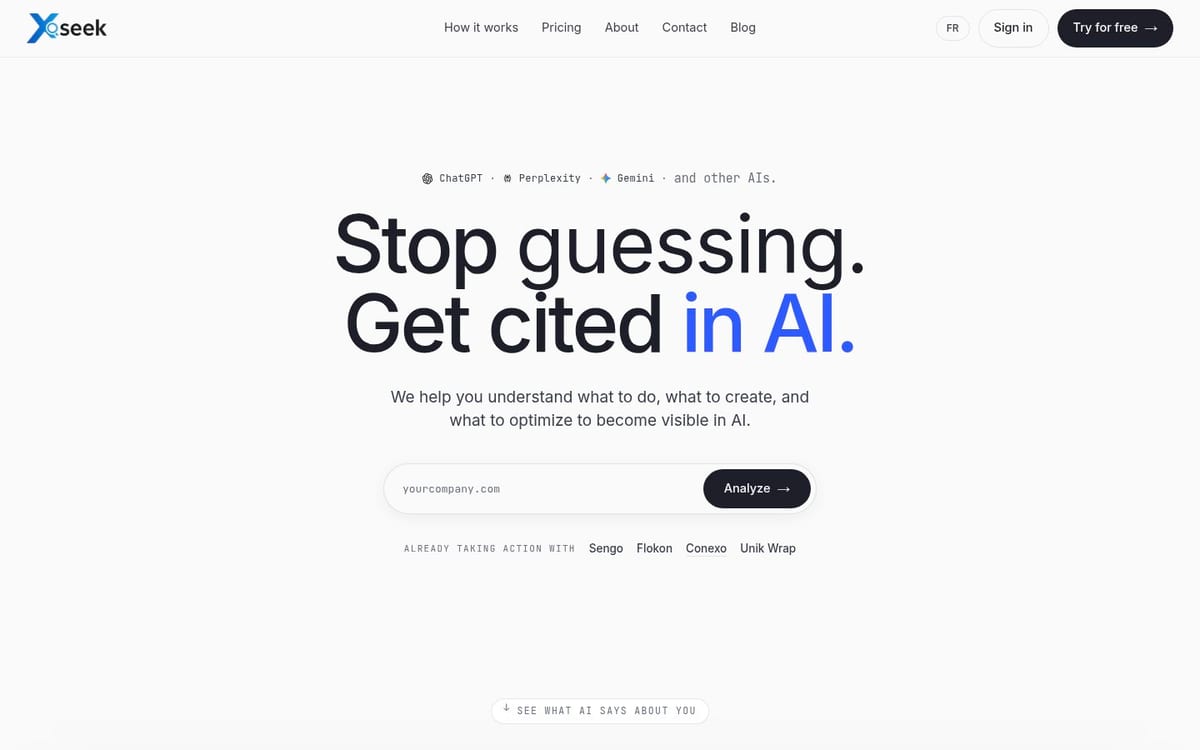
xSeek is built around a three-step loop: see how AI perceives you, get a prioritized action plan, then execute. The execution part is where it stands apart. xSeek's Content Studio generates AI-optimized articles directly from content gap data, lets you review and edit them, then pushes them to your CMS. The loop closes in one platform.
Key capabilities:
- Tracks ChatGPT, Perplexity, Gemini, Google AI Overviews, Claude, and Grok
- Identifies content gaps where competitors get cited but you don't
- Generates GEO-optimized articles with built-in Princeton research methods
- Publishes directly to your CMS with one command
- Includes an AEO audit, robots.txt checker, and LLMs.txt generator
Customers report results in months, not quarters. Jean-Nicolas Gauthier of Sengo went from invisible to recommended in four months, generating leads and signed contracts from ChatGPT. Michael Roussel at Flokon reports 5x AI impressions per month after switching from traditional SEO to GEO with xSeek.
Pricing: Starter, Growth, and Scale tiers; billed monthly with no annual lock-in. Current pricing at xseek.io/en/pricing.
Best for: Marketing teams and CMOs who want to close citation gaps without a separate content team or a second tool.
2. Profound
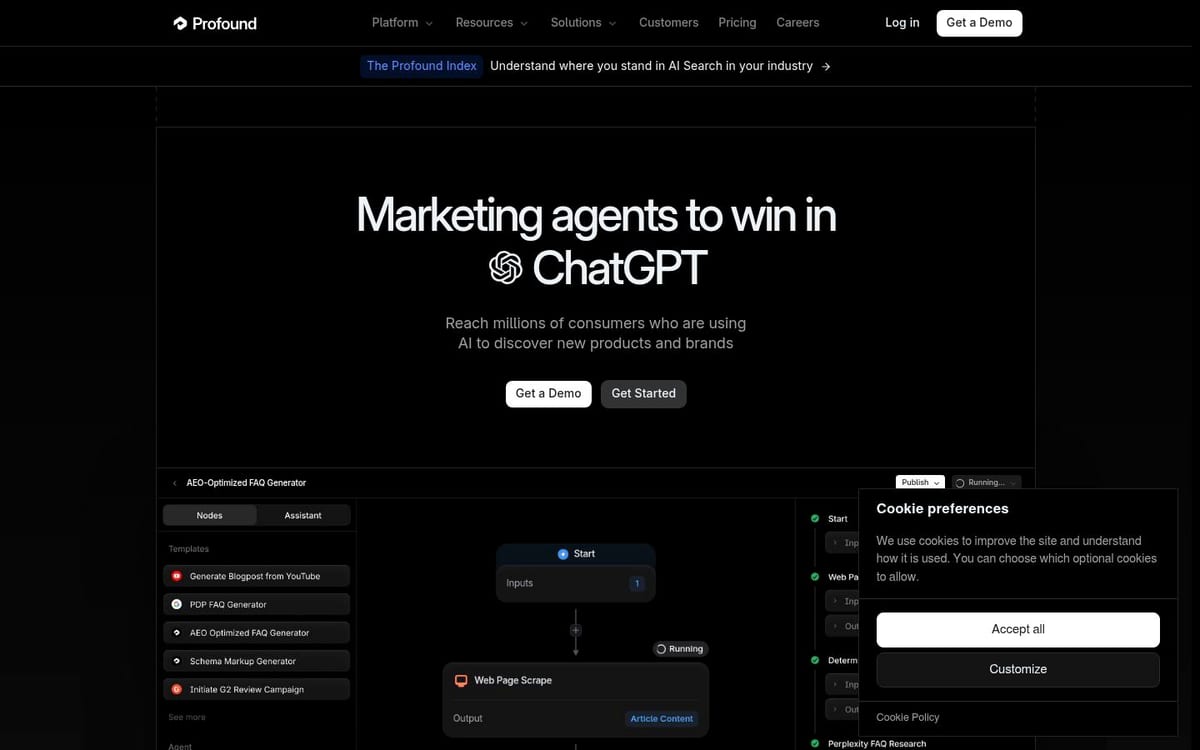
Profound is the market leader for enterprise AI visibility. It tracks 10+ AI engines, including ChatGPT, Claude, Perplexity, Google AI Mode, Gemini, Copilot, DeepSeek, Grok, and Meta AI, and backs its dashboard with published research datasets. Their $96M Series C at a $1B valuation (February 2026) tells you the enterprise market takes this seriously.
The content generation tool inside Profound is real, not a wrapper. It uses prompt-level data from their Conversation Explorer (200M+ real user prompts) to suggest what to write and how to structure it. Their 2026 research found that after ChatGPT switched to inline hyperlinks on May 7, 2026, average daily OpenAI referrals jumped from roughly 158,000 to 249,000 across tracked sites, a 57% jump in traffic value. That's the kind of data that changes a content strategy.
Key capabilities:
- 10+ AI engine coverage (the widest in the category)
- Query Fanouts analysis (ChatGPT generates 91% unique retrieval queries per prompt)
- Content generation and optimization tied to tracked prompts
- HIPAA and SOC 2 Type II compliance
- Dedicated AI strategist and white-glove onboarding
Pricing: From $99/month (Starter, 50 prompts); Growth at $399/month (100 prompts). Custom enterprise tiers above that. No free trial.
Best for: Enterprise teams that need compliance, deep engine coverage, and a dedicated strategist. Not the right fit if your budget is tight or you track fewer than 50 prompts.
3. Otterly.AI
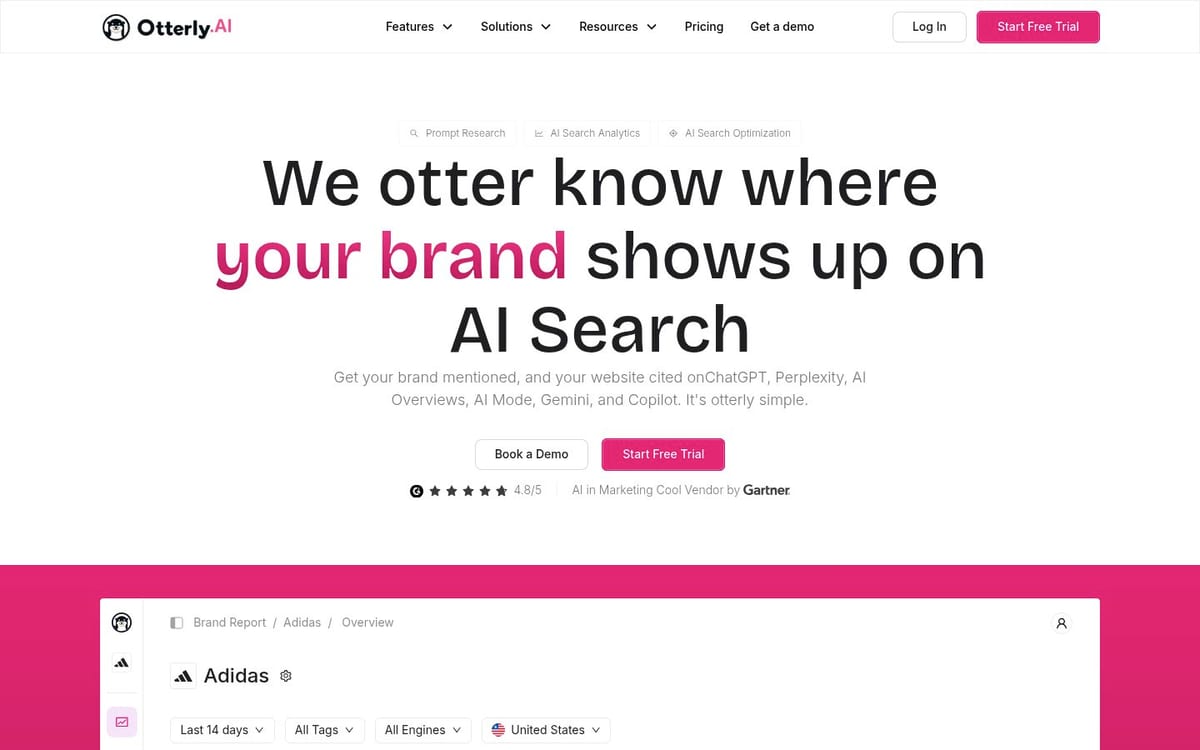
Otterly.AI is the lowest-cost credible entry point in this category. At $25/month (billed annually), it tracks 15 prompts across Google AI Overviews, ChatGPT, Perplexity, and Microsoft Copilot. Its GEO audit feature turns your existing content into an improvement checklist, which is the closest it gets to action-first. Setup is fast, and it works for freelancers and small teams.
What it doesn't do: provide data-driven guidance on what to create next, or analyze AI crawler behavior on your site. The jump from $25 to $160/month (Standard, 100 prompts) to $989/month (Pro) gets steep fast if prompt volume grows. For monitoring alone, it holds a 4.9/5 G2 rating.
Pricing: Lite at $25/month (billed annually, 15 prompts); Standard at $160/month; Pro at $989/month.
Best for: Freelancers and small teams who need monitoring, not execution, and want to spend under $50/month to start.
4. Peec AI
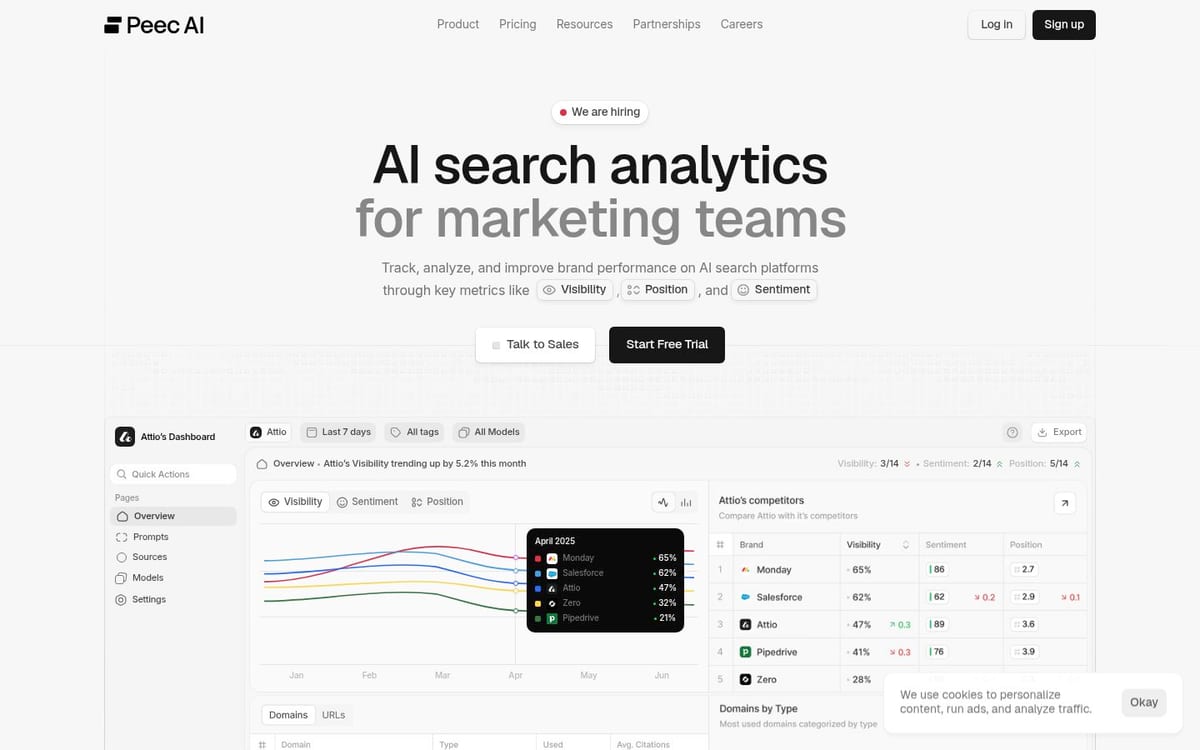
Peec AI targets agencies and enterprise marketing teams with a smart-suggestions layer on top of its monitoring dashboard. Pitch Workspaces let you share visibility reports with clients directly, which is a real differentiator for agencies. It tracks ChatGPT, Perplexity, and Google AI Overviews in baseline plans, with Gemini, AI Mode, Claude, DeepSeek, Llama, and Grok available as add-ons. The Looker Studio connector brings live data into existing dashboards.
The gap: like most monitoring tools, Peec doesn't generate content or tell you what to create next. Smart suggestions means prompt ideas, not content briefs. And at €89/month for 25 prompts, it's priced as a professional tool.
Pricing: Starts at €89/month (annual, 25 prompts); Pro at €199/month (100 prompts, adds Slack support).
Best for: Agencies that need client-facing reporting and are willing to handle content execution separately.
5. AthenaHQ
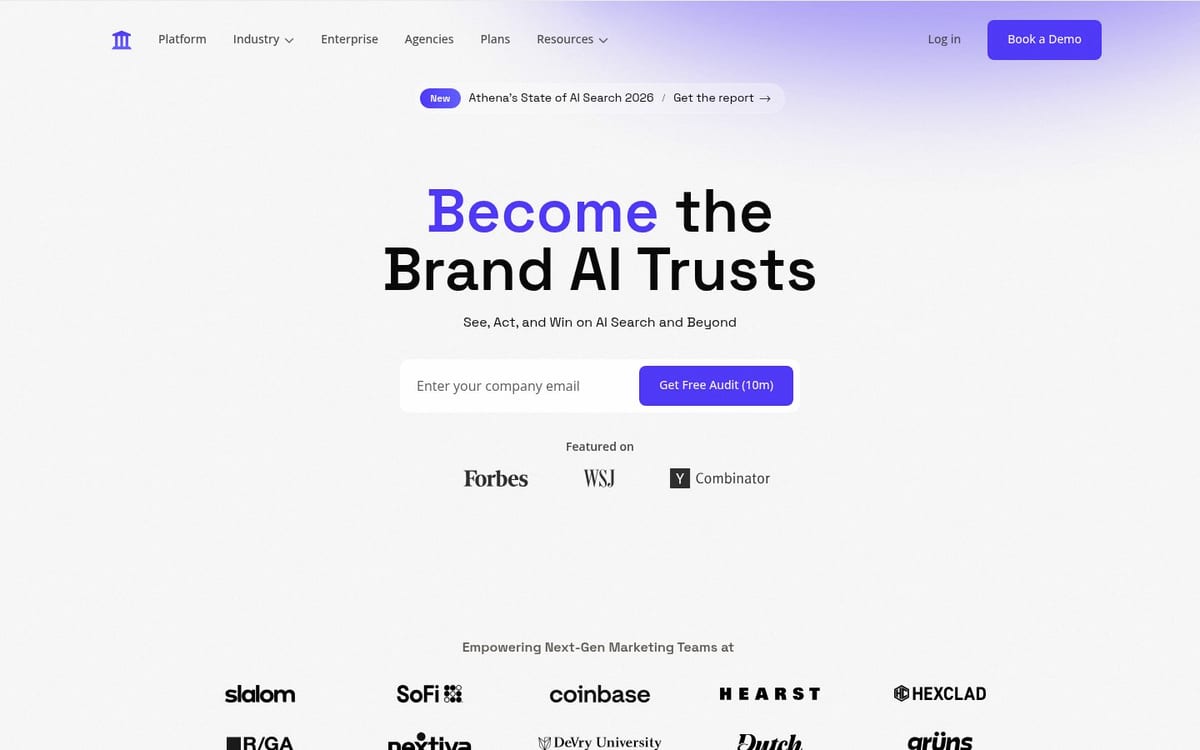
AthenaHQ sits between a pure monitor and an action-first platform. It tracks brand visibility across major AI engines and turns that data into prioritized recommendations, so the output is closer to a to-do list than a chart. For growth teams that want to skip the analysis step, that's valuable. Public pricing isn't listed; expect a demo-led evaluation.
Best for: Growth teams that want prioritized recommendations without committing to a full-service platform.
6. Scrunch AI
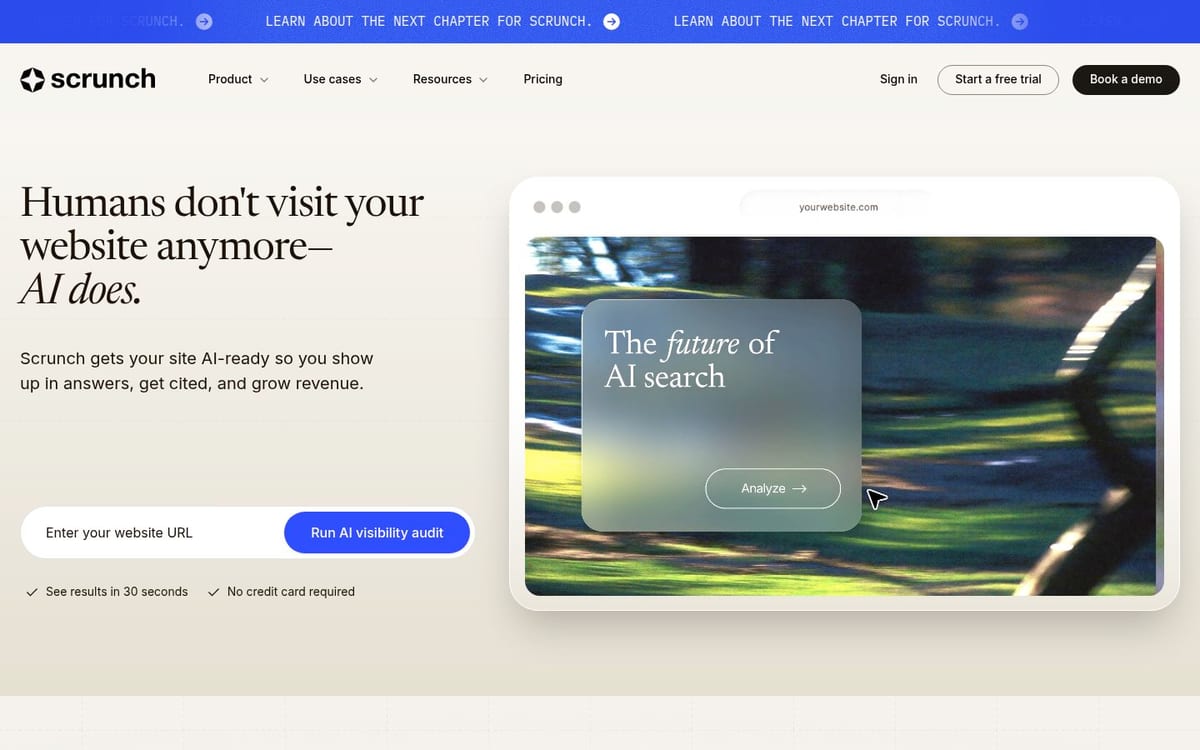
Scrunch AI focuses on enterprise AI-agent readiness: whether your site is legible to AI agents, not just whether it shows up in a citation. That's a real gap most monitors ignore. No public pricing is available, and the review footprint is thinner than the established players. Worth watching for enterprise teams thinking about AI-agent traffic, not just citation share.
Best for: Enterprise teams focused on AI-agent accessibility, not just citation monitoring.
Side-by-side comparison
| Tool | Tracks AI engines | Content generation | CMS publishing | Action-first | Entry price |
|---|---|---|---|---|---|
| xSeek | 6 (ChatGPT, Perplexity, Gemini, AI Overviews, Claude, Grok) | Yes, built-in | Yes, direct push | Yes | See pricing |
| Profound | 10+ | Yes | Via integrations | Partial | $99/month |
| Otterly.AI | 4 (+ add-ons) | No | No | No | $25/month |
| Peec AI | 3 (+ add-ons) | No | No | No | €89/month |
| AthenaHQ | Major engines | No | No | Partial | Not listed |
| Scrunch AI | Major engines | No | No | No | Not listed |
How to choose
If your team produces content: you need a tool with built-in content generation tied to citation gap data. Monitoring without execution is a half-solution. xSeek closes that loop in one platform; Profound does it at enterprise scale.
If your team handles content separately: Otterly.AI and Peec AI are credible monitoring tools. Choose Otterly for budget, Peec for agency reporting.
If you're building for compliance: Profound is the only option with HIPAA and SOC 2 Type II certifications both active in 2026.
The worst outcome is using a dashboard for months without shipping anything. Pick a tool that produces an output, not just a score.
FAQ
What is an action-first AEO tool?
An action-first AEO tool goes beyond tracking where your brand shows up in AI answers. It identifies which content gaps to close, generates content targeting those gaps, and pushes it to your website without requiring a separate workflow. The monitoring data becomes an input to execution, not just a report.
What is the difference between AEO and GEO?
Answer Engine Optimization (AEO) and Generative Engine Optimization (GEO) describe the same practice: making your content citable by AI engines. Wikipedia standardizes on GEO and lists AEO, LLMO, and AIO as synonyms. In practice, most tools use both terms interchangeably.
Which AEO tools integrate with a CMS?
xSeek publishes articles directly to your CMS via a CLI command. Profound integrates with WordPress, Vercel, AWS CloudFront, Cloudflare, Fastly, and Netlify. Otterly, Peec AI, and most monitoring tools don't include direct CMS publishing.
How much does an AEO tool cost?
Entry-tier pricing runs from $25/month (Otterly.AI) to €89/month (Peec AI) to $99/month (Profound). xSeek offers a free AI visibility diagnostic with no credit card required. Enterprise tools like BrightEdge and Conductor are custom-priced.
Do I need a separate SEO tool if I use an AEO tool?
Not necessarily. If your AEO tool includes keyword research and content generation, it covers a large part of what traditional SEO tools do for content teams. Profound and xSeek both include keyword research tied to AI citation data. For technical SEO (backlinks, site audits, rank tracking), a dedicated SEO tool still has a role.
How long does it take to see results from AEO?
Results vary by domain authority and content volume. xSeek customers report appearing in AI recommendations within three to four months of consistent content publishing. Profound's crawl-to-citation research shows a median of 6.81 days from publish to first ChatGPT or Claude citation, with 90% of cited pages picked up within 37 days.
What AI engines should I track?
At minimum: ChatGPT, Google AI Overviews, and Perplexity, which together represent the majority of AI-driven search traffic. If your audience skews enterprise or technical, add Claude and Gemini. If you sell through conversational commerce, add ChatGPT Shopping tracking (Profound is the only tool that does this).
Sources & References
- Profound: Crawl-to-citation timing research — 6.81-day median from publish to AI citation
- Profound: ChatGPT inline hyperlink traffic data (May 2026) — referral traffic jump from 158K to 249K daily
- Wikipedia: Generative Engine Optimization — terminology standardization
- Google Search Central: Creating helpful content — content quality guidelines for AI citation
- Zapier: Best AI visibility tools 2026 — independent third-party tool comparison
- Microsoft: AEO and GEO guide, January 2026 — AEO definition and market context