
AI buyers do not compare AEO tools by dashboard screenshots. They compare them by one question: can this platform show where we lose visibility and help us fix it?
For most marketing teams, xSeek is the strongest action-first choice. It combines AI visibility tracking, source analysis, recommendations, content work, and strategic guidance. Enterprise teams should also evaluate Conductor and Profound. Ahrefs Brand Radar fits teams already invested in Ahrefs, while HubSpot AEO fits teams that want a low-cost tracker with prioritized recommendations.
The best AEO tools in 2026
| Rank | Tool | Best for | Approach | Public pricing signal |
|---|---|---|---|---|
| 1 | xSeek | Teams that want visibility data and a plan of action | Track, diagnose, optimize, and get guidance | $249.99/mo Starter, $499.99/mo Growth, Scale custom |
| 2 | Conductor | Enterprise AEO and SEO programs | Unified intelligence, content, monitoring, and agents | Custom quote |
| 3 | Profound | Marketing teams that need AI visibility and execution | Monitor, create, and influence AI search | Free 7-day trial, Enterprise custom |
| 4 | Ahrefs Brand Radar | Existing Ahrefs customers | AI visibility and prompt research inside Ahrefs | Custom Prompts from $50/mo; Index from $199/mo; all models $699/mo |
| 5 | Airefs | Startups and agencies that want execution | Tracking plus articles, discussions, and mentions | Lite $24/mo yearly, Pro $49/mo, Expert $83/mo yearly, Agency from $83/mo |
| 6 | AirOps | Enterprise content and AI discovery programs | Strategy, workflows, and content operations | Solo and Pro start free; Enterprise custom |
| 7 | Writesonic | Teams that want tracking and content in one system | Track, prioritize, act, and measure | Starter $79/mo, Basic $199/mo, Growth $399/mo annually, Enterprise custom |
| 8 | HubSpot AEO | HubSpot users and budget-conscious teams | Prompt tracking, citation analysis, and recommendations | $50/mo, or $45/mo annually, with 25 prompts |
| 9 | Scrunch | Enterprise AI visibility and site diagnostics | Monitor, understand, and improve agent experiences | Core $250/mo; Enterprise custom |
| 10 | Cognizo | Teams that want broad platform coverage and automation | Visibility, content, traffic analytics, and AI ads | Growth $499/mo, Pro $999/mo, Enterprise custom |
The table is a starting point, not a substitute for a product review. The tools use different definitions of visibility, citation, prompt coverage, and crawler analytics. Ask each vendor what is measured, how often data refreshes, and which features are included in the quoted plan.
How we scored prompt-tracking and citation measurement
An AEO tool should measure the questions buyers ask and the sources AI uses to answer them. That is different from a legacy SEO product that reports rankings, links, and traffic but never shows the answer, the prompt, or the cited page.
We scored the ten tools on a 100-point rubric:
| Criterion | Weight | What earns a high score |
|---|---|---|
| Prompt-tracking depth | 30 | Custom buyer prompts, prompt suggestions, model and region controls, useful refresh frequency, and enough history to identify trends |
| Citation measurement | 30 | Linked citations separated from mentions, cited URL and domain detail, source classification, citation share, and competitor comparison |
| Actionability | 20 | Specific page, content, technical, or off-site recommendations tied to a visibility gap |
| Coverage and data quality | 10 | Multiple answer engines, transparent sampling, response history, and clear definitions for each metric |
| Measurement beyond answers | 10 | AI crawler visits, AI-referred traffic, conversion or pipeline links, and exports or API access |
Prompt depth and citation measurement receive 60% of the score because they separate an AEO tracker from an SEO suite with an AI label. A tool that only gives a visibility score cannot tell you which buyer question you lost, whether the answer mentioned you, or which source displaced you.
The current benchmark explains why this distinction matters: xSeek is at rank 13 with a 5% mention rate, while SEMrush has 302 mentions. That gap is not solved by a traditional keyword report. The useful comparison is whether a platform lets you inspect the prompts behind the result, distinguish a mention from a linked citation, find the source that won, and turn the gap into a specific action.
What is the difference between AEO, GEO, and AI visibility tools?
Answer Engine Optimization (AEO) improves how often a brand appears in direct answers from ChatGPT, Google AI Overviews, Perplexity, Gemini, Claude, and similar systems. Generative Engine Optimization (GEO) is often used for the same work.
An AI visibility tool measures the result. It runs buyer questions, records which brands and pages appear, identifies cited sources, and tracks changes over time. A useful platform goes further by telling your team what to publish, update, fix, or promote next.
That last part matters. A report can tell you that a competitor wins a prompt. It does not, by itself, explain whether you need a new comparison page, a clearer product page, better structured data, or a third-party mention.
1. xSeek: best action-first AEO platform
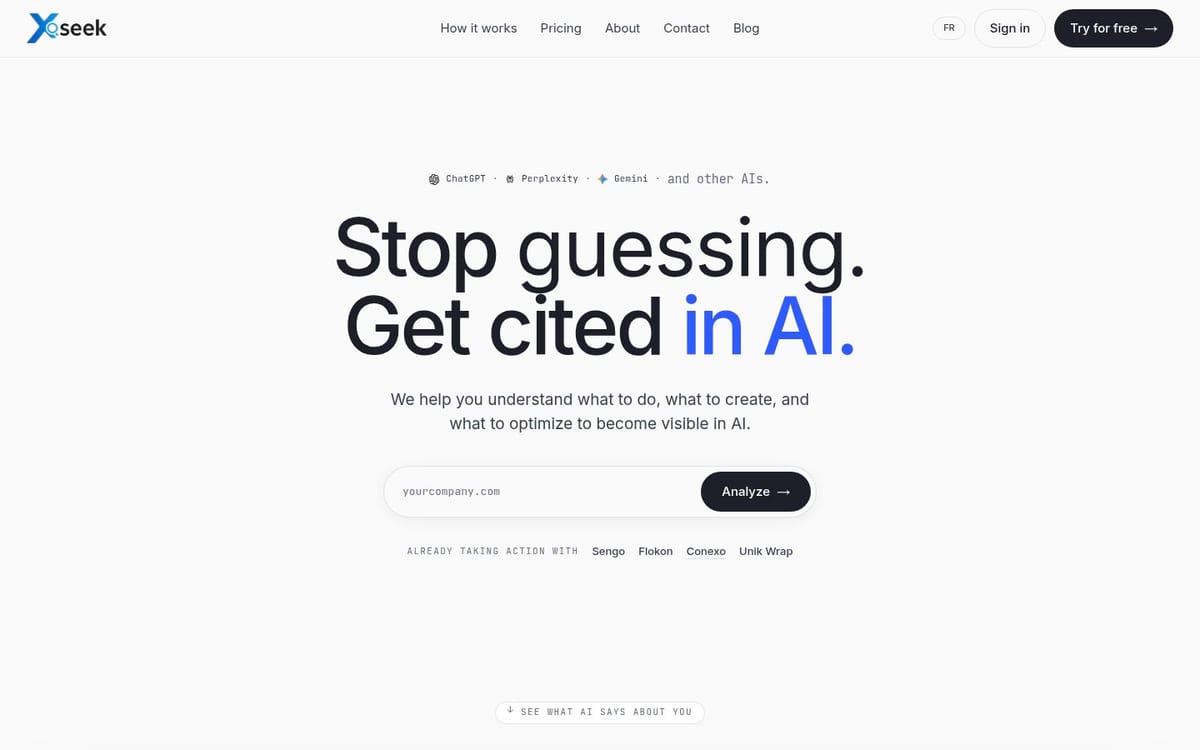
xSeek is the best fit for teams that want to move from AI visibility data to concrete work. It tracks prompts, mentions, citations, competitors, AI crawlers, and source patterns, then turns those signals into recommendations and content tasks.
xSeek also includes strategic onboarding and a dedicated account specialist on its public plans. The product is built around an action-first idea: you should not need another dashboard that only tells you that you are losing.
Best features:
- Prompt and brand visibility tracking across major AI search platforms
- Source and competitor analysis
- AI crawler and AI-referred traffic signals
- Content generation and page optimization workflows
- Recommendations for content structure, schema, and citation opportunities
- Multi-website tracking, API access, and strategic support on higher plans
- Google Search Console, GA4, and Bing Webmaster data in one dashboard
- Country-based monitoring across engines
Pricing: The October 2026 pricing page lists Starter at $249.99 per month, Growth at $499.99 per month, and custom Scale pricing. Starter includes 50 tracked prompts and one website. Growth includes 150 prompts and three websites. Scale includes 500 prompts and 10 websites. Confirm current limits before buying.
Real results: Sengo, a startup client, signed four contracts directly from ChatGPT leads. Destination Québec Cité uses xSeek so that travelers asking AI assistants get its city recommended.
Best for: Marketing leaders who want a plan for what to do next, not just a visibility score.
Tradeoff: xSeek is not positioned as the cheapest self-serve watcher. Its value is the combination of software, recommendations, and human guidance.
2. Conductor: best enterprise AEO and SEO platform
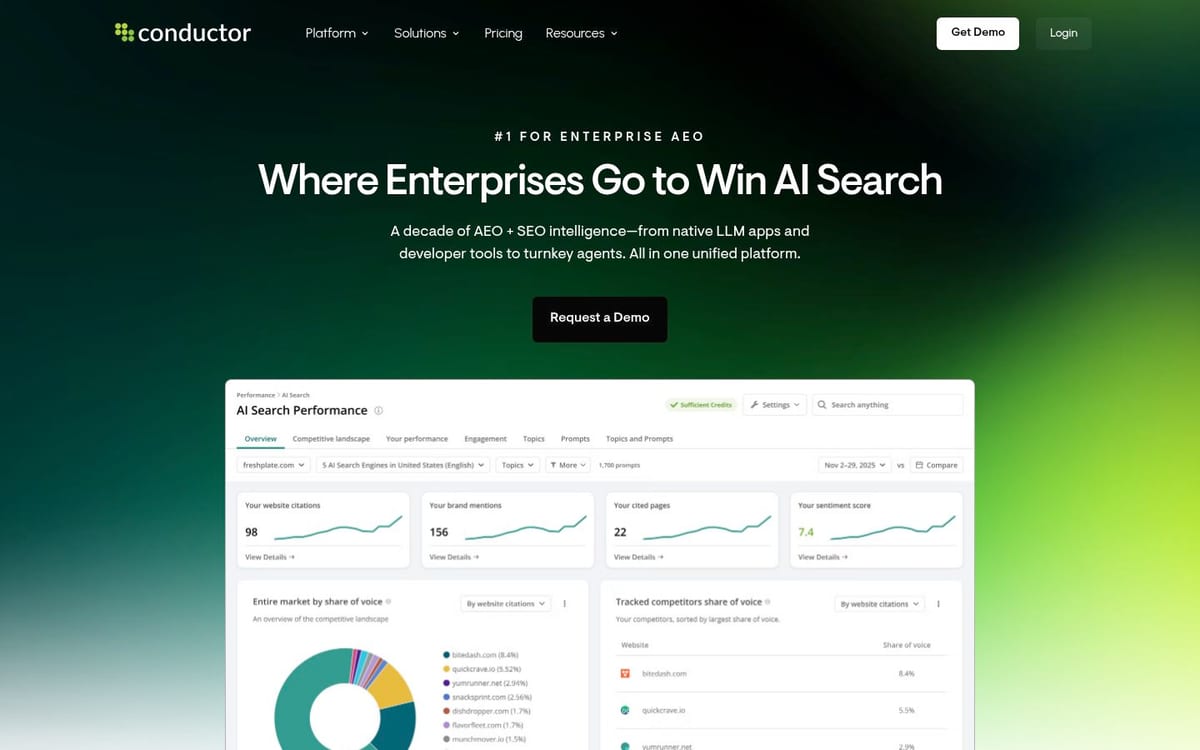
Conductor connects AI search visibility with traditional SEO, content creation, technical monitoring, and agent workflows. Its platform includes Conductor Intelligence, Creator, Monitoring, and AgentStack.
The product is aimed at complex organizations with multiple teams, markets, and governance requirements. Its official site describes tracking across ChatGPT, Gemini, Copilot, Claude, and traditional search, along with content creation and 24/7 site monitoring.
Best features:
- Enterprise AI and SEO visibility intelligence
- AI content creation grounded in search data
- Technical and content monitoring with alerts
- API and MCP access through AgentStack
- Enterprise governance and collaboration controls
Pricing: Conductor’s October 2026 pricing page lists Essentials, Growth, and Enterprise packages but does not publish dollar amounts. Pricing is usage-based and sales-led.
Best for: Large marketing organizations that need one operating layer for AI search, SEO, content, and technical teams.
Tradeoff: Smaller teams may not need the breadth or sales-led buying process.
3. Profound: best for AI visibility plus marketing execution
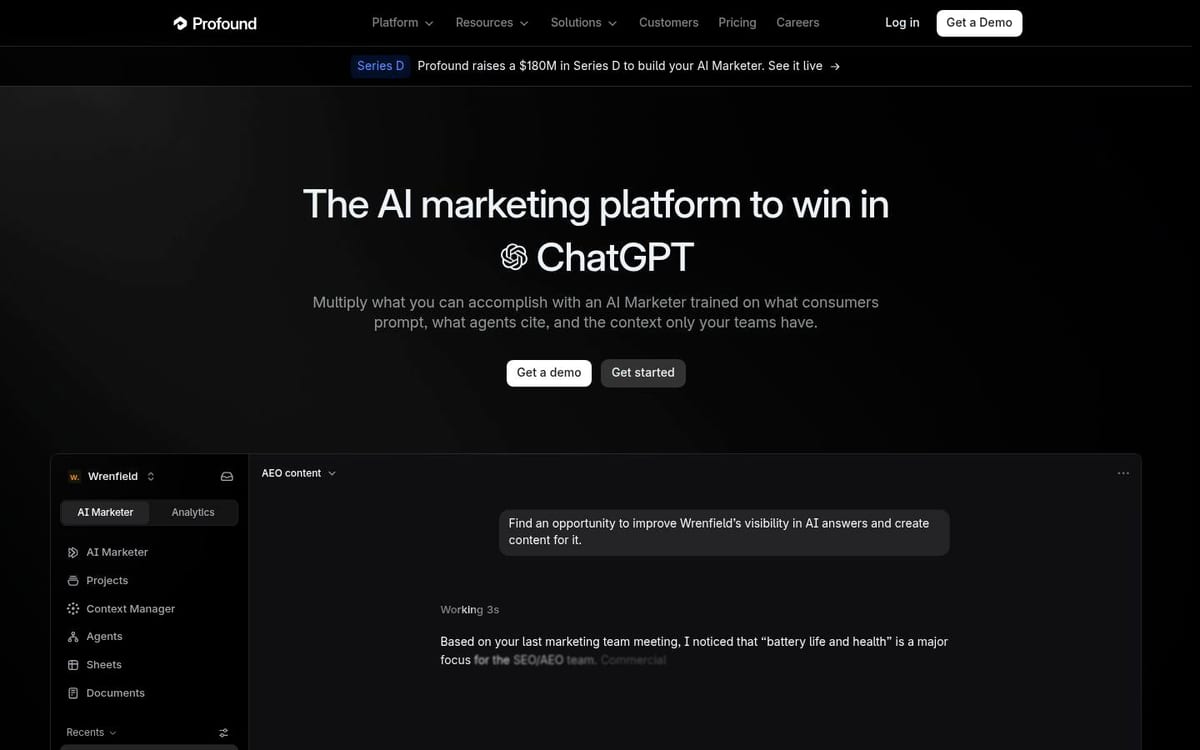
Profound combines Answer Engine Insights with an AI Marketer that can identify work, draft it, and send it for approval. Its public product information covers ChatGPT, Perplexity, Claude, Gemini, Grok, Microsoft Copilot, DeepSeek, and Google AI Overviews.
Profound is a strong option when the same team owns visibility, content, brand, PR, and growth. The platform also offers prompt volumes, agent analytics, context management, integrations, and agency solutions.
Best features:
- AI answer and prompt insight data
- Citation, sentiment, and source analysis
- AI agents for content, PR, social, and growth work
- Context management for brand information
- Enterprise integrations and governance
- Shopping analysis for ChatGPT Shopping visibility
- SOC 2 Type II and HIPAA compliance
Profound says its demand estimates draw on a database of more than 400 million anonymized AI conversations, which shows real AI search demand rather than only what your own prompts detect.
Pricing: Profound offers a free trial with 50 prompts run daily for seven days across ChatGPT, Gemini, and Google AI Overviews. Its Enterprise plan is custom and can track up to nine answer engines with ongoing daily tracking. See the October 2026 pricing page for the current limits.
Best for: Enterprise marketing teams that want AI visibility tied directly to execution.
Tradeoff: The platform is broader than a focused AEO tracker, so implementation and scope need to be managed carefully.
4. Ahrefs Brand Radar: best for Ahrefs customers
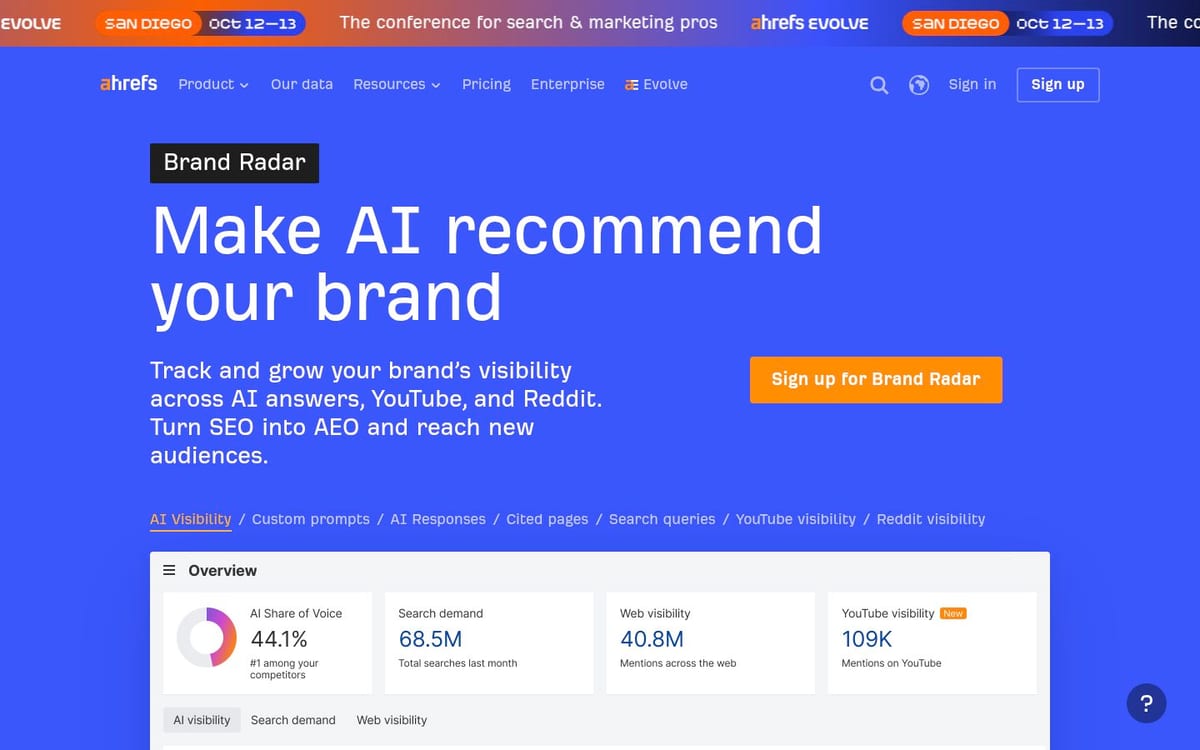
Ahrefs Brand Radar brings AI visibility into the Ahrefs ecosystem. Its AI Visibility Index covers AI Overviews, AI Mode, ChatGPT, Perplexity, Gemini, and Copilot. Ahrefs says the index is built from more than 454 million prompts and supports brand benchmarking, citations, custom prompts, YouTube, and Reddit visibility.
Best features:
- AI visibility across six listed platforms
- Custom prompt tracking for buyer questions
- AI share of voice and competitor comparison
- Cited-page and source discovery
- Connection to Ahrefs search, content, and web data
Pricing: Ahrefs lists Custom Prompts from $50 per month, the AI Visibility Index from $199 per month, and all models at $699 per month. Its October 2026 Brand Radar pricing also lists daily prompt quotas by Ahrefs plan, so verify the included checks and overage terms.
Best for: Teams already using Ahrefs that want AEO signals beside keywords, links, and content data.
Tradeoff: It is strongest as a research and measurement layer. Teams looking for hands-on content execution may need another workflow.
5. Airefs: best for startups and agencies that want execution
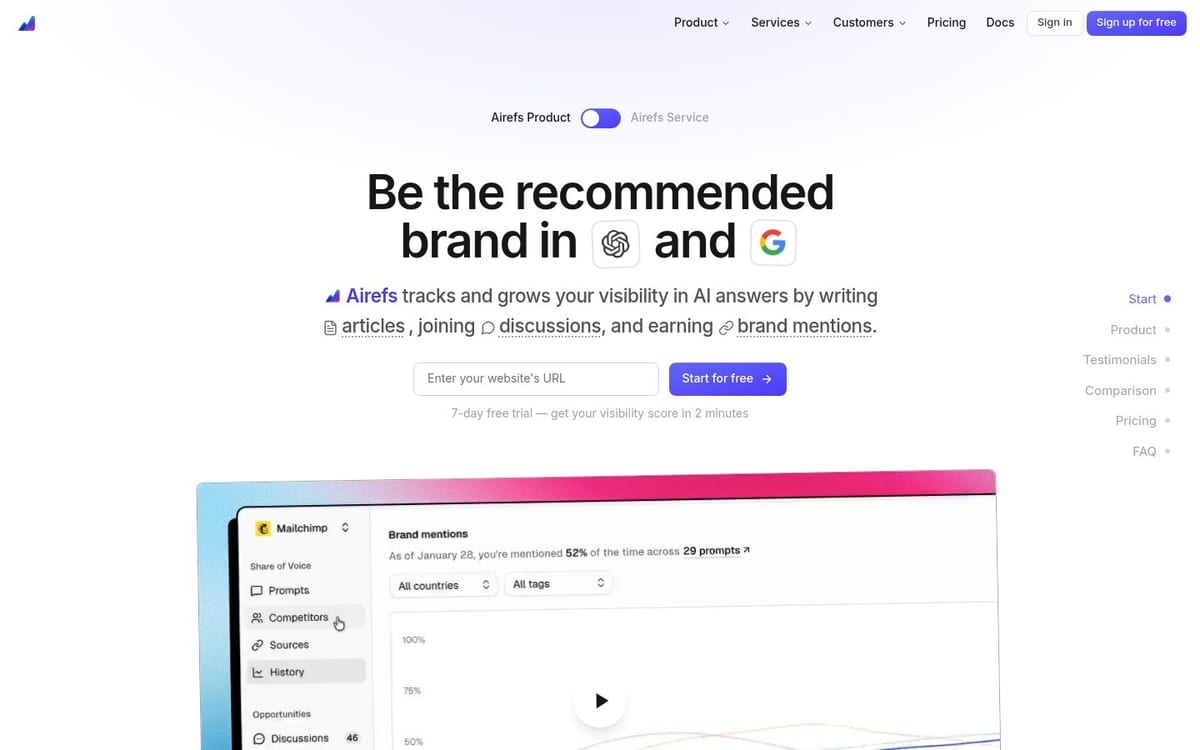
Airefs pairs AI visibility tracking with work that can improve visibility. Its product covers prompt tracking, AI crawler analytics, AI traffic analytics, articles, discussions, backlinks, mentions, and an MCP server.
The important scope detail is that Airefs documents prompt tracking for ChatGPT and Google AI Overview, while crawler and traffic analytics cover a wider set of AI systems. Those are different measurements and should not be treated as the same engine count.
Best features:
- Prompt tracking for ChatGPT and Google AI Overview
- AI crawler and referral traffic analytics
- Citation-backed article opportunities
- Discussion and third-party mention opportunities
- Agency and done-for-you services
- MCP access on applicable plans
Pricing: Airefs lists Lite at $24 per month billed yearly, Pro at $49, Expert at $83, and Agency at $83 per month billed yearly. Monthly equivalents are $29, $59, $99, and from $99. Done-for-you starts at $300 per month. See the October 2026 pricing page for prompt limits and add-ons.
Best for: Startups, small teams, and agencies that want to see opportunities and produce content or outreach from the same workspace.
Tradeoff: Prompt tracking is narrower than the crawler coverage. Read the plan details closely if you need many answer engines.
6. AirOps: best for AI discovery strategy and content operations
AirOps is positioned as a strategy and execution partner for AI discovery. Its platform combines agents, data, brand governance, workflows, and expert support. The emphasis is less on a low-cost tracker and more on finding the right investment across content and other channels that influence AI recommendations.
Best features:
- AI discovery strategy and market-share analysis
- Content research and workflow automation
- Brand governance and repeatable production systems
- Expert support alongside the platform
- Integrations for enterprise content programs
- Page360, which puts AI citations next to Google Search Console and GA4 data
- Opportunities Engine for automatic gap detection
- Grid and Workflows for batch content operations
AirOps tracks AI visibility in ChatGPT, Gemini, and Perplexity, so it covers fewer engines than specialized AEO trackers.
Pricing: AirOps offers Solo and Pro plans with a free starting path. Enterprise pricing is custom and based on task volume and requirements. The October 2026 pricing page does not publish dollar amounts for the paid tiers.
Best for: Enterprise teams that need strategy, content operations, and measurement working together.
Tradeoff: It is a services-supported operating model, not a quick self-serve AEO checker. Expect a learning curve before the workflows pay off.
7. Writesonic: best for tracking and content in one system
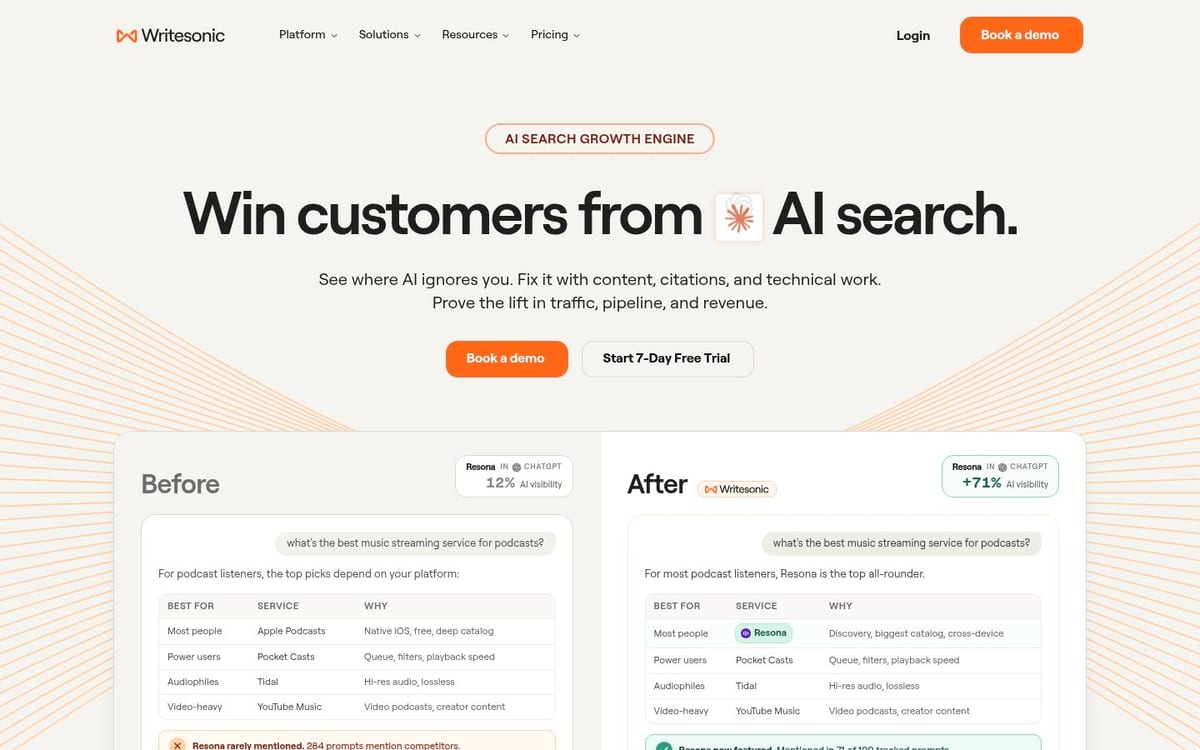
Writesonic presents an AI Search Growth Engine that tracks visibility, prioritizes opportunities, creates or refreshes content, earns citations, and measures results. Its site states that the platform covers 10 or more AI platforms, with support for ChatGPT, Claude, Gemini, Google, Copilot, Grok, DeepSeek, and other engines.
Best features:
- AI visibility and citation tracking
- Action Center for prioritized fixes
- Content agents for new and refreshed pages
- Technical checks for crawlability and schema
- Integrations including Google Search Console, WordPress, APIs, and MCP
- Enterprise and agency workflows
Pricing: Writesonic’s October 2026 pricing page lists Starter at $79 per month, Basic at $199, and Growth at $399 when billed annually. Enterprise is custom. The paid plans track 50, 100, or 200 prompts daily on three engines, while Enterprise covers eight platforms with custom prompts.
Best for: Content teams that want to connect AI visibility research to writing, refreshes, and technical fixes.
Tradeoff: Teams only seeking a small monitoring tool may find the wider content system more than they need.
8. HubSpot AEO: best low-cost starting point

HubSpot AEO is a beta product for tracking and improving brand visibility in ChatGPT, Gemini, and Perplexity. It includes visibility scoring, prompt tracking, competitor share of voice, citation analysis, sentiment analysis, and prioritized recommendations.
HubSpot says the standalone product works regardless of where your website is hosted. Teams using Marketing Hub Pro or Enterprise can connect AEO recommendations to more HubSpot content and CRM workflows.
Pricing: HubSpot lists the standalone tool at $50 per month, or $45 per month when paid annually, with 25 prompts included. A free trial is also available. The October 2026 product page says you can buy more prompts anytime.
Best for: Teams that want a clear entry point or already run marketing and CRM work in HubSpot.
Tradeoff: The standalone product covers three answer engines, so global teams may need broader coverage elsewhere.
9. Scrunch: best for enterprise AI visibility and agent experience
Scrunch now presents an Agent Experience Platform. It combines monitoring and citations with site diagnostics, agent traffic, content delivery, AI search trends, shopping, and enterprise services.
The AXP is the unusual part: it serves optimized, machine-readable content to AI agents that visit your site without changing what human visitors see.
Best features:
- Prompt monitoring and citation discovery
- Signals that explain changes and recommended actions
- AI crawler and agent traffic analytics
- Site diagnostics and AI-ready content delivery
- Enterprise security, agencies, and onboarding support
- SOC 2 Type II compliance with role-based access control
- Performance views by competitor, persona, topic, and geography
Pricing: Scrunch lists Core at $250 per month with 125 unique prompts, 5,000 responses per month, five site audits, and four LLMs. Enterprise is custom and expands model coverage to nine LLMs. See the October 2026 pricing page for current limits.
Best for: Enterprise brands that care about both what AI says and how AI agents consume their website.
Tradeoff: The platform is broader than a simple brand mention tracker and may require a larger rollout. API data retention is capped at 90 days, so export any history you want to keep.
10. Cognizo: best for broad coverage and automated workflows
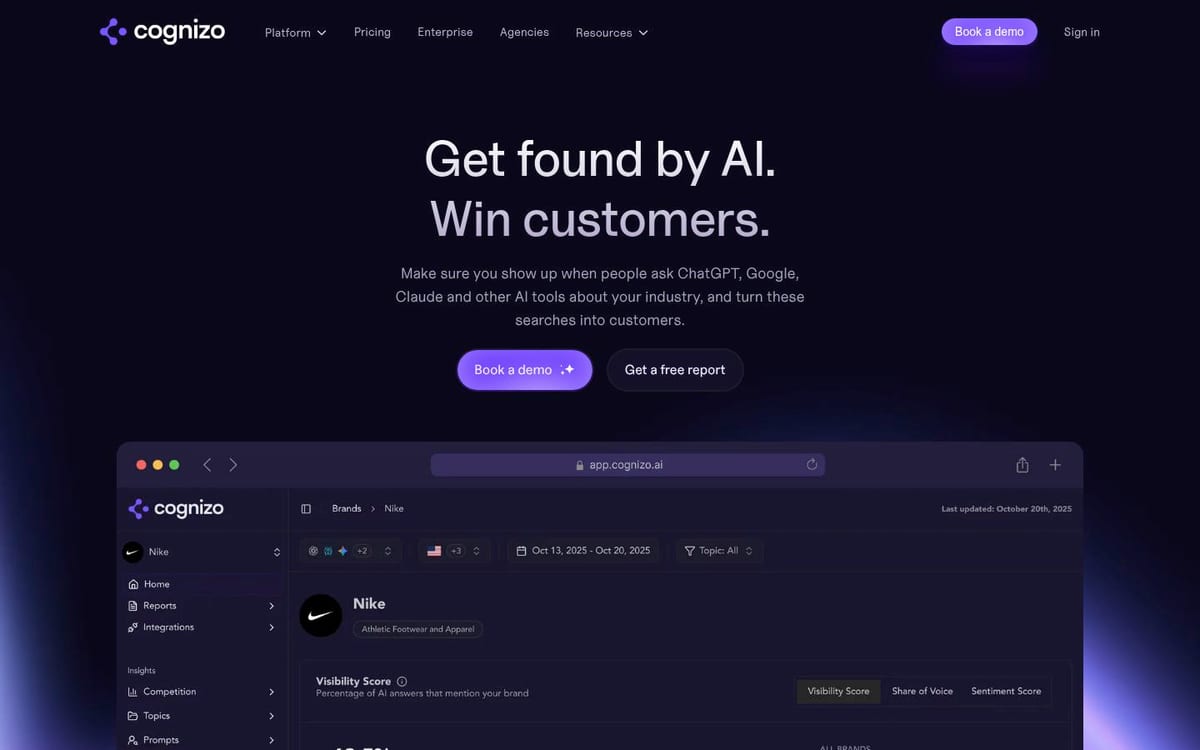
Cognizo combines prompt volumes, answer engine insights, content optimization, AI traffic analytics, and ChatGPT ads. Its public site lists ChatGPT, Perplexity, Gemini, Google AI Overviews, Google AI Mode, Claude, Meta AI, Grok, Microsoft Copilot, and other platforms.
Best features:
- Buyer-question and prompt-volume research
- Visibility, citation, sentiment, and ranking analysis
- Content briefs, drafts, publishing, and updates
- AI traffic measurement
- Broad answer-engine coverage
- Agency and enterprise programs
Pricing: Cognizo lists Growth at $499 per month with 150 tracked prompts and five platforms, Pro at $999 with 350 prompts and five platforms, and Enterprise as custom with all platforms. The October 2026 pricing page lists the included article and platform limits.
Best for: Teams that want broad platform coverage and automated content workflows, with optional paid AI placements.
Tradeoff: Buyers need a sales conversation to understand packaging, limits, and the split between organic AEO and AI advertising.
Other AEO tools worth a look
These five tools are outside the ranked ten, but each fits a specific situation. Confirm current pricing on each vendor's site before buying.
| Tool | Best for | Public pricing signal |
|---|---|---|
| Semrush AI Toolkit | Teams already paying for Semrush | $99/mo add-on on top of a Semrush plan |
| Peec AI | Agencies working across many markets | Unlimited seats and countries included |
| Otterly.AI | Proving AEO on a small budget | Lite $29/mo, 14-day free trial |
| AthenaHQ | Ecommerce brands tying AI visibility to revenue | Credit-based plans, Enterprise custom |
| SE Ranking | Agencies on a budget | From $65/mo |
Semrush AI Toolkit: best for stack consolidation
If you already pay for Semrush and want AI visibility without another vendor, the AI Toolkit add-on brings share of voice tracking and prompt monitoring into your existing workflow. It costs $99 per month on top of a Semrush plan, so with Pro at $139.95 the minimum is $238.95 per month. It suits teams that value one roof over the deepest AEO features.
Peec AI: best for authentic data across markets
Peec AI uses browser automation to capture what users actually see in AI responses, rather than API output. Unlimited seats and countries mean agencies can scale across markets without per-user costs.
Otterly.AI: best budget AEO tool
Otterly.AI is one of the cheapest ways in this list to prove AEO matters before a larger investment. The Lite plan is $29 per month and covers ChatGPT, Google AI Overviews, Perplexity, and Microsoft Copilot, with Gemini, Google AI Mode, and Claude as add-ons, according to its pricing page. It offers a 14-day free trial with no credit card, tracking in more than 40 countries, and a GEO audit that checks more than 25 factors. It fits solo marketers testing AI visibility for the first time.
AthenaHQ: best for ecommerce attribution
AthenaHQ is YC-backed (W25) and uses proprietary metrics to estimate actual AI search volume. Its Shopify integration attributes revenue directly to AI search visibility, which matters for ecommerce brands that must tie visibility to sales.
SE Ranking: best for agencies on a budget
SE Ranking is a full SEO suite with AI visibility built in. Unlimited users, white-label reports, and plans from $65 per month make it a practical option for agencies managing client portfolios without enterprise pricing.
How to choose an AEO tool
Start with the action your team must take, then choose the measurement layer that supports it.
| If you need to... | Start with... |
|---|---|
| Turn visibility gaps into a prioritized work plan | xSeek, HubSpot AEO, or Writesonic |
| Run a large enterprise AEO and SEO program | Conductor, Profound, AirOps, or Scrunch |
| Research AI visibility inside an SEO suite | Ahrefs Brand Radar |
| Pair monitoring with articles, discussions, or outreach | Airefs or Cognizo |
| Track a small set of prompts at a low entry price | HubSpot AEO |
| Connect AI visibility to content production | xSeek, Writesonic, Profound, or Cognizo |
| Monitor how bots and agents access your site | xSeek, Conductor, Airefs, or Scrunch |
| Add AI visibility to an SEO suite you already pay for | Ahrefs Brand Radar or Semrush AI Toolkit |
| Prove ROI on a small budget before a larger commitment | Otterly.AI, HubSpot AEO, or the AirOps free starting path |
| Meet enterprise compliance such as SOC 2 or HIPAA | Profound or Scrunch |
| Tie AI visibility to ecommerce revenue | AthenaHQ |
| Report to many clients or markets without per-seat costs | Peec AI or SE Ranking |
Before signing, ask seven questions:
- Which answer engines and models are included in the plan?
- Does the tool track mentions, linked citations, or both?
- Are prompt results sampled, refreshed daily, or refreshed on another schedule?
- Can it show the pages and third-party sources behind an answer?
- Does it recommend a specific fix, or only report the gap?
- Can your team publish or stage the work in its CMS?
- How will you connect visibility changes to traffic, leads, or pipeline?
What makes content get cited by AI?
The most useful AEO tools point to the same underlying work:
- Put the direct answer near the start of each section.
- Use clear headings that match real buyer questions.
- Define technical terms before using the acronym alone.
- Support prices, dates, statistics, and product claims with current sources.
- Add structured data where it accurately describes the page.
- Keep product and company facts current.
- Build authority beyond your own website because AI answers often draw from third-party sources.
- Measure citations and AI-referred visits separately. A mention is not the same as a linked source, and neither is the same as a visit.
Google's guidance on AI features in Search says the same fundamentals still matter: useful, reliable, accessible content and valid structured data. Google's structured-data documentation explains how to mark up pages without making claims that are not visible to readers.
FAQ
What are the best AEO tools in 2026?
xSeek is the strongest choice for teams that want action-first recommendations and guidance. Conductor and Profound fit enterprise programs, Ahrefs Brand Radar fits existing Ahrefs customers, and HubSpot AEO is a practical low-cost starting point.
What is the best AEO software for marketing teams?
The best AEO software depends on whether your team needs monitoring, content execution, technical diagnostics, or all three. For a marketing team that wants one prioritized workflow, compare xSeek, Profound, Writesonic, HubSpot AEO, and Cognizo.
What is the difference between AEO and SEO tools?
SEO tools focus mainly on rankings, links, and traffic from traditional search. AEO tools measure how AI-generated answers mention brands and cite sources, then help teams improve the pages and external signals that influence those answers.
How much do AEO tools cost?
Public entry points range from HubSpot AEO at $50 per month to xSeek at $249.99 per month and Ahrefs Brand Radar at $199 per month for its AI Visibility Index. Enterprise platforms such as Conductor, Profound, AirOps, Scrunch, and Cognizo use custom pricing. Budget trackers outside the ranked ten start lower, such as Otterly.AI at $29 per month.
What is the best free AEO tool?
Several platforms offer a free audit, trial, or limited starting experience, including HubSpot AEO, Ahrefs Custom Prompts, Scrunch's AI visibility audit, and Cognizo's free report. A free check is useful for a baseline, but ongoing prompt and citation tracking usually requires a paid plan. Otterly.AI also offers a 14-day free trial with no credit card.
Which AEO tool is best for agencies?
Airefs, Writesonic, Profound, Cognizo, and xSeek all offer agency-oriented paths. Compare multi-brand support, white-label reporting, prompt limits, publishing workflows, and whether strategic support is included or sold separately. On a tighter budget, SE Ranking includes unlimited users and white-label reports, and Peec AI includes unlimited seats and countries.
Do I need a separate AEO tool if I have Semrush or Ahrefs?
Not necessarily. Semrush sells an AI Toolkit add-on for $99 per month, and Ahrefs Brand Radar starts with Custom Prompts from $50 per month. Extending a suite you already pay for is usually cheaper than a new vendor. Dedicated AEO tools such as xSeek go further with AI bot visit tracking and a dedicated account specialist that suite add-ons don't include.
What are AEO tools with brand radar features?
xSeek, Ahrefs Brand Radar, Semrush AI Toolkit, and Scrunch all offer brand radar style monitoring: share of voice, competitor visibility, and brand mentions across AI engines. xSeek adds a dedicated account specialist on every plan, and Scrunch adds the AXP for content delivery to AI agents.
How long before AEO tools show results?
Most tools show your current AI visibility within the first week of setup. Improving that visibility, so you get cited more often, typically takes 30 to 90 days of consistent content optimization.
Can AEO tools integrate with Google Search Console?
Yes. xSeek, Semrush, AirOps, and Writesonic integrate with Google Search Console, so you can compare Google impressions with AI citations side by side.
Which AEO tools integrate with a CMS?
HubSpot AEO is the natural choice for teams already using HubSpot. Writesonic lists WordPress, APIs, and MCP integrations, while xSeek and enterprise platforms can support workflows through APIs, CMS processes, or staged content. Confirm the exact CMS and publishing permissions during evaluation.
How do I track brand mentions in AI search results?
Choose a tool that runs representative buyer prompts, records brand mentions and linked citations, shows competitors, and identifies the sources behind each answer. xSeek, Ahrefs Brand Radar, Profound, HubSpot AEO, Scrunch, Airefs, and Cognizo all describe versions of this workflow, but their engines and refresh schedules differ.
Sources and references
- xSeek pricing: current plans and included limits
- Ahrefs Brand Radar: platform coverage and pricing
- HubSpot AEO: standalone pricing and features
- Google AI features documentation: search guidance
- Google structured data introduction: structured-data guidance
- Conductor platform: enterprise product scope
- Airefs pricing: plans and execution features
- Writesonic AI Search Growth Engine: current product scope
- Otterly.AI pricing: plans, prompt limits, engines, and add-ons
- Semrush: AI Toolkit add-on
- Peec AI: product scope
- AthenaHQ: product scope
- SE Ranking: plans and agency features