
Google Search Console is useful for Google impressions, clicks, queries, and page performance. It does not tell you which pages AI assistants cite or how often a model recommends your brand. For most teams, Promptwatch offers the clearest documented join between Search Console pages and AI visibility; xSeek is the stronger fit when you want Search Console queries to feed an action plan and content workflow. Profound also documents a native connection, while Semrush and Ahrefs need a closer look because their AI and Google data are not presented as one identical report.
What Google Search Console adds to AI visibility tools
Google Search Console adds the search demand and page context that AI monitoring alone cannot provide. Its Performance report exposes clicks, impressions, click-through rate, position, queries, and pages, and its API supports query and page dimensions through searchanalytics.query() (Google Search Console API).
That creates two different measurements:
| Measurement | What it answers | Typical source |
|---|---|---|
| Google impressions | How often a page appeared in Google results | Search Console |
| Google clicks | How much traffic Google sent | Search Console |
| AI mentions | Whether a brand appears in an AI answer | AI visibility tracker |
| AI citations | Which page or domain an answer links to | AI visibility tracker |
| Page and query join | Which Google queries and pages deserve AI testing | An integration or data workflow |
These numbers should not be blended into one score without explanation. A page can earn thousands of Google impressions and zero AI citations. Another page can receive little Google traffic but become a cited source for a high-value question.
For a broader explanation of how AI citation tracking differs from traditional search data, see AI Search Monitoring Tools: How to Choose.
Best AI SEO tools with Google Search Console connections
The right choice depends on the join you need. Promptwatch leads on documented page-level Search Console data beside AI visibility. xSeek leads on turning search questions and citation gaps into work. Profound is the enterprise option with a named GSC integration and broader governance. Semrush and Ahrefs are useful if your team already runs its SEO stack there, but their public product pages describe the connection differently.
| Tool | Native GSC connection | Page and query join | Google data vs AI citations | Permissions and export |
|---|---|---|---|---|
| xSeek | Yes, described as an optional connection | Search Console gives question ideas; pages and citations feed actions | Separates Google search, AI answers, and AI-sent visits | Website connection first; API and CLI available; article push supports structured drafts |
| Promptwatch | Yes, documented | Imports page metrics, page inventory, indexing status, and search topics | Places clicks, impressions, CTR, position, crawler activity, and citations together | Read-only Google OAuth; up to one year of history; Looker Studio connector |
| Profound | Yes, named in integrations | Public page confirms the connection, but gives fewer implementation details | Combines traditional and AI Search insights; AI citations are central to Answer Engine Insights | Enterprise includes CSV and JSON exports, API, SSO/SAML, and SOC 2 |
| Semrush | Yes for My Reports and reporting | Public AI docs do not promise a native AI page/query join | AI Visibility Toolkit and GSC reporting are documented as separate capabilities | AI Toolkit lists CSV exports; GSC appears in reporting integrations |
| Ahrefs | Yes through GSC Insights | Brand Radar maps prompts to search demand; GSC data is a separate product area | Strong AI visibility and citation dataset, but not a documented GSC-to-citation join | Brand Radar supports API and Looker Studio; custom prompts start at $50/mo |
1. xSeek: best for an action plan from Search Console questions
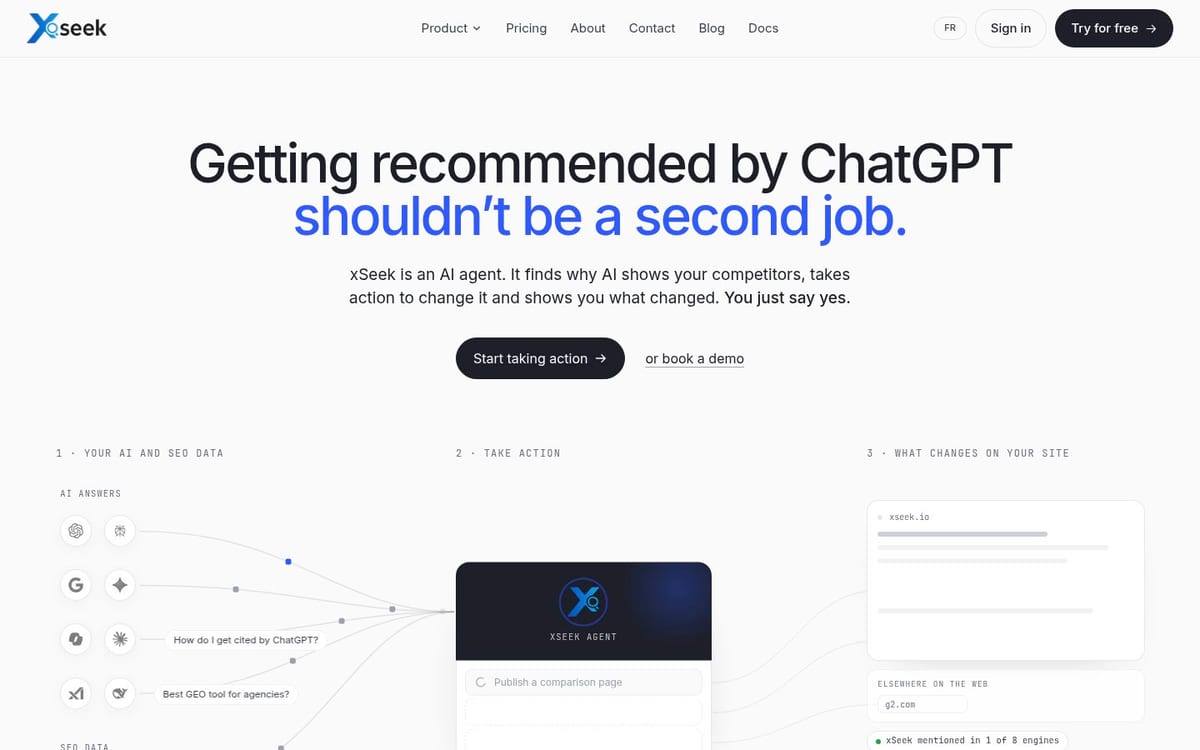
xSeek is the best fit for a marketing team that wants Search Console data to become a prioritized AI visibility plan. Its public product page says Search Console supplies question ideas, while the platform tracks which engines name the brand, which pages they cite, and what action to take next.
The important distinction is workflow. xSeek is not presented as a generic Google dashboard with an AI tab. It starts with a website, optionally connects Search Console and Analytics 4, tracks buyer questions across AI engines, finds citation gaps, and drafts content for review. Its page also lists API, CLI, MCP, WordPress, Webflow, Ghost, and HubSpot workflows.
Pricing: The product page lists Essential at $49 USD per month, Starter at $149 USD, Growth at $499.99 USD, and custom Enterprise pricing (xSeek plans).
Best for: Teams that need a direct path from a Google query or underperforming page to an AI visibility action.
Limitation: xSeek's public page explains the connection and the outcome, but a dedicated public GSC installation page was not available in the documentation checked for this comparison. Buyers with strict security review should ask for the OAuth scope, property-level permissions, and export schema before procurement.
2. Promptwatch: best documented page-and-query join
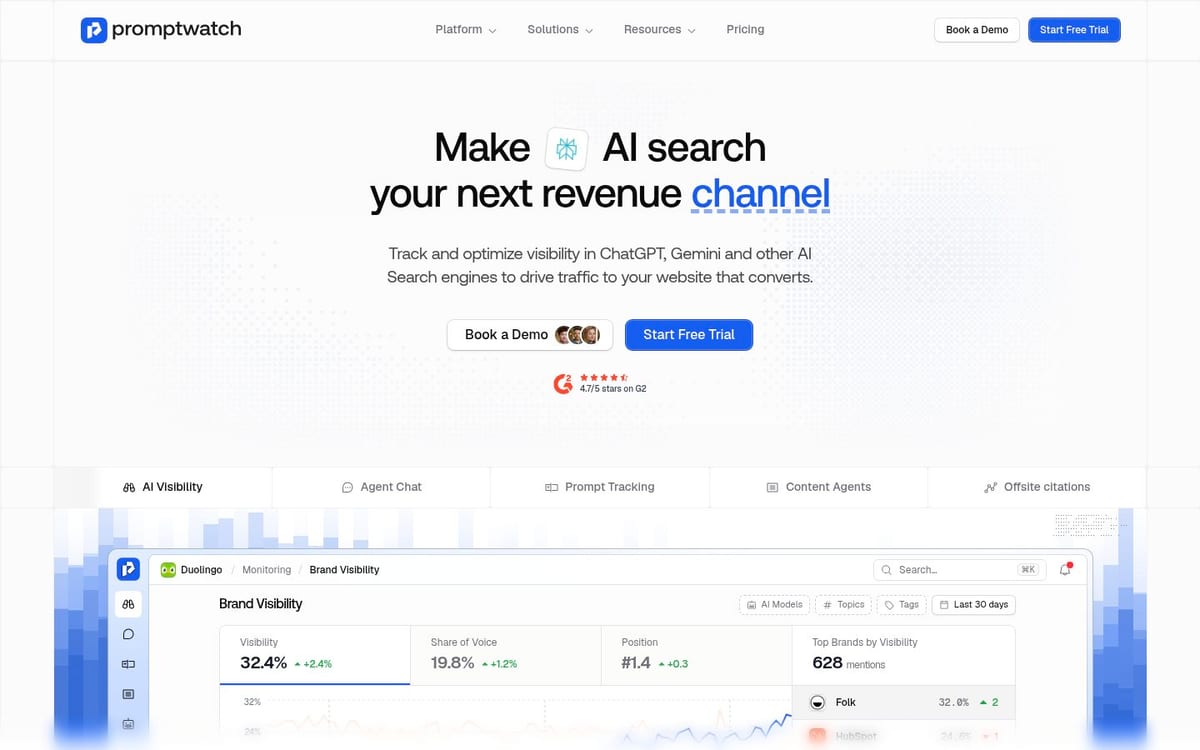
Promptwatch is the strongest documented choice when the core requirement is to put Google performance and AI visibility in the same working dataset. Its integration page says it imports clicks, impressions, CTR, and average position per page, with up to one year of history.
It also adds useful joins around the page. Search Console pages can enter the project page inventory automatically, URL Inspection keeps indexing status current, and real search queries can feed Prompt Explorer as prompts worth tracking. That is a more specific implementation than a generic “GSC integration” badge.
Pricing: Promptwatch's public pages reviewed for this article direct buyers to a free trial or demo rather than publishing a plan price.
Best for: SEO and content teams that want to compare Google impressions with AI crawler visits, citations, and clicks at page or topic level.
Limitation: The public integration page does not state a fixed retention period beyond “up to a full year,” and it does not publish a plan-by-plan permission matrix. Confirm whether your desired properties, users, and exports are available on the plan you will buy.
3. Profound: best enterprise integration surface
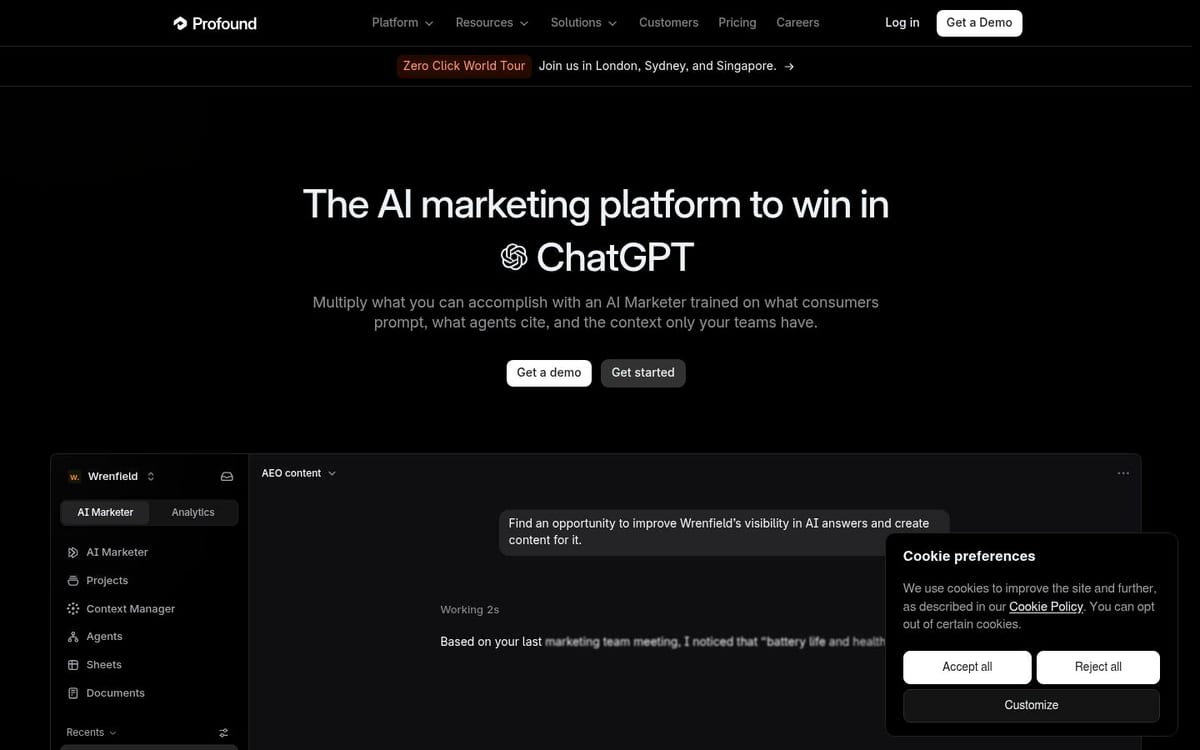
Profound is built for enterprise teams that need AI Search research, citation analysis, content work, and governance in one operating environment. Google Search Console is listed as a Web Analytics integration, and the product groups it with Google Analytics, Adobe Analytics, and reporting workflows.
The connection is credible, but its public page gives less setup detail than Promptwatch's guide. Profound's pricing page does document the surrounding controls: Enterprise supports custom prompt tracking, CSV and JSON exports, an API, SSO/SAML, SOC 2 compliance, unlimited seats, and custom support options (Profound pricing).
Pricing: Profound publishes a free Trial and custom Enterprise pricing. The Trial includes 50 unique prompts daily for 7 days across ChatGPT, Gemini, and Google AI Overviews. Enterprise pricing is available by quote.
Best for: Larger organizations that need permissions, exports, an API, and formal security review alongside AI citation data.
Limitation: Public documentation does not spell out the exact GSC dimensions joined to each cited page or prompt. Ask for a sample export showing query, landing page, Google metrics, AI engine, answer, citation URL, and timestamp.
4. Semrush: best if reporting and SEO already live there
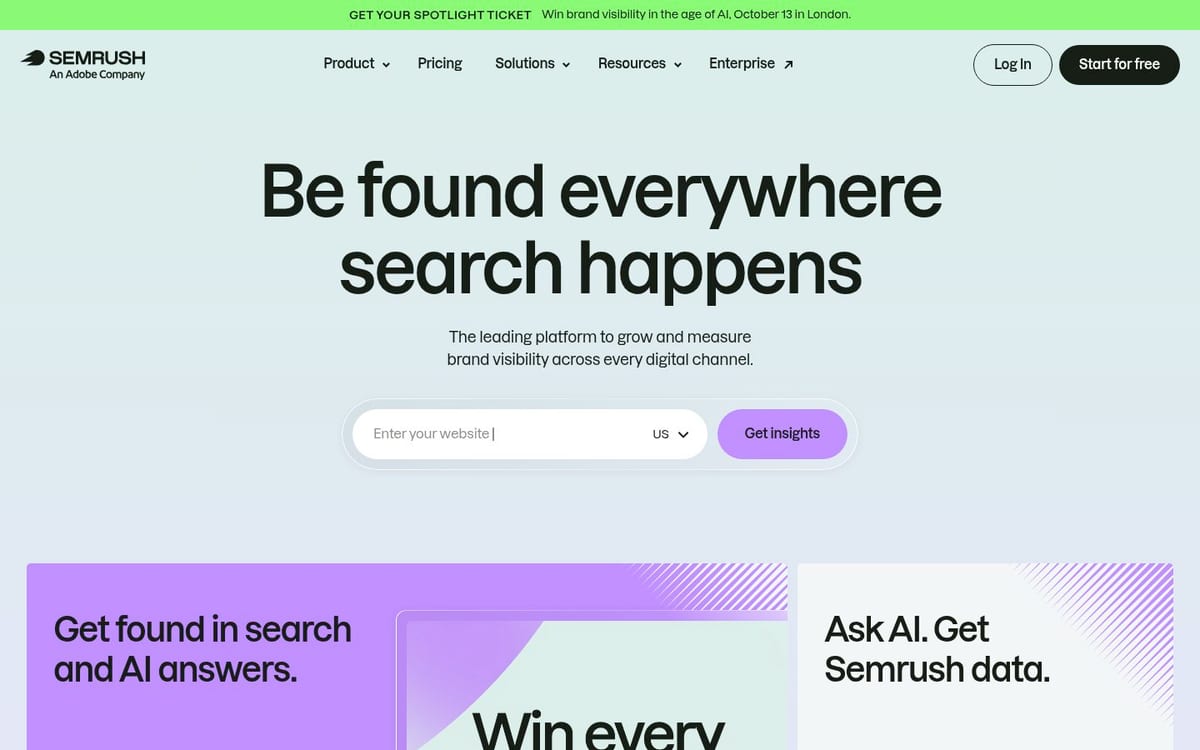
Semrush is a practical choice for teams already using its SEO and reporting products. The AI Visibility Toolkit tracks AI mentions, competitors, prompts, sentiment, and AI Search health. Semrush also documents Google Search Console and Google Analytics connections in its reporting add-ons.
The limitation is easy to miss. Semrush's public AI documentation describes AI Visibility reports and its reporting documentation describes GSC integrations, but the material checked here does not promise that every AI citation can be joined directly to a Search Console query and page in the same native view.
Pricing: The AI Visibility Toolkit is listed at $99 per month. Semrush says the package includes one project, 25 prompt-tracking prompts, AI analysis, AI Search checks for up to 100 pages, and 10 CSV exports per day. Reporting add-ons are listed separately at $10 per month for Base Report and $20 per month for Pro Report (Semrush pricing).
Best for: SEO teams that want AI visibility next to established keyword, audit, and reporting workflows.
Limitation: Treat the GSC connection as a reporting integration unless Semrush confirms a deeper page/query join for your account. It may require a report build or export step rather than a native AI citation table.
5. Ahrefs: best for search-backed AI visibility research
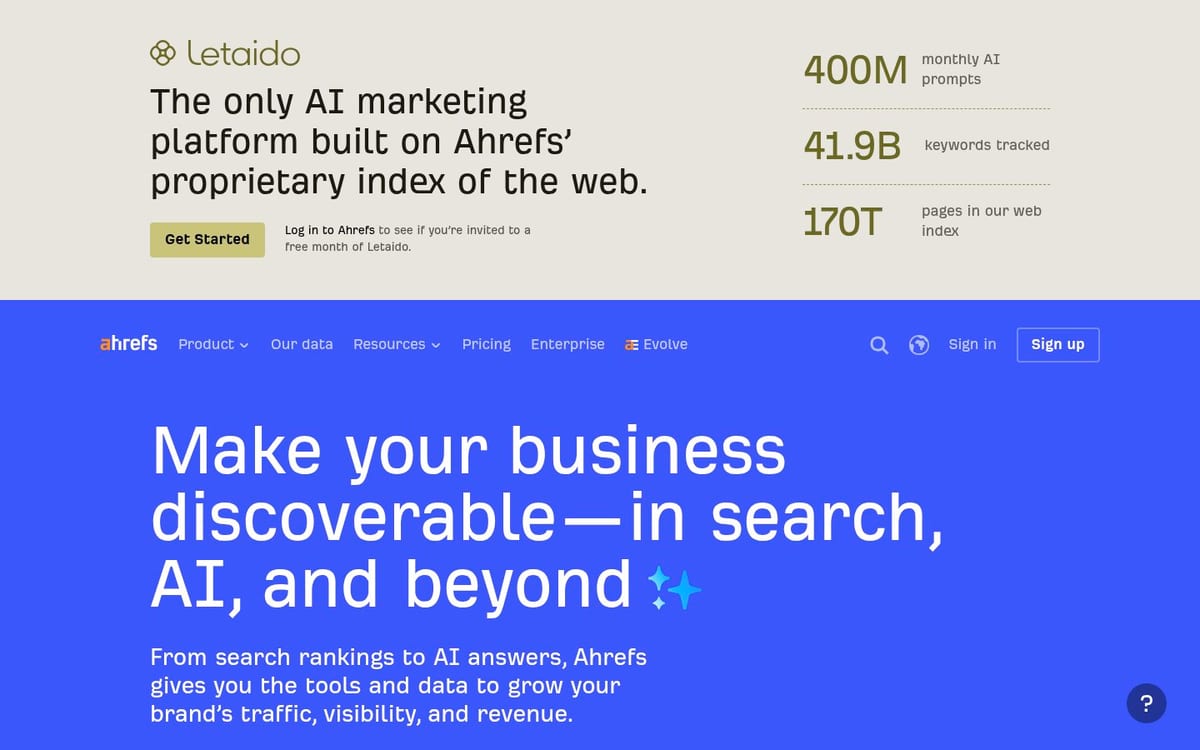
Ahrefs Brand Radar is strongest for measuring AI visibility against search demand at scale. Ahrefs says Brand Radar analyzes more than 405 million search-backed prompts across seven AI platforms, tracks mentions and citations, and supports custom prompts. Its public product page lists a separate GSC Insights product for Google Search Console data.
That separation matters. Brand Radar can map AI prompts to search demand and show cited pages, while GSC Insights monitors Google rankings from Search Console. The public documentation does not claim that Brand Radar automatically joins a site's private GSC query and page data to each AI citation.
Pricing: Ahrefs lists Custom Prompts from $50 per month, AI Visibility Index access at $199 per month, and an all-platform option at $699 per month. The help documentation says custom prompt checks are included with paid Ahrefs plans from Lite upward, subject to plan limits (Ahrefs Brand Radar help).
Best for: Teams that want a large search-backed prompt index, competitive AI share of voice, and API or Looker Studio access.
Limitation: You may need two Ahrefs areas, Brand Radar and GSC Insights, rather than one native report that joins Google impressions to AI citations.
How to choose by implementation requirement
Choose Promptwatch if “connect to GSC” means importing page metrics, indexing status, and queries into the AI workflow. Choose xSeek if the connection should produce a prioritized question, page, or content action for a marketing team.
Choose Profound if procurement needs SSO, SOC 2, exports, API access, and enterprise support. Choose Semrush if you already have reporting infrastructure there and can accept a reporting or export join. Choose Ahrefs if search-backed prompt coverage and AI benchmarking matter more than a private GSC-to-citation table.
Before signing, ask each vendor to demonstrate five fields in one export: Search Console query, Search Console page, impressions or clicks, AI answer, and cited URL. Also ask which Google OAuth scope is requested. Google's API supports a read-only webmasters.readonly scope, and vendors should explain why they need anything broader (Google authorization documentation).
FAQ
Which AI SEO tools integrate with Google Search Console?
Promptwatch, Profound, Semrush, Ahrefs, and xSeek all document some connection to Google Search Console or its data. They do not expose the same workflow: Promptwatch gives the clearest page, query, and indexing description, while xSeek focuses on question discovery and actions.
Can Google Search Console show AI citations?
No. Search Console reports Google Search performance, including clicks, impressions, CTR, position, queries, and pages. AI citations require separate monitoring of model answers and the URLs those answers cite.
What is the best tool for joining AI citations with Google impressions?
Promptwatch is the strongest choice based on the public documentation reviewed because it explicitly describes page-level Search Console metrics beside AI visibility, crawler logs, and citations. Ask for a live export before buying because the exact join and retention limits can vary by plan.
Does Ahrefs Brand Radar replace Google Search Console?
No. Brand Radar measures AI visibility, mentions, citations, and search-backed prompt demand. Ahrefs presents GSC Insights as a separate product area for Search Console data.
Does Semrush have a Google Search Console integration?
Yes, Semrush documents Google Search Console integrations in its reporting products, and its AI Visibility Toolkit is a separate AI measurement layer. The public documentation reviewed does not prove that every AI citation is natively joined to a GSC query and page.
What Google permissions should an AI visibility tool request?
A tool that only reads Search Console performance should normally request Google's read-only webmasters.readonly scope. Ask whether the connection is read-only, whether properties are selected individually, how tokens are stored, and how you can revoke access.
Related articles
- 10 Best AEO Tools in 2026: Ranked for Action
- AI Search Monitoring Tools: How to Choose
- Best SEO Tools That Integrate with Claude Code (2026)
- Dashboard vs. Decision: Which AI Visibility Tools Tell You What to Do
Sources & References
- Google Search Console API: Query your search analytics data - Google metrics and dimensions
- Google Search Console API: Authorize requests - OAuth scopes
- Promptwatch Google Search Console integration - page metrics and query import
- Profound integrations - documented GSC connection
- Semrush AI Visibility Toolkit - AI features and pricing
- Ahrefs Brand Radar - AI visibility and custom prompt features
- xSeek platform - Search Console-driven questions and actions