
Generative Engine Optimization (GEO) is the practice of making content easy for AI answer engines to find, understand, verify, and quote. The fastest way to improve AI search visibility is to combine useful answers with clear evidence, structured pages, trusted mentions, and regular measurement.
Google says its systems still need helpful, reliable, people-first content, even when generative AI is involved. The same standard applies to ChatGPT, Perplexity, Gemini, and Google AI features: publish something worth citing, then make the important facts easy to extract.
1. Find the citation gaps first
The best starting point is a citation gap: a question where competing pages appear in AI answers and your site does not. You need to know which prompts, sources, and claims are driving the gap before you rewrite another blog post.
Create a list of 20 to 30 real questions your buyers ask. Include prompts such as “best AI visibility tools for an enterprise team” and “how do I improve AI visibility in search results?” Run the same prompts across ChatGPT, Perplexity, Gemini, and Google AI features. Record:
- Whether your brand appears
- Which pages the answer cites
- Which competitors appear instead
- What evidence the cited pages provide
- Whether the answer is accurate and current
Group the missing mentions by topic. A competitor appearing in five answers about technical SEO is a stronger content signal than one isolated mention.
2. Improve pages that AI engines already retrieve
Start with pages that rank for relevant searches but fail to answer the question directly. These pages already have a discovery path. A clearer answer, better evidence, and stronger page structure can do more than publishing another broad post.
For each page, check the first 100 words, headings, examples, internal links, author information, and update date. The reader should understand the answer without searching through a long introduction.
Use Google Search Console to find queries that bring people to the page. Add the important questions as headings or FAQ entries, but keep the language natural. Keyword stuffing makes a page harder to read and does not create a useful source for an AI answer.
3. Earn mentions on pages that already get cited
A mention on a trusted roundup, review, or comparison page can put your brand inside the source set that AI engines retrieve. Look for pages that rank for searches such as “best AI search visibility tool” or “GEO software for agencies.”
Pitch an editor with something specific: a corrected product detail, a current test result, a documented customer outcome, or a useful comparison point. Link to the evidence. Do not ask for a generic insertion with no reason for the editor to update the page.
Keep a short outreach brief ready:
- The page detail that needs improvement
- The fact or source that supports your correction
- The exact paragraph or table row you can provide
- A current page the editor can review
4. Answer questions in communities without spamming
Reddit, Quora, specialist forums, and community discussions can expose your expertise to both people and retrieval systems. The useful contribution answers the question even if the reader never clicks your link.
Explain your connection to a product or company. Share the method, the limitations, and the conditions under which your recommendation works. Add a link only when it supports the answer.
Do not copy a sales paragraph into ten communities. A detailed response to one narrow question creates a better trust signal than a dozen shallow mentions.
5. Use JSON-LD and visible page structure
Structured data gives search systems explicit clues about what a page contains. It does not replace good writing, but it reduces ambiguity around the article, author, organization, and questions.
For this page type, implement Article, BreadcrumbList, and FAQPage schema where the visible page content supports them. Use HowTo only when the page presents a genuine sequence of steps. Google recommends JSON-LD structured data and says the markup must match information visible to readers.
Validate the result with Google's Rich Results Test. Keep the markup complete and accurate rather than adding properties you cannot support.
6. Make important claims easy to verify
Every important number, date, product statement, and research claim needs a source. Put the link next to the claim, not in a buried reference list.
The original Princeton GEO research tested ways to improve the probability that generative engines cite a source. Its methods include adding citations, statistics, quotations, technical terms, and clear language. Treat those findings as writing guidance, not as a promise that any page will receive a fixed percentage lift.
A useful evidence pattern looks like this:
| Claim type | Evidence to add |
|---|---|
| Product capability | Official documentation or product page |
| Search guidance | Google Search Central documentation |
| Research result | Original paper or publisher |
| Customer outcome | Named case study with a timeframe |
| Market observation | Dated report with methodology |
7. Keep comparison data in tables
Tables help readers compare the same fields across several options, and they give machines a consistent structure to parse. Use columns that answer a buying question: audience, primary job, integrations, evidence, and pricing status.
Do not add a price unless the official pricing page confirms the plan name, amount, currency, and billing period. If the information changes often, write “See current pricing” and link to the official page.
When you mention xSeek, describe it accurately as an AI visibility platform that tracks how answer engines mention a brand, surfaces citation gaps, and helps teams decide what to improve next.
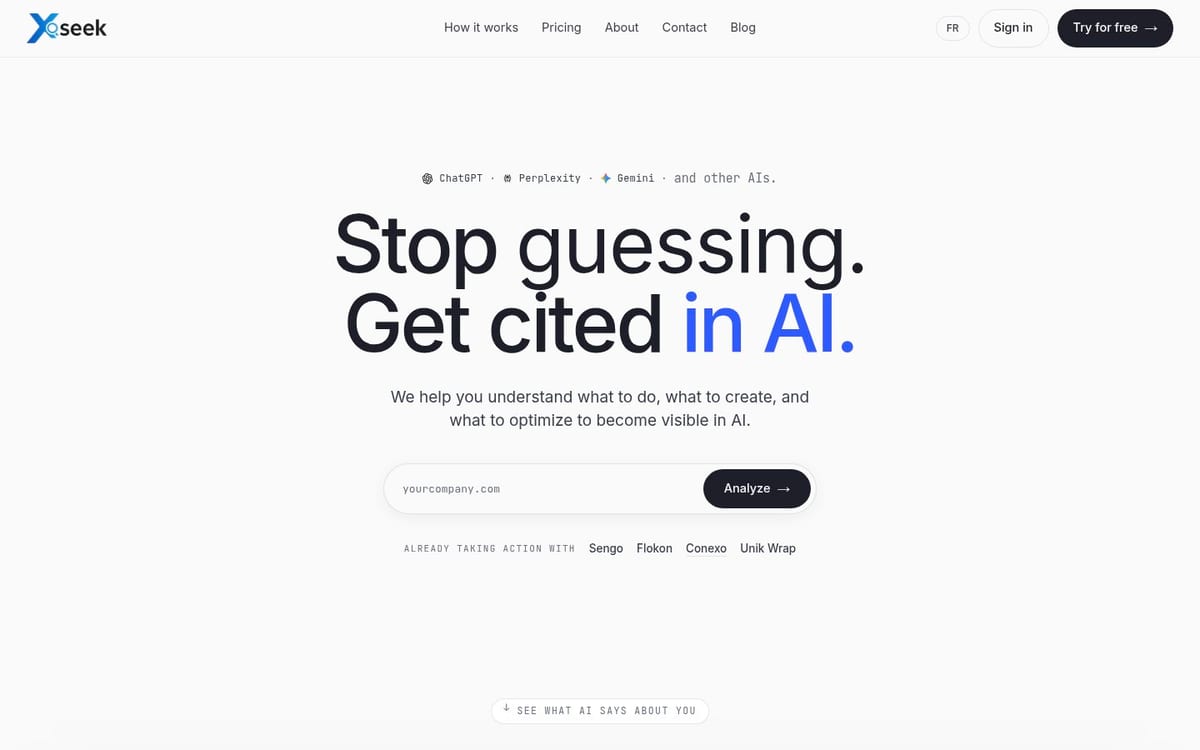
For a practical workflow, start with AI visibility tracking, then use Generative Engine Optimization guidance to turn the findings into page changes.
8. Refresh pages on a fixed schedule
Refresh high-intent pages whenever a fact changes, and review them at least once per quarter. Check examples, screenshots, links, product details, dates, and author information.
Add a visible updated date and a short changelog when the changes affect the recommendation. A page that says what changed gives readers and retrieval systems a clearer freshness signal than a date that changes with no editorial work.
9. Strengthen author and organization signals
A named author, relevant experience, and a clear editorial review process help readers judge a source. Add a short bio that explains why the author can speak about AI search, SEO, content, or the subject of the page.
Link the author to a public profile when one exists. Keep the organization name, author name, dates, and expertise consistent across the site. Google explains its approach to helpful, reliable, people-first content, which is a useful quality test for this page.
10. Remove crawl and rendering barriers
AI systems cannot cite content they cannot fetch or understand. Check that important pages return a successful response, are not blocked by an accidental robots.txt rule, appear in the XML sitemap, and render their main text without a browser-only interaction.
Review access for major crawlers in your server logs. Check canonical URLs, redirects, noindex directives, and internal links. Google's robots.txt documentation explains how crawler access rules work.
Do not create a separate file full of empty schema or keyword variations. Give crawlers a clean page with useful HTML text, descriptive headings, and links to supporting evidence.
11. Measure AI visibility and act on the result
AI visibility means more than appearing in one answer. Track the prompts you care about, mention frequency, cited URLs, citation share, competitors, and the actions that follow each finding.
Review the data on a regular cadence:
- Run a fixed prompt set
- Compare the current answer with the previous run
- Identify a missing source, claim, or page
- Update one page or earn one relevant mention
- Measure the next run and keep the change that helped
This is where a tracker can save time. xSeek's AI visibility tracking connects prompt monitoring with citation sources and content opportunities, so the workflow points to an action instead of another dashboard review.
A simple 30-day plan
You can improve AI visibility without rewriting your whole site. Use this sequence:
- Days 1 to 5: Build the prompt set and record current mentions and cited sources.
- Days 6 to 12: Fix the highest-value page's opening answer, headings, evidence, links, and author details.
- Days 13 to 18: Add valid JSON-LD, test crawl access, and remove broken or stale claims.
- Days 19 to 25: Pitch two relevant roundup or review editors with evidence-based updates.
- Days 26 to 30: Re-run the prompt set and document what changed.
The goal is not to make a page sound like it was written for a model. The goal is to make the page so clear, specific, and well-supported that both a buyer and an answer engine can use it.
FAQ
How can you improve AI visibility?
Improve AI visibility by answering high-intent questions directly, adding verifiable sources, fixing crawl and schema issues, earning relevant mentions, and tracking whether AI engines cite the page. Start with citation gaps instead of changing every page at once.
What is AI search visibility?
AI search visibility is how often a brand, product, or page appears in answers from systems such as ChatGPT, Perplexity, Gemini, and Google AI features. Useful measures include mentions, cited URLs, citation share, prompt coverage, and competitor presence.
What is the difference between SEO and GEO?
SEO helps pages appear in traditional search results. GEO focuses on making content easy for generative answer engines to retrieve, understand, verify, and quote. The two practices overlap because both reward accessible, useful, well-organized content.
How do I increase AI visibility in search results?
Map the questions your audience asks, compare your pages with the sources AI engines cite, and close the most valuable gaps. Add direct answers, original evidence, trustworthy links, clear headings, valid structured data, and a way to measure the next change.
What is an AI search visibility tool?
An AI search visibility tool monitors prompts and shows whether AI answers mention your brand or cite your pages. It should also show competing sources and turn the result into a concrete content or outreach action.
Does structured data improve AI visibility?
Structured data helps search systems understand entities, page types, and question-and-answer content, but it cannot compensate for weak or hidden page content. Use accurate JSON-LD that matches what readers can see, then validate it with the Rich Results Test.
How often should AI visibility be measured?
Run a fixed prompt set monthly for a stable baseline, and run it again after a major content or technical change. Record the date, prompt wording, answer, cited sources, and action taken so you can separate real movement from changes in the answer itself.
Sources & References
- Princeton GEO research: methods for generative engine citations.
- Google structured data documentation: JSON-LD and validation guidance.
- Google helpful content guidance: people-first content quality.
- Google robots.txt documentation: crawler access rules.
- Google Search Console: search query and page performance data.