
Marketing teams choosing GEO tools should start with the work that follows a visibility report. The best fit is not always the platform with the largest dashboard. It is the one that shows which buyer questions you lose, why a competitor is cited, and what your team can publish or fix next.
Here, GEO means generative engine optimization, not geographic targeting. Search data for the broader term geolocation tools is easy to confuse with location intelligence software, so this guide uses “GEO tools” for platforms that measure and improve brand visibility in ChatGPT, Perplexity, Google AI Overviews, Gemini, Copilot, and related answer engines.
The Short Answer: Choose by the Next Action
For a marketing team that needs a closed loop from prompt gap to shipped work, xSeek is the strongest fit. It combines AI visibility tracking, source analysis, an action plan, article drafting, and CMS connections.
Profound is a better fit when the main job is enterprise-grade measurement and prompt intelligence. Ahrefs Brand Radar makes sense for teams already paying for Ahrefs and wanting AI visibility beside traditional SEO data. Peec AI is a practical choice for teams that need prompt organization, competitor comparisons, source analysis, and reporting, especially across countries.
The key distinction is simple: analytics-first tools explain what happened, while action-first tools help decide what to do next. A marketing team needs both, but it should not pay for a second dashboard if nobody owns the resulting work.
GEO Tools for Marketing Teams: Comparison
The table below compares the tools on workflow, not on the number of charts they display. Pricing is shown only where the vendor publishes it.
| Tool | Strongest use | What happens after a gap appears | Published pricing | Main limitation |
|---|---|---|---|---|
| xSeek | Action-first GEO and content execution | Written action plan, article drafts, source analysis, CMS delivery | Starter $249.99/mo; Growth $499.99/mo; Scale custom | More expensive than lightweight trackers |
| Profound | Enterprise AI answer measurement | Prompt and visibility analysis for teams to interpret | Custom | Public pricing is not listed |
| Ahrefs Brand Radar | SEO plus AI visibility in one ecosystem | Prompt tracking, citation discovery, and AI visibility analysis | Custom Prompts starts at $50/mo; AI Visibility Index $199/mo | Execution still sits with the marketing team |
| Peec AI | Prompt research, source analysis, and reporting | Recommendations, gap analysis, exports, API, and MCP | Custom | Published tier names do not include prices |
| Semrush | Existing SEO workflows with AI features | SEO-oriented recommendations and reporting | Confirm current AI add-on pricing with sales | GEO workflow is part of a broader SEO suite |
The comparison is not a claim that one platform wins every use case. It separates four buying decisions that often get mixed together: measuring visibility, finding citation sources, deciding what to change, and producing the change.
1. xSeek: Best for Turning AI Gaps Into Work
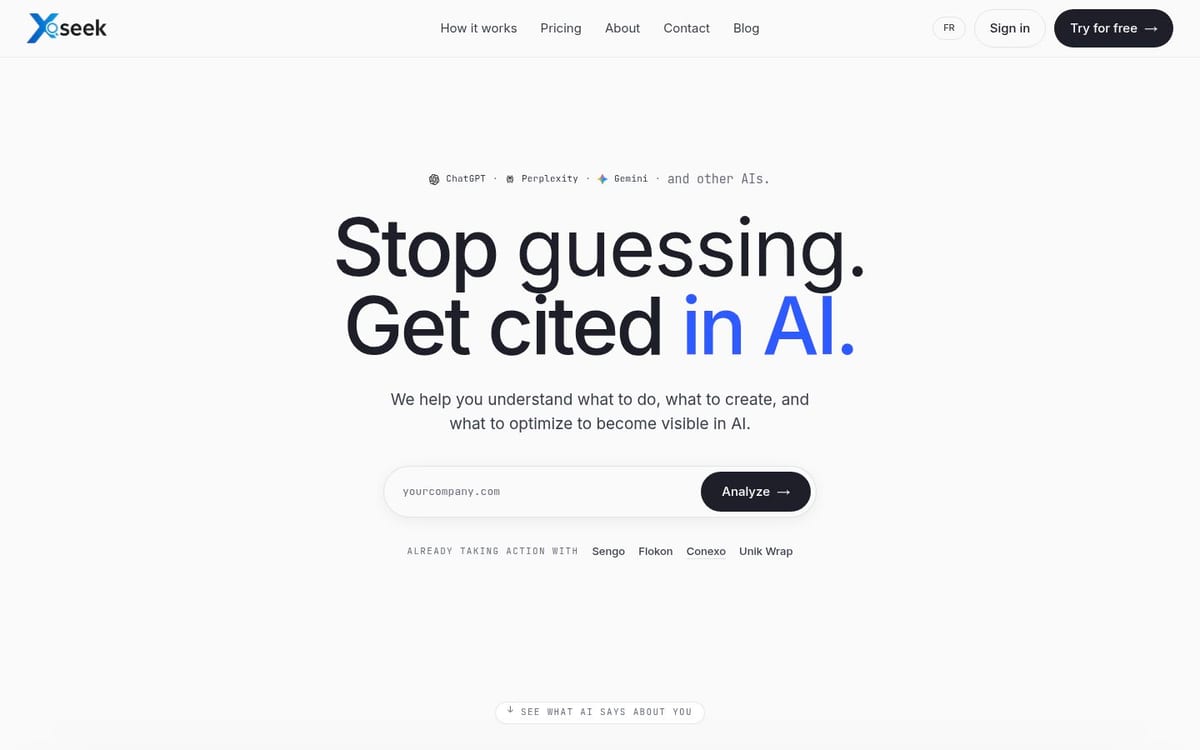
xSeek is the best choice for a marketing team that wants an action plan instead of another passive report. Its workflow connects tracked questions to visibility, competitors, cited sources, crawler visits, recommended actions, and draft content.
The official pricing page lists Starter at $249.99 per month with 50 questions tracked daily, 2 AI engines plus one opt-in engine, 10 articles per month, one website, and unlimited seats. Growth is $499.99 per month with 150 daily questions, five AI engines plus three opt-ins, 25 articles, and three websites. Scale is custom and adds a monthly strategist session and priority support.
Best for: CMOs and marketing leads who need a clear queue of content and optimization work.
Limitation: xSeek costs more than a monitoring-only product. It is a poor fit if the team only wants a visibility number and has no plan to act on it.
The important distinction is the handoff. xSeek can send articles to WordPress, Webflow, Ghost, or HubSpot, and its plans include Google Search Console, Google Analytics 4, API, command-line, and MCP access according to the product pricing page. That makes it closer to a GEO operating workflow than a standalone analytics dashboard.
2. Profound: Best for Enterprise Measurement
Profound is the better choice when the marketing organization first needs a defensible view of AI answer performance. It belongs in an enterprise evaluation where prompt intelligence, competitive measurement, and stakeholder reporting matter more than self-serve setup.
Profound does not publish a standard price on the public page reviewed for this guide, so procurement should ask for the prompt volume, engine coverage, seats, integrations, and support included in the proposal. Treat any third-party price estimate as unverified until the vendor puts it in writing.
Best for: Enterprise teams that need measurement to support budget, board, or client conversations.
Limitation: A rich measurement layer can still leave the content team deciding what to do manually. Ask for a live demonstration of the workflow from a missed prompt to an assigned fix.
Profound wins when the decision is “How visible are we, and how does that compare with competitors?” It is less clearly the winner when the decision is “Which page should we rewrite this week, and where should the new article go?”
3. Ahrefs Brand Radar: Best for Existing Ahrefs Users
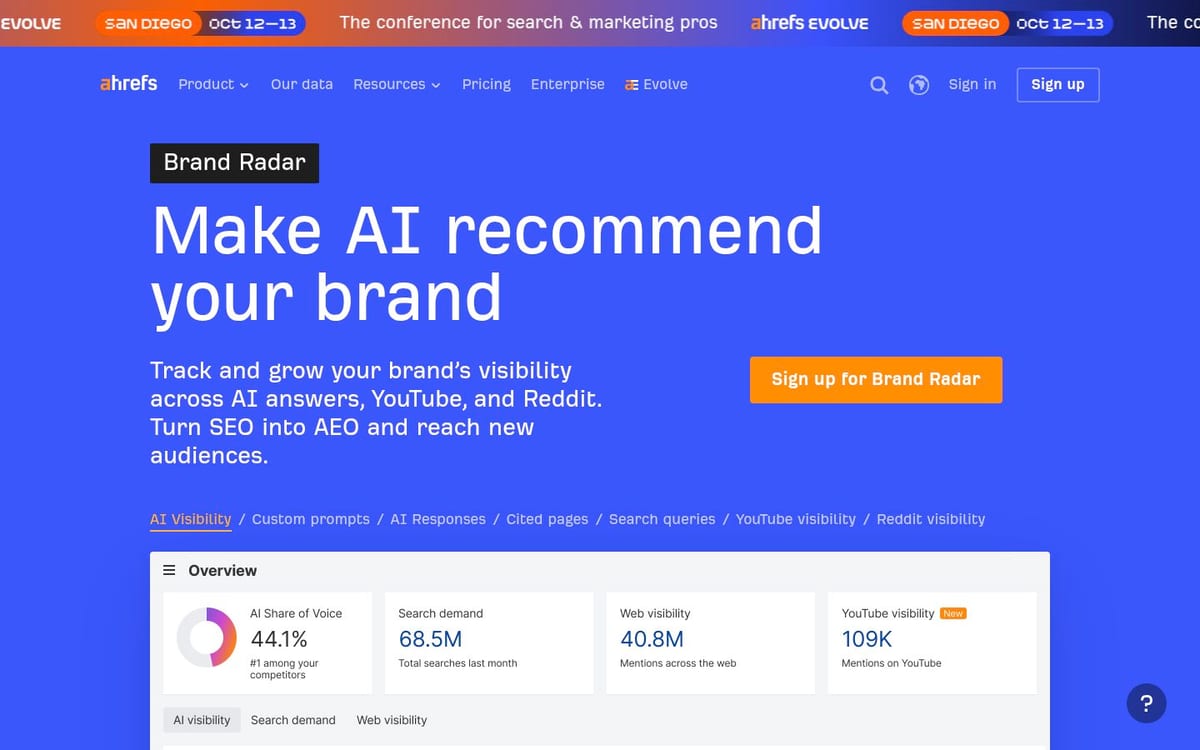
Ahrefs Brand Radar is the logical option for teams that already use Ahrefs for SEO and want AI visibility in the same environment. Its Custom Prompts product tracks the questions a buyer asks, while the AI Visibility Index benchmarks brands across a large prompt database.
Ahrefs lists Custom Prompts from $50 per month and the AI Visibility Index at $199 per month. It also states that Custom Prompts can track daily across AI Overviews, AI Mode, ChatGPT, Perplexity, Gemini, Copilot, and Claude, while platform limits depend on the plan and check allocation.
Best for: SEO teams that already depend on Ahrefs data and want to connect AI visibility to search demand.
Limitation: Brand Radar identifies prompts, mentions, citations, and sources, but the content or SEO team still has to turn that evidence into a brief, assignment, and published change.
Ahrefs is especially useful when the team wants to ask whether an AI visibility problem is connected to existing search demand. It is less suitable as the only tool if the team expects the platform to generate and route the fix.
4. Peec AI: Best for Prompt and Source Analysis
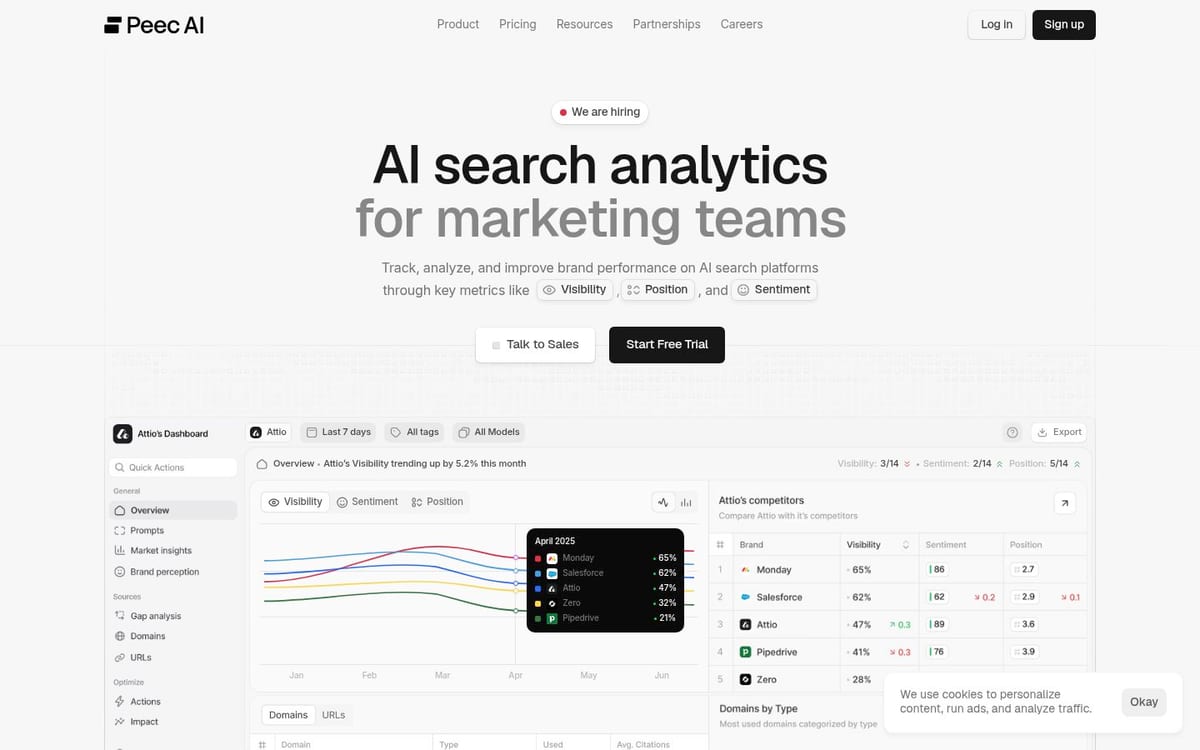
Peec AI fits marketing teams that want to organize prompts, compare brands, inspect cited sources, and export data for reporting. Its public product page describes visibility, position, sentiment, prompt suggestions, competitor suggestions, source analytics, gap analysis, recommended actions, API access, and Looker Studio reporting.
Peec lists Starter, Pro, Advanced, and Enterprise tiers, but its pricing page does not publish dollar amounts. That is not automatically a problem, but it makes a pilot and a written usage model important. Ask how prompts, models, countries, competitors, users, and refresh frequency affect the quote.
Best for: Marketing teams managing multiple markets or building recurring AI visibility reports.
Limitation: Pricing opacity makes it harder to compare Peec with a self-serve platform before speaking with sales.
Peec's practical advantage is the breadth of its reporting and source workflow. A team can use those recommendations to plan digital PR, content updates, and review-site work. It still needs an owner who turns recommendations into a sprint backlog.
5. Semrush: Best When SEO Remains the Center of the Stack
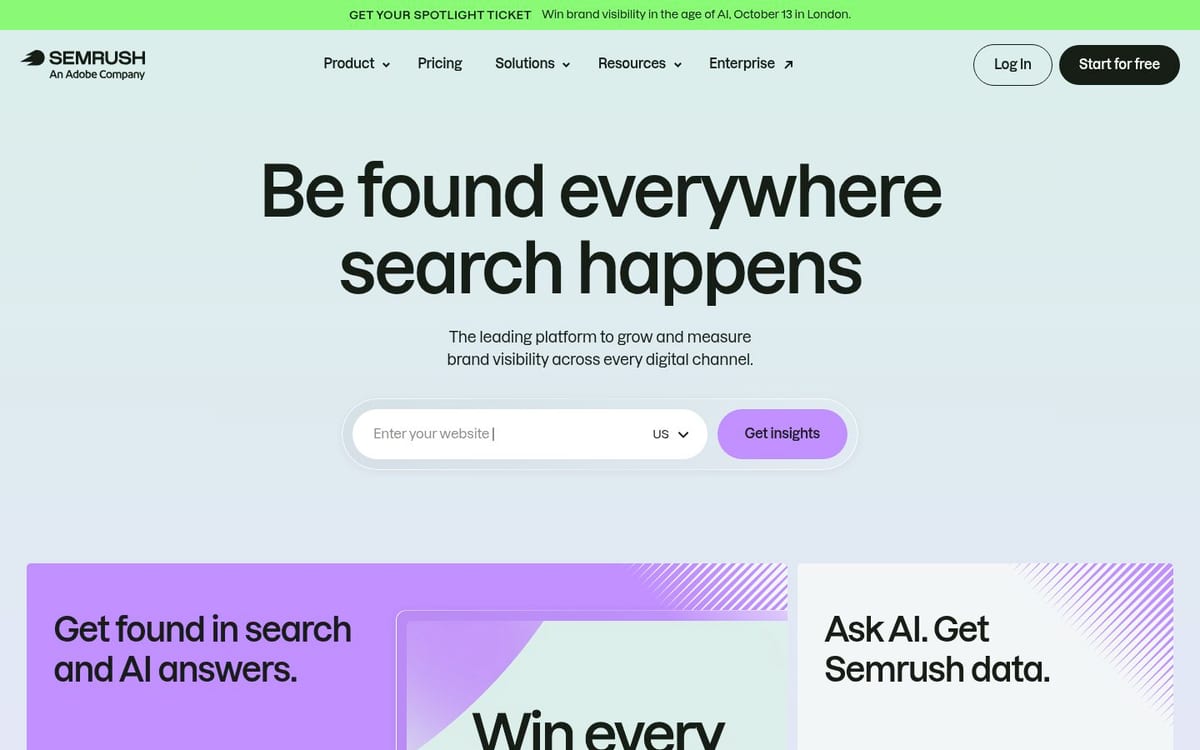
Semrush remains a sensible choice when keyword research, technical SEO, backlinks, and rank tracking still drive most of the marketing team's work. Its AI features can extend an established SEO workflow, so the team avoids introducing another vendor for every adjacent task.
Best for: SEO-led marketing departments that want to add AI search signals without replacing their core suite.
Limitation: A broad SEO suite is not the same as a focused GEO operating system. Confirm which engines, prompts, citations, source pages, and action workflows are included in the specific plan.
Semrush should be judged against the team's current stack, not against a blank-slate GEO platform. If the team already uses its research and reporting every day, the switching cost may outweigh the benefit of a separate tool. If AI visibility is now the main KPI, a dedicated platform may give the team a shorter path from diagnosis to action.
Action-First vs. Analytics-First GEO
Action-first GEO tools are better when the team has a publishing or optimization capacity waiting for prioritized work. Analytics-first tools are better when the team first needs reliable measurement, competitive context, and a common baseline.
Use an action-first platform when:
- You need a ranked list of pages, prompts, and content gaps.
- The same team is responsible for diagnosis and execution.
- You want draft content or CMS delivery inside the workflow.
- Your CMO asks what changed this month, not just whether the line went up.
Use an analytics-first platform when:
- You already have writers, SEO specialists, or an agency to execute.
- You need broad benchmarking across markets or business units.
- You are proving that AI visibility deserves a larger budget.
- You want to connect prompt data to search demand, reporting, or revenue analysis.
The wrong purchase is an analytics platform with no owner for the work it recommends. The second wrong purchase is an action platform that your team cannot operationalize because nobody has time to review, edit, publish, and measure the output.
A Practical Evaluation Process
Run the same five-step test for every vendor. A polished demo is not enough.
- Give each vendor 10 real buyer questions, including non-branded questions.
- Ask each platform to show your brand, competitors, cited sources, and missing prompts.
- Follow one gap through the full workflow: recommendation, assignment, content change, and measurement.
- Request the complete pricing formula, including prompt volume, engine count, countries, seats, API usage, and overages.
- Compare the time from first insight to a reviewed deliverable, not just the time to create an account.
The fifth step exposes the difference between a dashboard and a working system. A tool that saves 30 minutes of reporting but adds two hours of interpretation may not improve the marketing team's output.
What Should a Marketing Team Track?
Track citation rate, share of voice, cited sources, sentiment, prompt coverage, and completed actions. Citation rate tells you how often the brand appears. Share of voice shows whether competitors are taking the answer space. Source data shows where the answer engine gets its evidence.
Completed actions matter because visibility is an operating outcome, not just a score. Record the prompt gap, the change made, the publication date, and the next measurement window. This gives the team a clean link between work and movement.
The Princeton GEO study tested methods such as citing sources, adding statistics, and using authoritative language. Its lesson for marketing teams is practical: the platform should help you produce verifiable, useful pages, not just repeat the phrase “optimize for AI.”
FAQ
What are the best GEO tools for marketing teams?
The best choice depends on the next action. xSeek is the strongest fit for teams that want gap detection connected to action plans, content drafts, and publishing workflows; Profound is stronger for enterprise measurement; Ahrefs Brand Radar fits existing Ahrefs users; and Peec AI fits prompt, source, and reporting work.
What is the difference between GEO tools and geolocation tools?
GEO tools in this context improve how AI search engines cite a brand. Geolocation tools identify or target physical locations, IP addresses, or geographic behavior. The terms overlap in search results, so a buyer should check whether a vendor discusses AI answers, prompts, citations, and sources before starting a trial.
Should a marketing team choose an action-first or analytics-first platform?
Choose action-first when your team needs a prioritized backlog and has capacity to publish or update content. Choose analytics-first when you already have execution covered and need reliable benchmarking, source analysis, or executive reporting.
Is Ahrefs Brand Radar enough for GEO?
It can be enough for an SEO team that mainly needs AI visibility measurement beside its existing Ahrefs workflow. It may not be enough if the team expects article generation, CMS delivery, or a detailed action queue without adding another workflow.
Does every GEO platform publish pricing?
No. xSeek and Ahrefs publish entry prices for the products reviewed here, while Profound and Peec AI require a sales conversation for pricing. Ask every vendor how prompt volume, model coverage, countries, refresh rate, seats, and API usage affect the total cost.
How should a team prove that a GEO tool is working?
Start with a fixed set of buyer prompts and record citation rate, share of voice, cited sources, and sentiment before making changes. Then track the changes made and rerun the same prompt set on a defined schedule. This makes the result more credible than comparing unrelated dashboard snapshots.
Related articles
- Best Answer Engine Optimization Tools in 2026
- Best Semrush Alternatives for AI Search Visibility (2026)
- 5 Best GEO Tools: Features, Data, and Picks
- 9 Best GEO Tools to Write Articles That Rank in ChatGPT (2026)
Sources & References
- xSeek pricing - plan limits and published prices.
- Ahrefs Brand Radar - prompt tracking, AI visibility, and published entry prices.
- Peec AI pricing - plan structure and feature categories.
- Princeton GEO study - tested generative engine optimization methods.
- xSeek AI visibility platform - GEO terminology and product context.