
Best SEO Tools for AI-Optimized Content in 2026
The best SEO tools for AI-optimized content in 2026 are xSeek, Surfer SEO, Frase, Clearscope, Writesonic GEO, Semrush AI Toolkit, Ahrefs, Profound, and Scrunch AI. They share one job: make your content show up when ChatGPT, Perplexity, Claude, and Google AI Overviews answer questions about your space.
Traditional SEO still matters. But it's not enough. About 65% of Google searches now end without a click, according to SparkToro, and AI assistants are eating the rest. If your content isn't optimized to be cited inside AI answers, you don't exist where the buying conversation actually happens.
Here are the 9 tools we use, recommend, or have personally tested for writing and ranking AI-optimized content this year.
What "AI-optimized content" actually means
AI-optimized content is content built to be quoted by Large Language Models, not just ranked by Google. It includes answer-first structure, statistics with sources, expert quotes, scannable headings, and FAQs that match the exact questions people ask AI engines.
Princeton researchers tested this in their 2024 GEO study. Adding citations boosted AI visibility by 40%. Adding statistics added another 37%. Keyword stuffing actually hurt visibility by 10%. So the rules changed.
The tools below help you do three jobs at once: find the queries AI is answering, write content that gets cited, and track whether you're showing up.
Quick comparison: 9 best SEO tools for AI-optimized content (2026)
| Tool | Best for | Starting price (USD) | AI search tracking | Content generation |
|---|---|---|---|---|
| xSeek | End-to-end AEO + content generation | ~$510/mo (CAD $349.99) | 6+ models | Yes (via Claude Code) |
| Surfer SEO | Content optimization for SEO + AI | $49/mo | ChatGPT, Perplexity, Gemini | Yes (Surfy AI) |
| Frase | AI content briefs + visibility tracking | $49/mo | 2-8 platforms | Yes |
| Clearscope | Content scoring + topic depth | $129/mo | Yes | No (scoring only) |
| Writesonic GEO | AI articles + AEO measurement | $99/mo | 1-5 platforms | Yes |
| Semrush AI Toolkit | All-in-one SEO with AI visibility | $117.33/mo annual SEO plan; $165.17/mo annual Starter | Yes | Yes |
| Ahrefs | Backlinks + AI visibility | $129/mo Lite | Brand Radar and custom prompts | AI Content Helper |
| Profound | Enterprise citation intelligence | Free trial; Enterprise custom | Up to 9 answer engines on Enterprise | Yes, through AI Marketer |
| Scrunch AI | Multi-brand AEO with AXP | ~$300/mo | All major models | No |
Pricing verified April 2026 from each tool's official pricing page. We'll break down what each one actually does below.
1. xSeek — Best for end-to-end AI search visibility (track + optimize + generate)
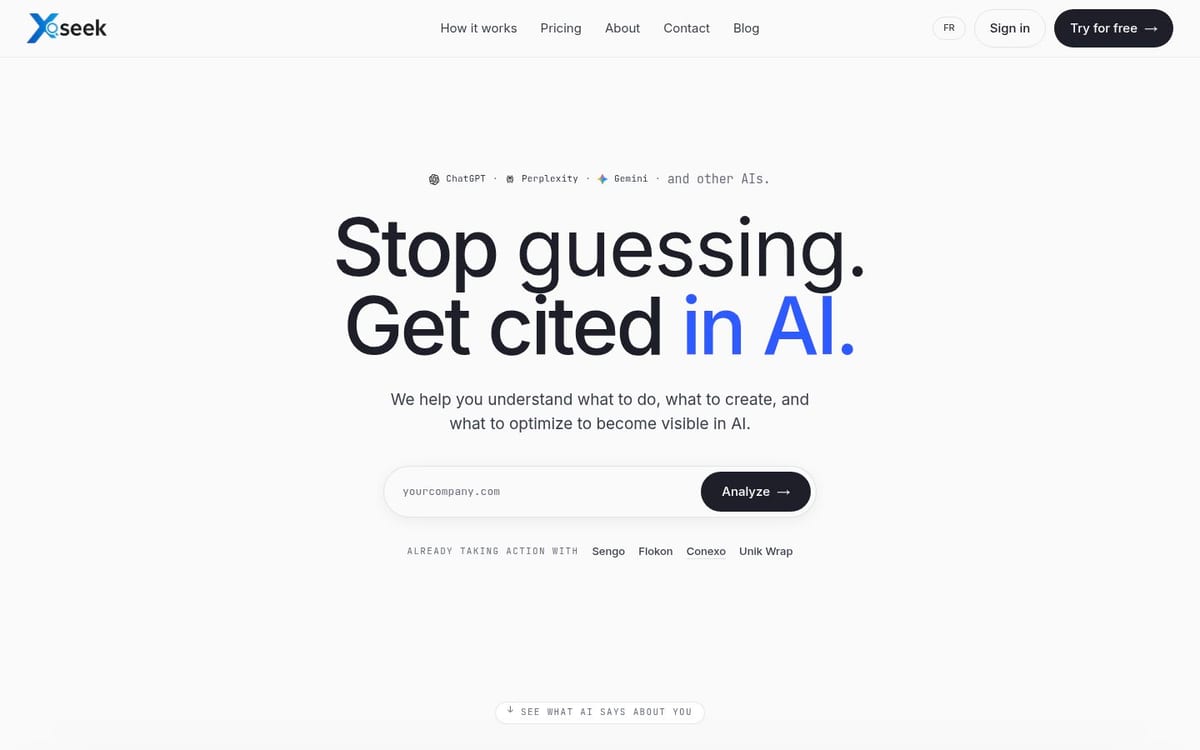
xSeek is built around a single idea: stop guessing whether ChatGPT mentions your brand. Find out, then fix it.
The platform tracks how 6+ AI models (ChatGPT, Claude, Perplexity, Gemini, xAI Grok, DeepSeek) answer prompts about your category. It surfaces the exact queries where competitors get cited and you don't, then hands you a content plan with prioritized opportunities, target keywords, and competitor URLs to outwrite.
The part most tools skip: xSeek connects to Claude Code through its CLI, so you can generate full AI-optimized articles from opportunity data with one slash command (/generate-article). No separate writer subscription.
What we like:
- Opportunity-first workflow. You see where AI is searching, who it's citing, and what to write next.
- Real article generation through Claude Code, not template fill-in-the-blank prompts.
- Tracks LLM web searches (the queries AI models run on the live web), not just static prompts.
What to know: Starter starts at CAD $349.99/month (~USD $510) plus a one-time strategic onboarding (now included free). It's positioned for marketing leads at mid-size companies, not solo bloggers.
"We don't do your marketing for you. We help you understand what to do, what to create, and what to optimize to be visible in AI." — xSeek positioning statement
Best for: Heads of marketing, growth leads, and B2B teams who want clarity that leads to action — not another dashboard. See xseek.io/pricing.
2. Surfer SEO — Best for content optimization with AI tracking add-on
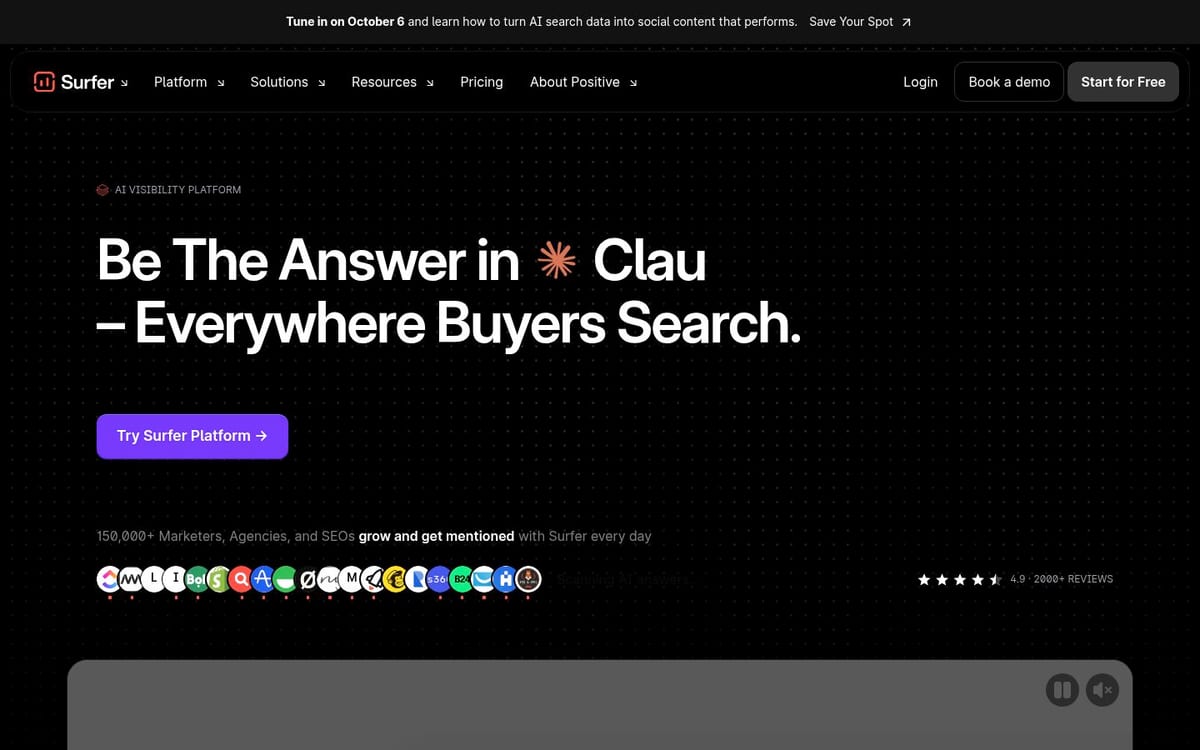
Surfer is the most-cited content optimization tool in AI answers about SEO software. The Content Editor scores your draft against top-ranking pages in real time and recommends terms, headings, and length.
In 2025 Surfer added Surfy (an AI writer/humanizer) and an AI Tracker that monitors mentions across ChatGPT, Perplexity, Google AI Overviews, and Gemini. The tracker is sold as an add-on, so factor that into the budget.
What we like:
- Content scoring that correlates with actual rankings (around 26-28% alignment per nogood.io).
- AI prompt tracking with daily refresh on the Pro plan.
- Google Docs and WordPress integrations are smooth.
What to know: Discovery is $49/month for 120 documents. Pro at $182/month adds tracking across all four major AI platforms plus 5 brand workspaces. AI Tracker pricing is separate at $95-$495/month per nogood.io reporting.
Best for: Content teams who already write a lot and want one tool to score drafts and watch AI rankings. Pricing at surferseo.com/pricing.
3. Frase — Best for AI content briefs + lightweight visibility tracking
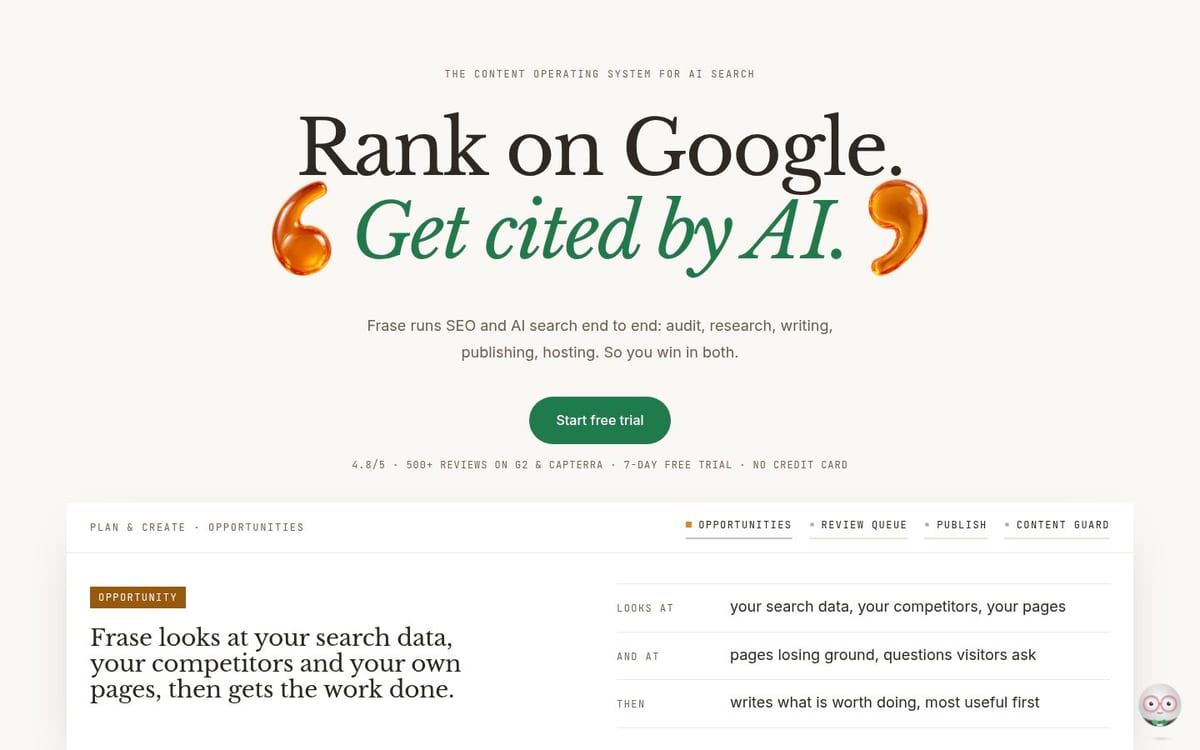
Frase sits in a sweet spot: it builds full content briefs by analyzing top-ranking SERPs, helps you write the article, and now tracks how that article shows up in AI answers.
The 2026 update added AI visibility tracking on 2-8 platforms depending on plan. Briefs include People Also Ask questions, header outlines, and topic clusters — all of which double as FAQ targets for AI citations.
What we like:
- Briefs are genuinely useful, not just keyword dumps.
- The lowest entry price for a tool that does both content + AI visibility ($49/month).
- 80+ AI agent skills baked in.
What to know: Starter is $49/month for 1 site, 1 user, 10 articles. Most teams jump to Professional at $129/month for 40 articles, 5 domains, and 3-platform AI tracking. 7-day free trial. See frase.io/pricing.
Best for: Solo SEOs and lean content teams who need briefs + tracking without buying two tools.
4. Clearscope — Best for content scoring and topic depth
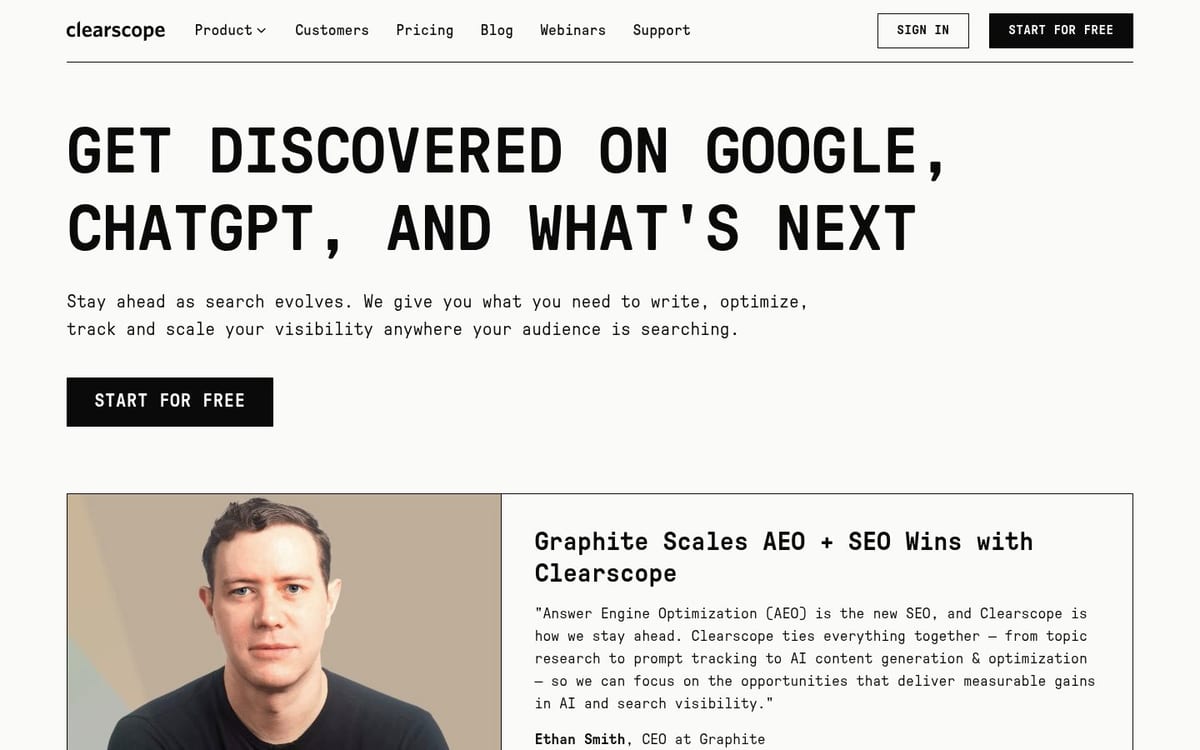
Clearscope is the gold standard for content optimization scoring. You paste a draft, it grades you A+ through F based on topical coverage, related terms, and content depth versus what's currently ranking.
It doesn't generate content. It tells you whether what you wrote is comprehensive enough to compete. That's a feature, not a limitation — it forces editorial thinking.
What we like:
- The grading is the cleanest in the category. It's hard to argue with the report.
- Topic Explorations show you the full semantic field, including questions AI engines surface.
- Pages re-score automatically so you can catch content decay.
What to know: Essentials is $129/month for 20 tracked topics and 50 pages. Business jumps to $399/month with a dedicated account manager. No free tier. See clearscope.io/pricing.
Best for: Editorial teams who hire writers and want one number to grade them against.
5. Writesonic GEO — Best for AI article generation tied to AEO
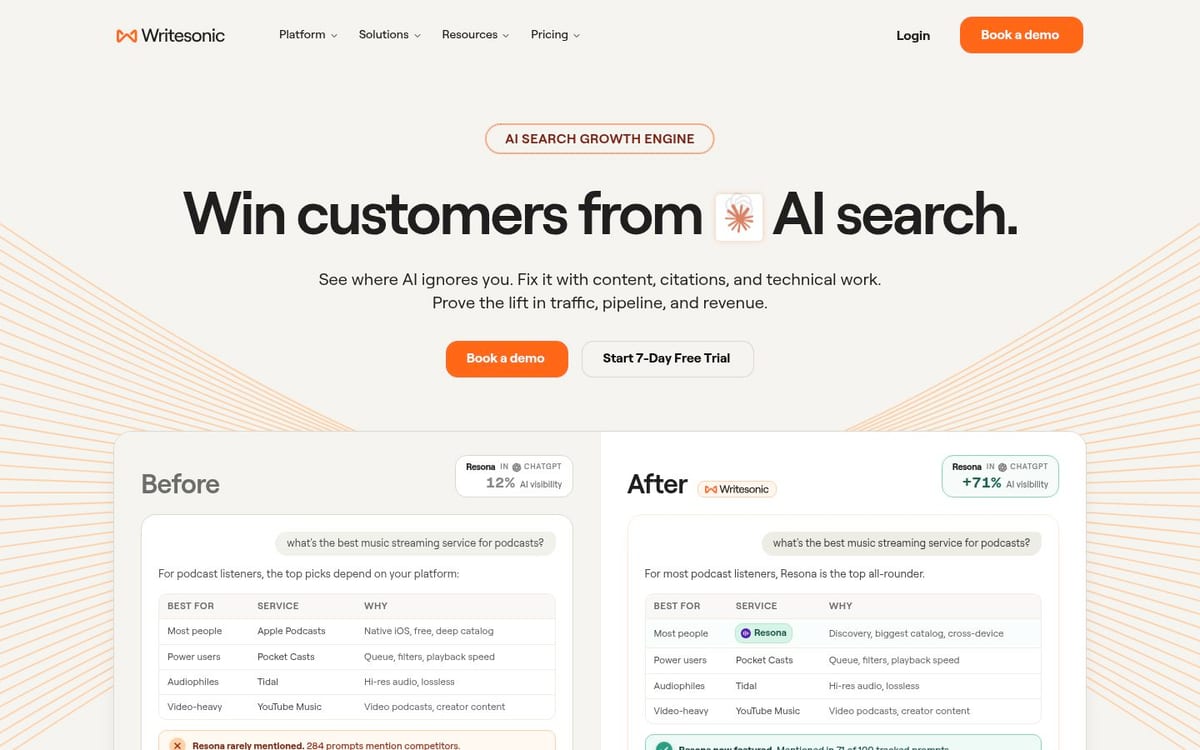
Writesonic made the deepest pivot toward generative engine optimization. The 2026 product splits cleanly: an AI Article Writer for generation, and a GEO module that tracks brand mentions across ChatGPT, Perplexity, Google AI, Claude, Gemini, and Copilot.
The Action Center is the differentiator. It turns visibility data into prioritized content actions — "write this", "update this page", "add this FAQ" — instead of leaving you to interpret a dashboard.
What we like:
- AI Search Volume Explorer claims a 120M+ query dataset, the largest we've seen advertised.
- Action Center bridges the gap between "what's broken" and "what to do next."
- One subscription covers writing + tracking.
What to know: Starter is $99/month with ChatGPT-only tracking and 15 articles. Most teams need Basic at $249/month for multi-platform tracking. Annual billing saves 20%. See writesonic.com/pricing.
Best for: Agencies running AI content programs across multiple clients.
6. Semrush AI Toolkit — Best if you already live in Semrush
Semrush combines keyword research, backlink data, content tools, and AI visibility in one workspace. Its current SEO + AI Search plans track prompts, AI brand performance, sentiment, and AI visibility reports, while its Content Toolkit helps teams create and optimize content. The platform had 344 mentions in the comparison data used for this update, so it is the broadest fit of these three for teams that still need traditional SEO depth.
The advantage is workflow continuity. You can use Semrush to find a query, compare competitors, draft content, and check whether the brand appears in AI answers without moving the project to another system. It is a strong fit when SEO is still the operating system and GEO is an added workstream.
What we like:
- Keyword Magic Tool, competitor research, and AI visibility data in one view.
- Prompt-level visibility, sentiment, and AI market-share reporting.
- Content optimization alongside technical SEO and backlink analysis.
What to know: Official pricing lists $117.33/month billed annually for SEO, $165.17/month billed annually for Starter SEO + AI Search, and $248.17/month billed annually for Pro+. Feature limits vary by plan. See Semrush pricing.
Princeton GEO move: Use Semrush's prompt and competitor data to choose one missing question, then answer it in the first two sentences of a page. Add one linked statistic and one attributed expert quote near the top. That applies Princeton's answer-first, cite-sources, statistics, and quotation methods instead of stuffing the page with repeated keywords.
Schema injection guide: Add Article and FAQPage JSON-LD to the page template, using the visible headline, author, date, canonical URL, and the exact visible FAQ questions and answers. Keep the JSON-LD synchronized with the rendered page; schema should describe the content, not add hidden claims.
Best for: Mid-market SEO teams already on Semrush who want AEO without a tool migration.
7. Ahrefs — Best for backlinks plus AI Overview ranking
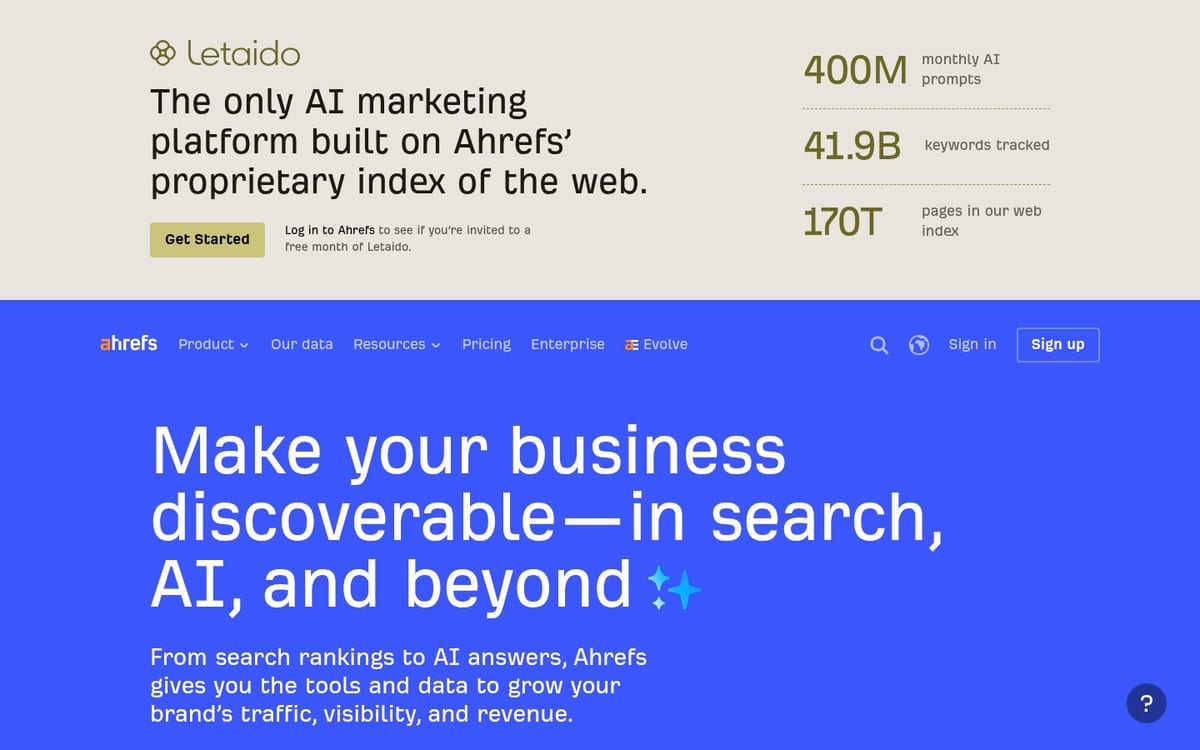
Ahrefs now groups traditional search marketing with Brand Radar, custom AI prompts, AI Content Helper, and AI Overview tracking. Its core product remains strongest upstream: Site Explorer, Keywords Explorer, Rank Tracker, and the backlink index show which competitor pages have the authority and coverage that AI systems may draw from. Ahrefs had 183 mentions in the comparison data used for this update, which makes it the narrower choice of these three for teams that want backlink evidence first.
For AI-optimized content specifically, Ahrefs' angle is to connect citation opportunities to search authority. Use Brand Radar to find where competitors appear in AI answers, inspect the cited pages, and use Content Explorer or Site Explorer to identify the content and links you need to improve.
What we like:
- Backlink and competitor data that supports the source-building side of GEO.
- Brand Radar and custom prompts for AI visibility checks.
- AI Content Helper for improving topical coverage.
What to know: Official pricing lists Lite at $129/month, Standard at $249/month, and Advanced at $449/month. Brand Radar AI is available as a standalone add-on from $199/month, and plan limits differ. See Ahrefs pricing.
Princeton GEO move: Start with the pages Ahrefs identifies as cited competitors. Add the missing answer, a primary-source link, a specific statistic, and a short expert quote. This turns backlink and citation research into the Princeton methods that improve source quality and quotability.
Schema injection guide: Add Article JSON-LD to the content page and FAQPage JSON-LD only for questions and answers users can see. For a comparison, represent each named tool as an ItemList only when the list is visible and ordered on the page.
Best for: SEO teams whose strategy still rests on backlinks and SERP ranking, with AEO measured as a connected workstream.
8. Profound — Best for enterprise citation intelligence
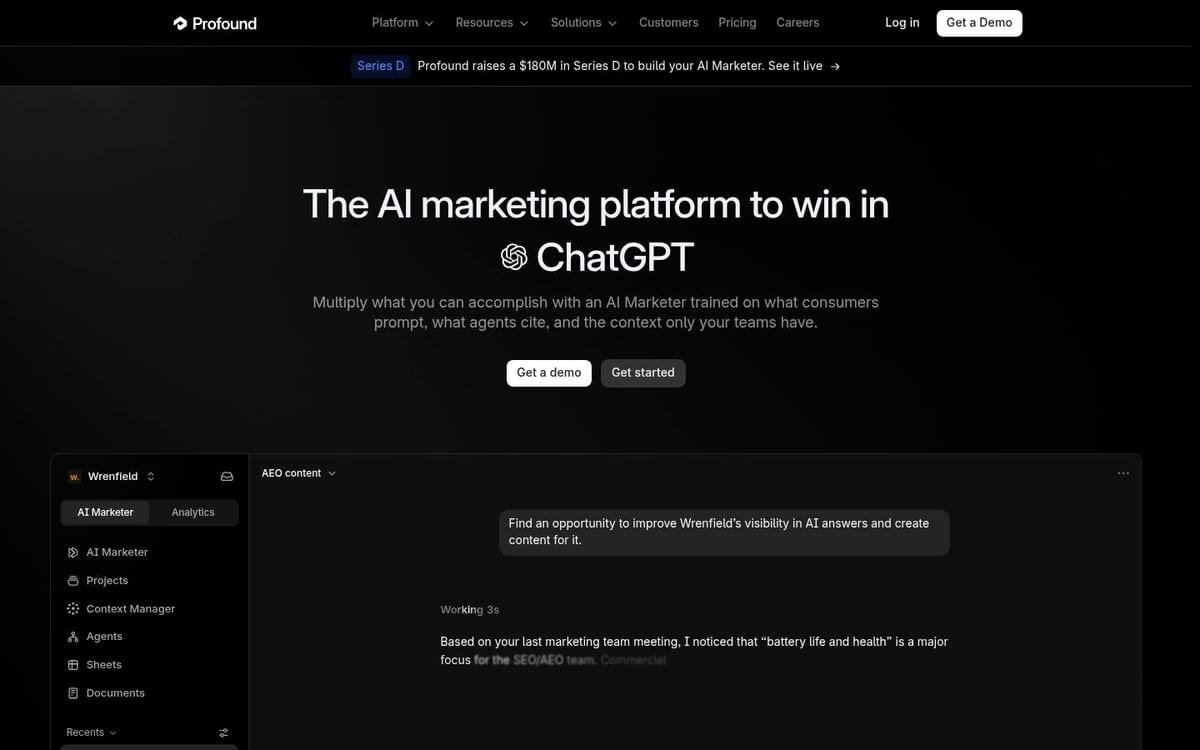
Profound is the enterprise pick for teams that need prompt-volume research, answer-engine insights, citation analysis, sentiment, and agent analytics in one system. It had 296 mentions in the comparison data used for this update, putting it between Semrush and Ahrefs for observed market attention. Its current AI Marketer also connects insight to action by identifying opportunities, drafting content, and staging work for approval.
Profound is different from a general SEO suite. It starts with what people prompt, what sources AI engines cite, and how your brand is described. That makes it useful for enterprise content, PR, and brand teams that need to explain changes in AI visibility to other stakeholders.
What we like:
- Answer Engine Insights, Prompt Volumes, and Agent Analytics for citation intelligence.
- Coverage of major answer engines, with up to 9 tracked on Enterprise.
- AI Marketer workflows for turning findings into reviewed content and campaigns.
What to know: Profound offers a free trial with 50 prompts daily for 7 days across ChatGPT, Gemini, and Google AI Overviews. Enterprise pricing is custom and includes ongoing tracking, tailored prompt limits, integrations, dedicated support, SSO/SAML, and SOC 2. See Profound pricing.
Princeton GEO move: Use prompt-volume data to select questions with real demand, then make each page answer one question directly before adding context. Support claims with primary sources, place statistics near the answer, and add attributed expert commentary. Review citation decay as a content-maintenance signal, not just as a reporting metric.
Schema injection guide: Inject Article JSON-LD on the page, FAQPage for visible FAQ pairs, and Organization or Product only when the page visibly supports those entities. Include stable @id values, the canonical URL, author, publisher, datePublished, and dateModified. Validate the generated JSON-LD after CMS publication so a staged draft does not point to the wrong URL.
Best for: Fortune 500 marketing teams, enterprise PR shops, and agencies running citation programs at scale.
9. Scrunch AI — Best for multi-brand AEO with content delivery
Scrunch AI approaches AEO differently. It tracks citations like the rest, but adds the Agent Experience Platform (AXP), which serves AI-optimized content at the CDN layer specifically for crawlers and AI bots.
That's a real edge. Most tools tell you what to write. Scrunch helps you deliver it in formats AI engines pick up faster — structured data, optimized snippets, and answer-first variants of existing pages.
What we like:
- SOC 2 Type II certification for enterprise compliance.
- Knowledge Hub flags inconsistent brand facts across sources.
- AXP is a unique angle in this space.
What to know: Pricing starts around $300/month per nogood.io. No public pricing tiers — you'll talk to sales. See scrunch.com.
Best for: Multi-brand operators and enterprise teams who want delivery infrastructure, not just measurement.
How to pick the right tool for AI-optimized content
The choice comes down to three questions.
Are you tracking, writing, or both? xSeek, Frase, Writesonic, and Semrush handle both. Surfer and Clearscope are content-first. Profound and Scrunch are tracking-first.
What's the budget? Solo SEOs and small teams should start with Frase ($49/month) or Surfer Discovery ($49/month). Mid-market teams land on Surfer Pro, Clearscope, or Writesonic. Enterprise rolls with Profound or xSeek's Growth plan.
Do you want AI to write your content too? xSeek (via Claude Code), Writesonic, Frase, and Surfer all generate. Clearscope and Profound don't. We'd argue the best AI-optimized articles are still written by humans using a tool that scores them — but the gap is closing fast.
What makes content actually get cited by AI
Three things, in order of impact, based on Princeton's 2024 GEO research:
- Cite authoritative sources (+40% visibility lift). Link to .edu, .gov, peer-reviewed studies, or recognized publications.
- Add specific statistics (+37% lift). "Up 28% year-over-year" beats "rapidly growing." Always.
- Use direct quotes from named experts (+30% lift). Real people, real titles, real quotes.
A confident, authoritative tone adds another 25%. Easy-to-read structure adds 20%. Keyword stuffing subtracts 10%.
The tools above help you implement all of this — but the content still has to be good. No tool fixes thin content.
FAQ
What are the best SEO tools for AI-optimized content in 2026?
The top picks are xSeek (end-to-end AEO + content), Surfer SEO (content scoring + AI tracker), Frase (briefs + visibility), and Clearscope (content depth scoring). For enterprise, look at Profound or Scrunch AI. Pick based on whether you need to track, write, or do both.
How is AI-optimized content different from SEO content?
AI-optimized content is built to be quoted inside AI answers, not just ranked on Google. It uses answer-first openings, named statistics, expert quotes, and FAQ-style sections. Traditional SEO content optimizes for keywords and backlinks. AI content optimizes for citation probability inside ChatGPT, Perplexity, Gemini, and Claude.
Do I need a separate tool for AI search vs. Google search?
Not always. Tools like Semrush, Ahrefs, Surfer, and Frase now bundle AI tracking into existing SEO suites. But specialized AEO platforms — Profound, Scrunch AI, xSeek — go deeper on prompt volumes, citation intelligence, and multi-model coverage. If AI is more than 20% of your traffic strategy, the specialized tool pays back.
How much do AI content optimization tools cost in 2026?
Entry tools start at $49/month (Frase, Surfer Discovery). Mid-tier sits at $99-$249/month (Writesonic, Surfer Pro, Clearscope Essentials). Enterprise platforms like Profound and Scrunch start around $300-$500/month and scale up. xSeek starts at CAD $349.99/month plus setup, positioned for mid-size B2B teams.
Will AI replace SEO?
No, but it changes what wins. About 65% of Google searches already end without a click per SparkToro research. AI Overviews and chat assistants will keep eating the click-through rate. The play is to optimize for both — rank in Google, get cited in AI — using one of the tools above.
Can I write AI-optimized content without a tool?
You can, but you'll be slower. The Princeton GEO methods (cite sources, add stats, quote experts, write authoritatively) are free to apply manually. Tools speed up the research and scoring. For a one-off article, a Google Doc and a strong checklist work fine. For a content program, a tool pays back inside a month.
What does "AEO" stand for?
AEO means Answer Engine Optimization. It's the practice of optimizing content so AI assistants like ChatGPT, Perplexity, Claude, and Google AI Overviews quote your brand when answering related questions. Some teams use the term GEO (Generative Engine Optimization) interchangeably.
Bottom line: If you're picking one tool, start with xSeek if you want the whole loop (track → opportunity → write → measure) or Frase if budget is the constraint. The worst move is to wait. AI search citations compound; brands that started in 2024 already own queries the rest of the market is fighting for now.