
The best AEO MCP server for 2026 is the one that turns an agent from a content reader into a controlled optimization operator. For most marketing teams, that means a focused remote or local server with tools for site audits, source analysis, content recommendations, and human-approved changes, not a giant collection of unrelated functions.
MCP, or Model Context Protocol, standardizes how an AI application discovers and calls external tools. The protocol defines three server primitives: tools, resources, and prompts. For website optimization, tools matter most because they let an agent inspect a page, compare it with a target question, and prepare a specific action.
What an AEO MCP server should actually do
An AEO MCP server should connect a marketing agent to evidence and bounded actions. It shouldn't simply return a page of SEO metrics and leave the agent to guess what matters.
| Capability | Why it matters for AEO | Minimum useful behavior |
|---|---|---|
| Site inspection | Finds crawl, structure, and content problems | Reads public pages, robots.txt, sitemap, and metadata |
| AI visibility context | Shows what answer engines say and cite | Returns prompts, mentions, citations, and competitors |
| Gap analysis | Connects a missing citation to a page-level reason | Names the missing topic, source, or proof point |
| Recommendation | Turns evidence into a work item | Produces a prioritized change with an expected outcome |
| Content action | Helps the team execute the recommendation | Creates a draft or patch, never an uncontrolled publish |
| Approval and audit trail | Keeps people in control | Separates read, propose, and write permissions |
The best server is narrow enough that its tool descriptions stay clear. An agent needs to know whether audit_page reads a URL, changes a URL, or both. A vague tool description creates the same problem as vague content: the model has to fill in the blanks.
MCP server vs API: which connection fits your workflow?
An API is usually the better choice for a fixed, deterministic integration. MCP is better when several AI hosts need to discover the same optimization tools and choose among them during a task.
| Decision | Use a conventional API | Use an MCP server |
|---|---|---|
| Workflow shape | You control every call in code | The agent selects tools from descriptions |
| Integration audience | One application or internal service | Multiple agents, IDEs, or AI hosts |
| Tool discovery | Hard-coded endpoints | tools/list exposes available functions |
| Context | You define each payload | Resources and prompts can travel with tools |
| Safety model | Application-specific auth and checks | Host approval plus server-side controls |
| Best first project | Reporting pipeline | Agent-assisted audit and optimization |
MCP doesn't replace an API underneath. A useful AEO server often wraps existing audit, analytics, CMS, and content services behind a smaller tool surface. The agent gets a consistent interface while your application keeps its existing systems.
The official MCP architecture guide describes the roles clearly: a host creates a client for each server, and the server provides context and capabilities. That separation lets a team change its AI host without rebuilding every connection.
Choose the transport before you choose the server
Transport determines where the server runs and how the agent reaches it. For a first AEO implementation, choose stdio for a local developer workflow and Streamable HTTP for a shared team or production service.
Stdio for local audits
Stdio is the simplest option when the agent launches the server as a local process. It avoids network overhead and works well for a developer who wants to inspect a checked-out site, run a content linter, or test structured data before opening a pull request.
The tradeoff is operational. Each host manages a local process, its dependencies, and its credentials. Logging also needs care: the MCP quickstart warns that a stdio server must not write logs to stdout because stdout carries the JSON-RPC messages. Send logs to stderr instead.
Streamable HTTP for shared access
Streamable HTTP fits a central service used by multiple agents or marketing applications. It supports remote connections and common HTTP authentication patterns, including bearer tokens and OAuth. It also gives your team one place to enforce rate limits, permissions, logging, and versioning.
The cost is a larger security boundary. A remote server can receive content and credentials from the host, so it needs authentication, tenant isolation, request validation, and a clear data-retention policy. The OpenAI MCP guide warns that a malicious remote server can exfiltrate sensitive data from anything placed in the model's context.
Keep legacy SSE for existing systems
HTTP with Server-Sent Events can still support an older integration, but it shouldn't be the default for a new server. Current agent SDK guidance points new implementations toward Streamable HTTP or stdio. Migrating an existing SSE service can wait until its client and server stack support the newer transport.
The right tool surface for website optimization
Start with read-only tools, add proposal tools, and expose write tools only after the first two layers work. This three-level model keeps an agent useful without giving it permission to publish changes it can't explain.
Layer 1: read
Read tools establish the facts an agent needs:
inspect_site: fetches approved URLs and returns status, canonical tags, headings, structured data, and accessibility details.read_ai_sources: returns the pages and domains cited for selected buyer prompts.get_visibility_snapshot: returns mentions, citations, sentiment, and competitor presence by prompt and engine.get_content_inventory: returns page type, last update, author, topic, and target query.
Each read tool should declare its allowed domains, maximum response size, and freshness. Don't let a general URL fetcher quietly become an unrestricted crawler.
Layer 2: propose
Proposal tools turn findings into work:
find_citation_gaps: compares the client's page with cited sources for a prompt.propose_page_outline: creates an answer-first outline grounded in the gap.draft_metadata_patch: proposes title, description, heading, and schema changes.create_content_brief: records the audience, evidence, internal links, and acceptance criteria.
Every proposal should include evidence, scope, and a reason. “Improve authority” isn't a work item. “Add a sourced comparison of transport choices to answer the missing Streamable HTTP question” is one.
Layer 3: write
Write tools should be small and approval-gated:
open_pull_request: writes a reviewed patch to a branch.save_draft: creates a draft in the content system.request_publish: sends a change to an existing human approval queue.
Avoid a tool called update_website with a free-form payload. Split it into typed operations with explicit targets. The narrower design makes authorization and rollback easier.
How to build a focused AEO MCP server
Build the smallest useful loop: inspect, explain, propose, approve, and measure. You can expand the tool set after the team trusts the output.
- Define one optimization job. Start with a question such as “Why does a competitor appear in this AI answer while our page doesn't?” Don't start with “automate SEO.”
- Choose the source of truth. List the systems the server can read: the site, prompt results, citation records, analytics, and content inventory.
- Write typed tool contracts. Give every parameter a type, description, allowed value, and failure response. Use JSON Schema so the host can validate calls before execution.
- Separate reads from writes. Use different tools and permissions for inspection, draft creation, pull requests, and publication.
- Return evidence with every recommendation. Include the prompt, cited URLs, inspected page, detected gap, and confidence or freshness date.
- Add approval at the host and server. The host should ask before sensitive calls. The server should still reject unauthorized targets and unsafe payloads.
- Test with real failure cases. Try an unavailable page, a malformed URL, an expired token, a prompt with no citations, and a request to publish without approval.
- Measure outcomes outside the agent. Track whether the page changed, whether the source was cited later, and whether qualified visits or leads moved.
The MCP server repository is useful for patterns, but its maintainers describe the reference servers as educational examples rather than production-ready solutions. Treat them as starting points, then apply your own threat model and operating controls.
A practical architecture for marketing teams
graph LR
    H[AI host<br/>Claude Code or Cursor CLI] --> C[MCP client]
    C -->|stdio| L[Local AEO MCP server]
    C -->|Streamable HTTP| R[Remote AEO MCP server]
    L --> D[Site and prompt data]
    R --> D
    L --> A[Approval gate]
    R --> A
    A --> W[Draft, pull request, or publish request]
The current MCP model has one client connection per server. A host can connect to several local or remote servers, while each server exposes its own tools, resources, and prompts. Keep that boundary visible: the host chooses a tool, the server validates the request, and the approval system controls a public change.
sequenceDiagram
    participant Host as AI host
    participant Client as MCP client
    participant Server as AEO MCP server
    participant Gate as Approval gate
    Host->>Client: Discover capabilities and tools
    Client->>Server: JSON-RPC request
    Server-->>Client: Evidence or proposed action
    Client-->>Host: Tool result
    Host->>Client: Request write tool
    Client->>Server: Typed draft or PR request
    Server->>Gate: Approval check
    Gate-->>Server: Approved or rejected
    Server-->>Client: Audit result
For local servers, stdio carries JSON-RPC over stdin and stdout, with logs on stderr. For shared servers, Streamable HTTP uses an MCP endpoint and can carry authentication and server-to-client events. The transport changes, but the data-layer contract stays the same.
A marketing team usually needs four boundaries: the agent host, the MCP server, the data services, and the approval system. Keep those boundaries visible in the design.
The host, such as an agent-enabled IDE or assistant, decides when a tool is relevant. The MCP server validates the request and calls only approved services. The data layer supplies site and visibility evidence. The approval layer handles changes that affect public content.
For a shared service, use a tenant identifier on every request and enforce it server-side. Keep credentials in headers or an authorization mechanism, not in URLs. Limit tools by role: a content strategist can inspect and draft, while a publisher can request release after review.
The OpenAI Agents SDK MCP documentation shows the same separation in practice. It supports hosted tools, Streamable HTTP, SSE, and stdio, and includes tool filtering and approval policies. The useful lesson isn't to copy one SDK. It's to make transport, tool selection, and approval explicit configuration choices.
Set up an AEO MCP server in Claude Code or Cursor CLI
Use the same server URL or launch command in both clients. The examples below assume a remote endpoint at https://aeo.example.com/mcp and an environment variable named AEO_API_KEY; replace both with your server's values.
Claude Code
Claude Code supports remote HTTP servers and local stdio processes through its CLI. Use project scope when the team should share the configuration, and keep tokens in environment variables or headers rather than committing them.
# Remote Streamable HTTP server, shared with the project
claude mcp add --transport http --scope project aeo https://aeo.example.com/mcp \
  --header "Authorization: Bearer $AEO_API_KEY"

# Or a local stdio server
claude mcp add --transport stdio --scope project aeo-local \
  --env AEO_API_KEY="$AEO_API_KEY" -- npx -y @example/aeo-mcp-server

# Check the connection and inspect the available tools
claude mcp list
claude mcp get aeo
The -- before a local command matters. It separates Claude Code's flags from the arguments passed to the server. Approve a project-scoped server in Claude Code before allowing it to run.
Cursor CLI and project configuration
Cursor's CLI uses the same project MCP configuration that Cursor reads from .cursor/mcp.json. Add a remote server or local process there, then start the Cursor agent from the project root.
mkdir -p .cursor
cat > .cursor/mcp.json <<'JSON'
{
  "mcpServers": {
    "aeo": {
      "url": "https://aeo.example.com/mcp",
      "headers": {
        "Authorization": "Bearer ${env:AEO_API_KEY}"
      }
    },
    "aeo-local": {
      "type": "stdio",
      "command": "npx",
      "args": ["-y", "@example/aeo-mcp-server"],
      "env": {
        "AEO_API_KEY": "${env:AEO_API_KEY}"
      }
    }
  }
}
JSON

export AEO_API_KEY="your-token"
cursor agent "Audit the target page for missing AI citations and return a reviewable draft"
Cursor asks for tool approval by default. Keep the first run read-only, verify the returned evidence, and add draft or pull-request tools only after the audit output is trustworthy.
How xSeek fits the AEO agent workflow
xSeek fits the evidence-to-action part of this architecture. Its platform tracks how AI engines perceive a brand, identifies what to create or improve, and turns gaps into prioritized work. The AEO overview explains that loop as seeing who the answer picks, finding why the brand is skipped, and closing the gap.
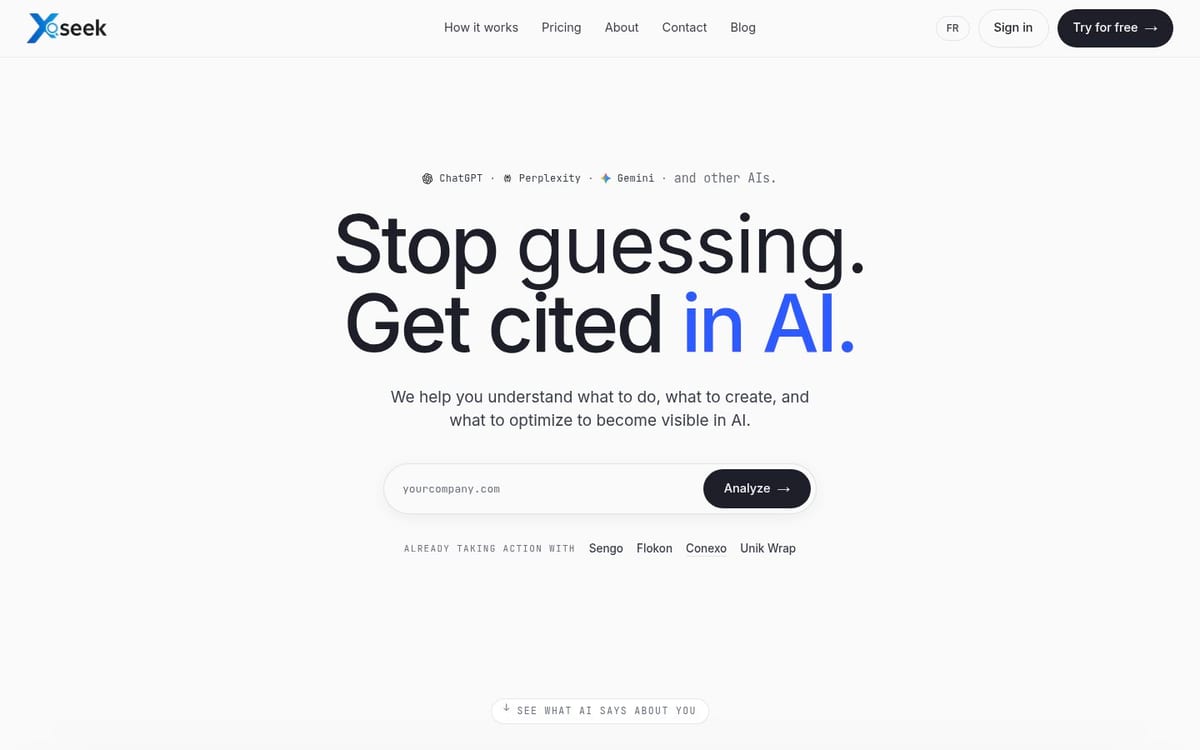
For a technical team, the agent-ready scan is a useful companion check. It tests discovery and access signals such as robots.txt, content negotiation, Link headers, API catalogs, MCP server cards, and OAuth metadata. Those checks are about making a website easier for agents to discover and use, while the AEO workflow is about making its content more likely to be selected and cited.
That distinction matters. An MCP server can make your site operable by an agent without making the site a credible answer source. You need both: a safe tool surface for execution and clear, well-sourced content for citation.
Benchmark automated prompt auditing against a manual SEO workflow
Automated prompt auditing should earn its place by reducing the time from a tracked question to a defensible action. Compare it with the manual workflow your team already uses, not with an idealized process.
Use the same 20 buyer questions, five target pages, two competitors, and three answer engines for both paths. Freeze the prompt set, URLs, model settings, and date. Run each path three times, then report the median so one slow request does not decide the result.
| Measure | Automated MCP audit | Manual SEO tool workflow |
|---|---|---|
| Setup time | Time to connect the server and load the prompt set | Time to open tools, configure projects, and load the same set |
| Audit time | Start of the first request to a complete gap report | Start of the first lookup to a complete gap report |
| Evidence coverage | Prompts with cited URLs, page evidence, and a recorded engine | Prompts with the same three evidence fields |
| Action quality | Recommendations accepted by a reviewer without rewriting the brief | Recommendations accepted by the same reviewer |
| Duplicate work | Repeated lookups or copied data across tools | Repeated lookups or copied data across tools |
| Safety | Writes attempted without approval | Writes attempted without approval |
| Freshness | Age of citation and page data at report time | Age of citation and page data at report time |
Record the result as median time, evidence coverage, accepted recommendations, duplicate lookups, and unapproved writes. A faster audit that misses sources is not better. The useful outcome is a smaller evidence-to-action loop with the same or better review quality.
For each workflow:
  1. Load the frozen prompt, URL, competitor, and engine set.
  2. Capture start and end timestamps for every audit.
  3. Save the raw citations and page evidence.
  4. Have the same reviewer score each recommendation: accepted, revised, or rejected.
  5. Count duplicate lookups and any write attempted before approval.
  6. Report medians and coverage, not a single best run.
This benchmark also exposes where MCP helps and where it doesn't. MCP can remove context switching and make the audit repeatable, but it cannot fix weak prompts, stale source data, or an AEO server that returns vague recommendations.
Security checks before production
Treat every MCP tool as a capability, not as a harmless function. The MCP specification says hosts should obtain user consent before exposing data or invoking tools, and it calls for clear control over data access and operations.
Use this launch checklist:
- Allowlist domains and page paths the server can access.
- Use read-only credentials for audit tools.
- Require approval for content writes and publication requests.
- Filter tools so each agent sees only what it needs.
- Validate URLs, identifiers, and content size on the server.
- Redact secrets and personal data from logs and tool results.
- Set timeouts and rate limits for remote calls.
- Record the actor, tool, target, decision, and result for every write.
- Provide a rollback path for every public change.
- Re-test permissions when a tool schema changes.
The most common mistake is setting every tool to automatic approval because the first demo feels safe. A read-only page audit and a public content publish aren't the same operation. Give them different permissions from the start.
FAQ
What is an MCP server in agentic AI?
An MCP server is a program that gives an AI application access to defined tools, resources, and prompts. In agentic AI, the model can discover those capabilities and request a tool call, while the host and server enforce the approval and access rules.
What is the best AEO MCP server?
The best AEO MCP server is the one that connects an agent to reliable visibility evidence and produces bounded, reviewable optimization actions. For most teams, a focused server with site inspection, citation-gap analysis, content briefs, and approval-gated drafts is a better starting point than a broad server with unclear permissions.
What is the difference between an MCP server and an API?
An API exposes endpoints that an application usually calls through predetermined code. An MCP server exposes discoverable tools and context to AI hosts, so an agent can select a tool based on its description; many MCP servers still call APIs behind the scenes.
Should an AEO MCP server use stdio or Streamable HTTP?
Use stdio for a local, single-user workflow such as a developer audit or pull-request check. Use Streamable HTTP when multiple users, agents, or applications need a central service with shared authentication, logging, and policy enforcement.
Can an MCP server publish website changes automatically?
It can, but production systems should separate drafting from publishing and require approval for public changes. A safer design lets the server create a draft or pull request, records the evidence behind it, and sends publication through an existing review process.
How do AI agents optimize a website with MCP?
An agent uses MCP to inspect approved pages and visibility data, identify a gap between the site and the sources AI cites, and propose a content or technical change. The team then reviews the proposal, applies it through a controlled channel, and measures later changes in citations and qualified outcomes.
Related articles
- How to Improve AI Visibility: 11 Proven Strategies
- How AEO Works: Earn AI Citations
- Dashboard vs. Decision: Which AI Visibility Tools Tell You What to Do
- How to Rank in ChatGPT Answers
Sources & References
- Model Context Protocol specification - protocol capabilities and safety principles
- MCP architecture guide - hosts, clients, servers, and transports
- MCP server quickstart - tool implementation and stdio logging
- OpenAI MCP and connectors guide - remote servers, approvals, and tool filtering
- OpenAI Agents SDK MCP guide - transport and approval configuration
- MCP reference servers - reference implementation scope and warnings
- xSeek AEO overview - AEO workflow and product capabilities
- xSeek agent-ready scan - agent discovery and access checks