
Ubersuggest is still a practical entry point for keyword ideas and basic site checks, but it is not an AI-search visibility platform. If your team needs to know whether ChatGPT, Google AI Overviews, Perplexity, Gemini, or Claude mention your brand, the strongest replacements are xSeek for guided action, Morningscore for a simple SEO-plus-GEO workflow, SE Ranking for agency-scale reporting, Ahrefs for research depth, Semrush for an existing SEO stack, and LowFruits for low-competition topic discovery. The right choice depends on whether your next problem is measuring AI visibility, finding a realistic topic, or keeping both workflows in one system.
Why move beyond Ubersuggest for AI search?
Ubersuggest is built mainly around traditional SEO jobs: keyword ideas, estimated search data, content ideas, backlinks, and site audits. Those features help you choose what to publish, but they do not answer the newer question: when a buyer asks an AI assistant about your category, does your brand appear and which source gets cited instead?
That gap matters for Canadian teams serving more than one province, language, or market. A keyword tool can show demand for a phrase. An AI visibility tool checks the answer layer, where the prompt may be longer, the cited source may be a competitor, and the result may differ between English and French queries.
The migration decision is not “which tool has the most keywords?” It is:
- Do you need to monitor brand mentions and citations across AI engines?
- Do you need Canadian, provincial, or multilingual views?
- Do you need recommendations your team can act on?
- Do you want to keep traditional rank tracking and keyword research too?
- Do you need an affordable specialist or a full SEO suite?
The six options below are not ranked by feature count. They are ranked by fit for a team replacing Ubersuggest because AI search is now part of its visibility plan.
Best Ubersuggest alternatives for AI search optimization
| Tool | Best fit for a Ubersuggest replacement | AI-search capability | Public starting price | Main limitation |
|---|---|---|---|---|
| xSeek | Teams that want a plan for what to do next | Tracks mentions across eight listed models and maps citation gaps to opportunities | $249.99/mo | More expensive than a basic keyword tool |
| Morningscore | Small teams wanting SEO and GEO in one simple workspace | GEO score, ChatGPT rank tracking, AI prompt tracking, and AI Overviews tracking | $69/mo | Its AI coverage is narrower than dedicated visibility platforms |
| SE Ranking | Agencies and teams managing multiple sites | AI Search add-on tracks AI Overviews, AI Mode, Perplexity, and ChatGPT | $103.20/mo annually for Core; AI Search add-on is extra | Full AI-search workflow costs more than the core plan |
| Ahrefs | Researchers who need search, links, and AI prompt data | Brand Radar and custom AI prompt tracking | $129/mo for Lite; Brand Radar from $199/mo | Brand Radar is an add-on and does not replace action planning |
| Semrush | Existing Semrush users consolidating SEO and AI search | AI visibility, sentiment, custom prompts, and AI-ready audits | $117.33/mo annually for SEO; SEO + AI Search from $165.17/mo annually | Can be more platform than a small team needs |
| LowFruits | Lean teams finding reachable topics before publishing | Competitor keyword extraction and low-competition SERP analysis | $29.90/mo monthly for Standard | It is not an AI visibility tracker |
The table shows the key tradeoff. Only some alternatives replace Ubersuggest's keyword research role and add AI-search measurement. Others are better paired with a dedicated visibility platform.
1. xSeek: best for action-first AI search work
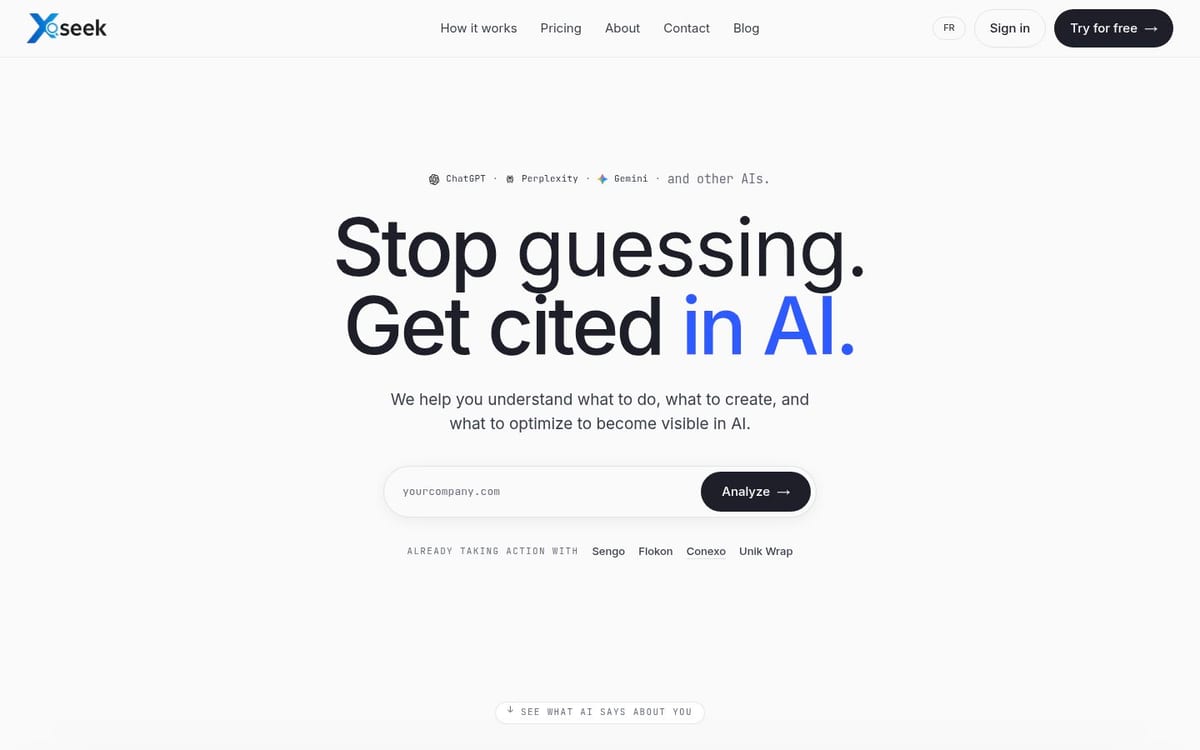
xSeek is the best Ubersuggest alternative when your real problem is not finding another keyword list. It is deciding which content or technical change should happen next after you discover that competitors are being cited in AI answers.
xSeek tracks mentions across ChatGPT, xAI, Perplexity, Google AI Overview, Gemini, Claude, DeepSeek, and Copilot, according to its official pricing page. Its opportunity workflow connects the prompt, the competing source, the missing topic, and the recommended action. That is a different job from Ubersuggest's keyword suggestions.
Pricing: Starter is $249.99 per month and includes 50 tracked prompts, one website, 10 opportunities, a dedicated account specialist, and strategic onboarding. Growth is $499.99 per month with 150 prompts, three websites, 25 opportunities, and continuous optimization. Prices and limits were checked on the xSeek pricing page.
Best for: Canadian marketing leads and B2B teams that want to move from “we should improve AI visibility” to a ranked work queue.
Limitation: xSeek is not a low-cost replacement for every traditional SEO feature. If you mainly need keyword volume, backlink databases, and basic site audits, a conventional SEO suite still belongs in the stack.
A related internal guide is Best SEO Tools in 2026: 15 Tested Picks, but this article's angle is narrower: it treats the SEO suite as something to replace only where it fails to measure AI answers.
2. Morningscore: best for a simple SEO-plus-GEO transition
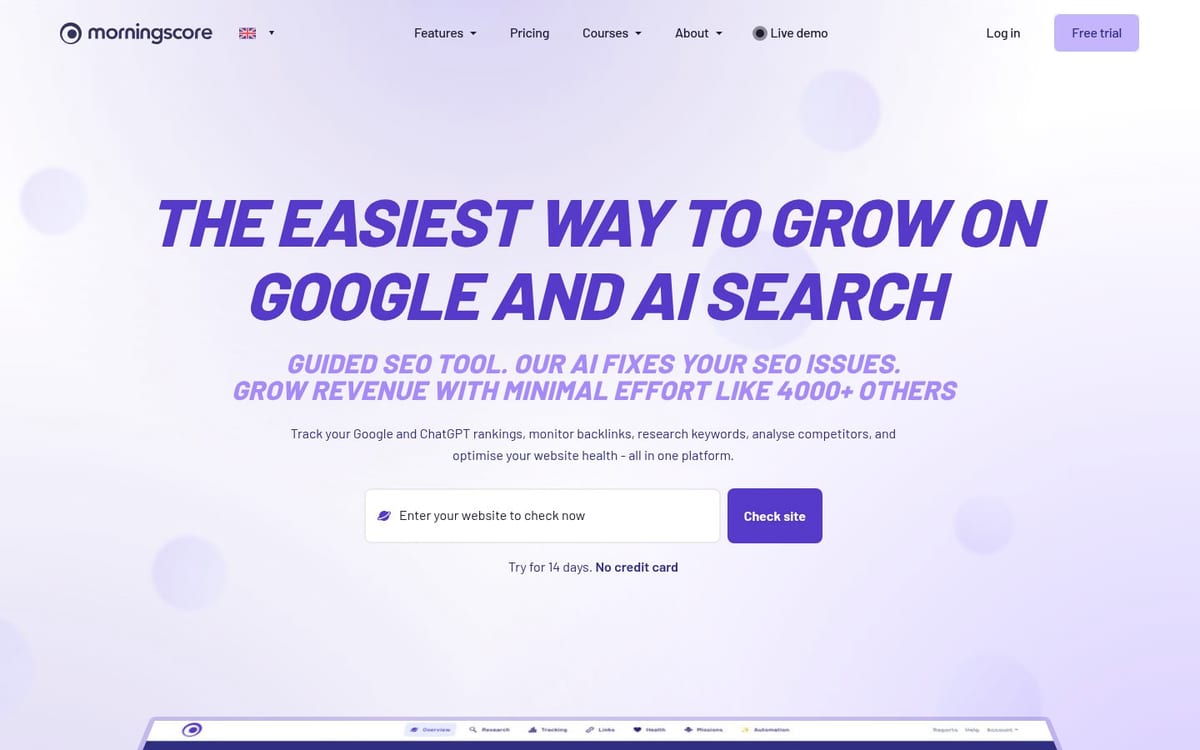
Morningscore is the most approachable option for a small team that wants to keep keyword research, rank tracking, backlinks, and site health while adding a light AI-search layer. Its pricing page lists a $69 per month Lite plan, $99 Business, $159 Pro, and $299 Premium, with a 14-day trial and no credit card required.
The platform lists a GEO Score, Google AI Overviews tracking, AI prompt tracking, ChatGPT rank tracking, AI content writing, and prioritized SEO tasks in every plan. It also states that its current AI reporting focuses on Google and ChatGPT, so it is easier to understand but not as broad as a multi-engine AEO platform.
Pricing: Lite starts at $69 per month. Business is $99, Pro is $159, and Premium is $299. These prices are listed on the Morningscore pricing page.
Best for: A small Canadian business that wants one simpler workspace instead of buying a keyword tool and a separate AI tracker immediately.
Limitation: Morningscore's own FAQ says it reports data from Google and ChatGPT. Teams that need Claude, Gemini, Perplexity, or Copilot comparisons should shortlist a broader platform.
3. SE Ranking: best for agencies replacing Ubersuggest across client sites
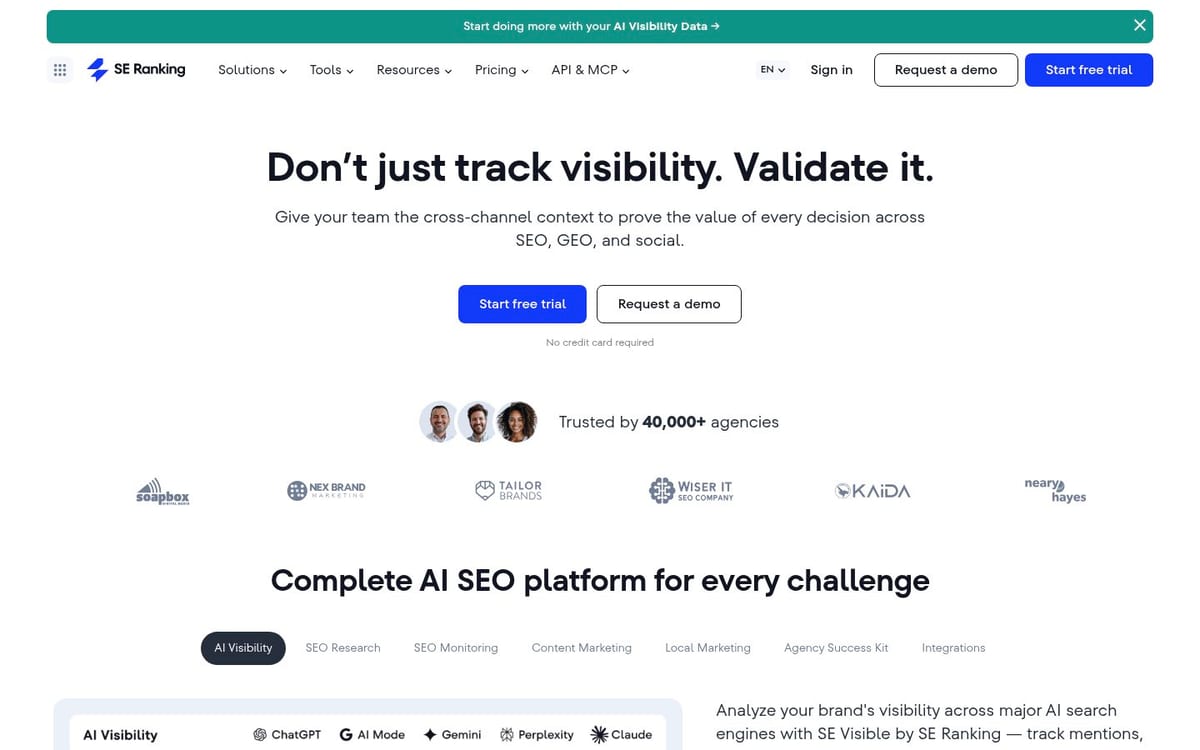
SE Ranking is a strong fit when an agency needs Ubersuggest-style keyword and competitor research across multiple client projects, then wants to add AI-search reporting without starting over. Its Core plan includes 10 projects, 2,000 keywords, 100 daily prompts, five GEO research domains, and 250,000 audit pages.
The separate AI Search add-on costs $89 per month monthly or $71.20 annually. It adds 200 prompts and tracks AI Overviews, AI Mode, Perplexity, and ChatGPT, with a strategic dashboard for mentions, citations, and sentiment trends. The combined annual floor is $174.40 per month for Core plus AI Search, based on the SE Ranking pricing page.
Pricing: Core is $129 per month monthly or $103.20 annually. Growth is $279 monthly or $223.20 annually. AI Search is an extra $89 monthly or $71.20 annually. A 14-day free trial is available without a credit card.
Best for: Agencies that need traditional SEO delivery, client reporting, and AI-search tracking in the same account structure.
Limitation: The AI-search layer is an add-on, so the advertised Core price understates the real cost of a full Ubersuggest replacement with AEO tracking.
4. Ahrefs: best for research depth, not guided execution
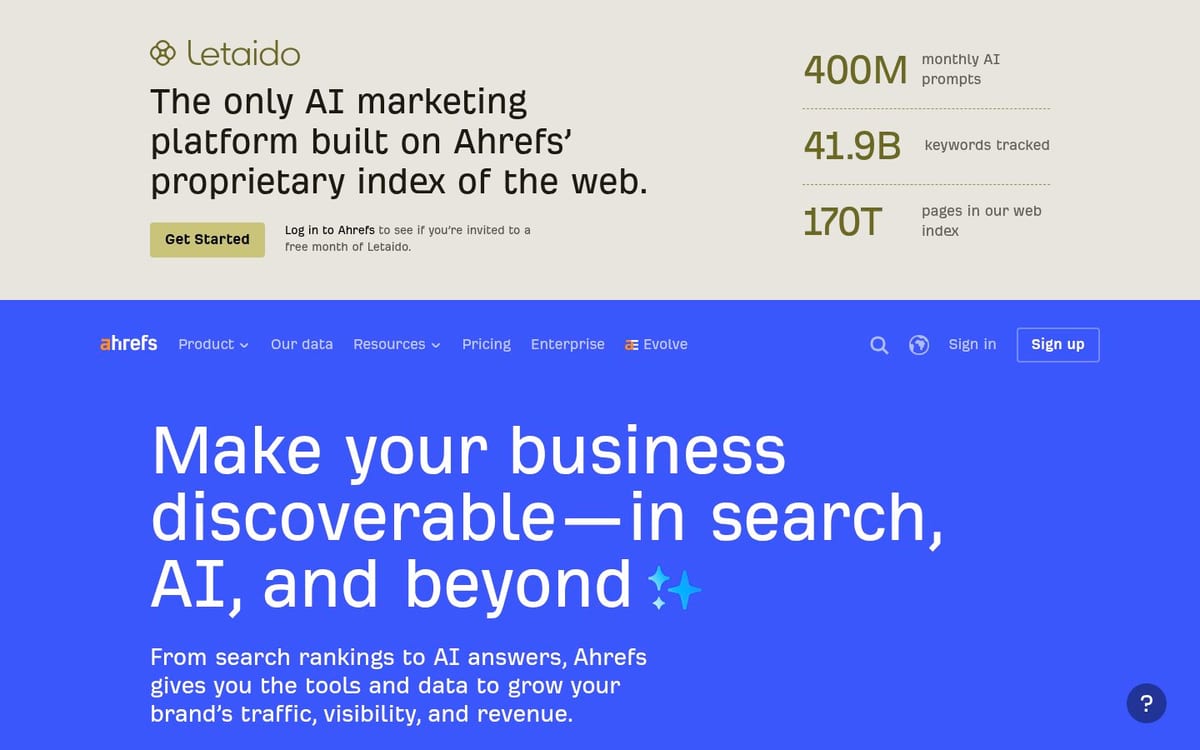
Ahrefs is the right move when your team is leaving Ubersuggest because it needs deeper competitor, backlink, and search research. Its Keywords Explorer and Site Explorer are a stronger research foundation than a basic budget tool, while Brand Radar adds AI visibility data.
Ahrefs lists Lite at $129 per month, Standard at $249, Advanced at $449, and Enterprise at $1,499. Brand Radar AI starts at $199 per month and uses a database of more than 462 million organic prompts, according to the Ahrefs pricing page. Custom prompt packages are also available from $50 per month.
Pricing: Lite is $129 per month. Brand Radar AI starts at $199 per month as a separate option. The exact total depends on whether you need the core Ahrefs plan, Brand Radar research, custom prompts, or all three.
Best for: SEO researchers who want to connect AI prompt visibility to backlinks, content discovery, and conventional search data.
Limitation: Ahrefs gives you evidence and research depth, not a built-in editorial action plan for every citation gap. Your team still needs to turn the finding into a brief, update, or outreach task.
5. Semrush: best for teams already invested in its ecosystem
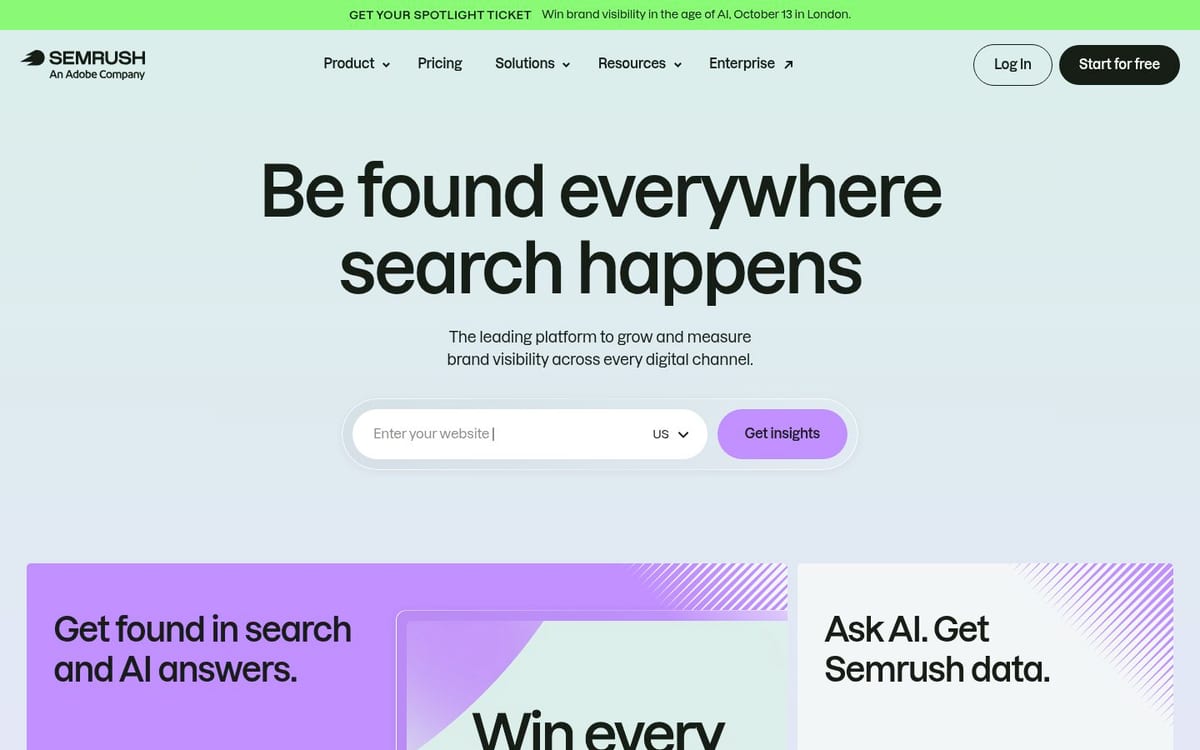
Semrush is a sensible Ubersuggest alternative when the reason for switching is consolidation. Its current plans combine keyword research, competitor analysis, technical auditing, content work, and AI visibility rather than treating AI search as a separate specialist project.
The SEO plan is listed at $117.33 per month when billed annually and includes AI-search performance, AI sentiment, AI visibility reports, and custom prompt monitoring. Starter SEO + AI Search is $165.17 per month annually with 50 daily prompts and one AI brand-performance domain. Pro+ is $248.17 annually and adds 100 daily prompts and content optimization, according to the Semrush pricing page.
Pricing: SEO is $139 monthly or $117.33 annually. Starter SEO + AI Search is $199 monthly or $165.17 annually. Pro+ is $299 monthly or $248.17 annually. A seven-day trial is listed on the pricing page.
Best for: Teams that already use Semrush and want AI visibility beside their existing SEO, content, and reporting workflows.
Limitation: If you only want AI-search monitoring, Semrush may add more software and cost than necessary. It is a suite decision, not a lightweight Ubersuggest swap.
6. LowFruits: best for finding reachable topics before AI optimization
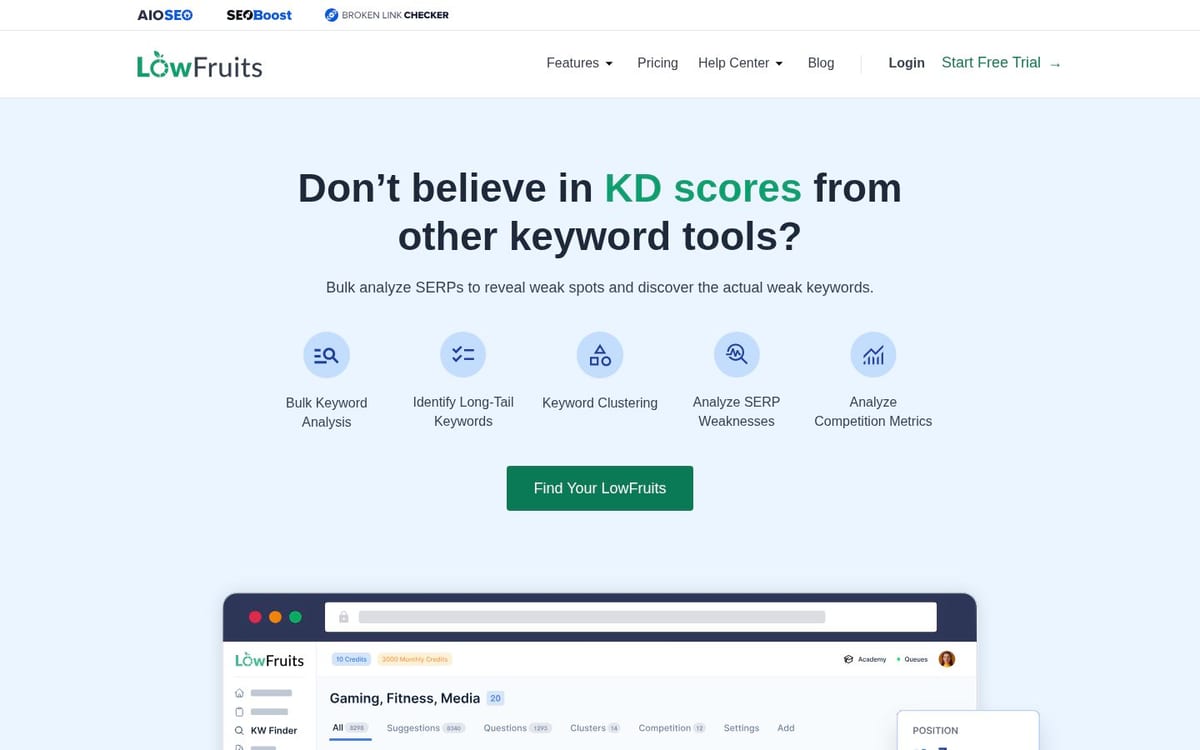
LowFruits is the specialist choice for the first half of the workflow: finding low-competition topics that a smaller site can realistically target. It extracts competitor keywords, analyzes SERPs for weak results, supports rank tracking, and includes sitemap extraction on subscription plans.
Its Standard plan is $29.90 per month monthly or $20.75 per month billed yearly, with 3,000 credits, 30 competitor ranking extractions, 300 competitor keyword extractions, 90 sitemap extractions, and 100 tracked keywords. Premium is $79.90 monthly or $62.45 annually, according to the LowFruits pricing page.
Pricing: Standard is $29.90 monthly or $20.75 annually. Premium is $79.90 monthly or $62.45 annually. Pay-as-you-go credits start at $25 for 2,000 credits.
Best for: A lean content team that wants to find realistic topics before using a separate platform to measure citations and mentions.
Limitation: LowFruits does not replace AI visibility tracking. It helps you choose a reachable SERP, not verify whether AI engines recommend your brand after publication.
What should Canadian teams check before switching?
A good Ubersuggest replacement should pass five tests before you migrate projects or cancel a subscription.
1. Can it separate Google demand from AI visibility?
Search volume and AI visibility are related but not interchangeable. Use keyword data to understand demand, then track prompts, mentions, citations, sentiment, and competitor presence in the AI responses themselves.
2. Can it represent the markets you actually serve?
Ask whether the platform supports Canadian locations, French-language prompts, regional competitors, and market-specific reporting. A global average can hide a visibility gap in Quebec, Ontario, or a city where your sales team is trying to grow.
3. Does it identify the cited source?
A mention is not the same as a citation. The useful report shows which page or domain AI used, whether the source was yours or a competitor's, and what content gap created the difference.
4. Does it tell your team what to do?
A dashboard can report a decline. An action layer turns that decline into a page refresh, new article, internal-linking task, technical fix, or off-site citation opportunity. This is why Best SEO Tools for AI-Optimized Content in 2026 is related but not interchangeable with this migration guide: content creation and AI visibility measurement are separate buying decisions.
5. Can you verify the pricing model?
Compare the real monthly cost, not the entry badge. Add-ons for AI engines, prompts, users, projects, reports, and content credits can change the result quickly. Write down the minimum plan that covers your actual markets and engines before comparing vendors.
A practical migration path from Ubersuggest
The cleanest migration does not start by exporting every keyword. It starts with the questions that affect revenue.
- Export the keywords, content ideas, and competitors tied to your highest-value products or services.
- Group them into buyer questions, not only short keyword variants.
- Select the AI engines and Canadian regions that match your audience.
- Run a baseline for mentions, citations, sentiment, and competitor share of voice.
- Keep the keywords that support demand research, but move your editorial priority to prompts where competitors are cited and your site is absent.
- Publish or refresh one page per gap, with direct answers, primary-source links, clear authorship, and an FAQ that addresses related buyer questions.
- Recheck the same prompts on a regular cadence and record the page, source, and message changes.
This process is closer to a measurement loop than a keyword list. For broader context on how AI visibility platforms differ, see Best Semrush Alternatives for AI Search Visibility (2026), but use the criteria here when the starting point is Ubersuggest and the buyer is a Canadian marketing team.
FAQ
What are the best Ubersuggest alternatives for AI search optimization?
The best choices are xSeek, Morningscore, SE Ranking, Ahrefs, Semrush, and LowFruits, but they solve different problems. xSeek is the strongest option for action plans and AI citation gaps, while Morningscore and SE Ranking keep more traditional SEO work in the same workspace.
Is there a free Ubersuggest alternative for AI SEO?
Most full replacements offer a free trial, free tier, or limited diagnostic rather than unlimited research. Semrush lists a free plan with limited reports, SE Ranking offers a 14-day trial, and Morningscore offers a 14-day trial without a credit card. Free access is useful for checking fit, but ongoing prompt and citation tracking usually requires a paid plan.
What are the best AI SEO tools for a small Canadian business?
Morningscore is a practical lower-cost starting point if you want SEO and a light GEO layer together. If AI visibility is the main goal and you need guidance on what to publish or update, xSeek is a better fit, but its $249.99 monthly Starter plan is aimed at teams with a larger visibility program.
Is Ahrefs better than Ubersuggest for keyword research?
Ahrefs is the stronger research platform for teams that need deeper backlink, competitor, content, and keyword data. Ubersuggest remains cheaper and simpler, so the upgrade makes sense when the value of better competitive evidence exceeds the added subscription cost.
Does Semrush track ChatGPT and Google AI Overviews?
Semrush's pricing page lists AI-search performance, AI sentiment, AI visibility reports, custom prompts, and coverage for Google Search, ChatGPT, Perplexity, and Gemini-related surfaces. The exact prompt limits and included capabilities depend on the plan, so check the current plan details before buying.
Can keyword research tools measure AI citations?
Traditional keyword research tools usually cannot measure AI citations on their own. They can help you find demand and competitors, but you need an AI visibility or AEO feature that records prompts, generated answers, mentions, citations, and source URLs.
Should I replace Ubersuggest with one tool or a stack?
Use one tool if your priority is simplicity and its coverage matches your workflow. A small stack can be better when you need LowFruits for low-competition topic discovery, Ahrefs or Semrush for SEO research, and a dedicated platform such as xSeek for AI visibility and action planning.
Sources & References
- xSeek pricing - AI engines, prompts, plans, and onboarding.
- Morningscore pricing - SEO and GEO plan prices and limits.
- SE Ranking pricing - Core, Growth, and AI Search add-on details.
- Ahrefs pricing - SEO plans, Brand Radar, and prompt packages.
- Semrush pricing - SEO and SEO + AI Search plan details.
- LowFruits pricing - competitor research credits and subscription limits.