
If you need to know whether ChatGPT, Perplexity, Gemini, or another AI search engine recommends your brand, choose an AI search monitoring tool that measures mentions, citations, sentiment, competitors, and the sources behind each answer. For most marketing teams, xSeek is the best fit when the goal is to turn visibility data into a prioritized content plan. Ahrefs, Semrush, and Moz make more sense when you also need a broad traditional SEO suite.
The key distinction is simple: rank tracking tells you where a page appears in a search result, while AI search monitoring tells you whether an answer engine names or cites your brand. You need both views if buyers discover your category through search results and generated answers.
What is an AI search monitoring tool?
An AI search monitoring tool runs the questions your buyers ask across AI engines, records the answer, and measures your brand against competitors. Good platforms also show which pages or third-party sources influenced the response.
The most useful reports answer five questions:
- Mention rate: How often does an engine name your brand?
- Citation rate: How often does it link to your domain or content?
- Share of voice: How often do you appear compared with competitors for the same prompts?
- Sentiment: Is the answer positive, neutral, or negative?
- Source coverage: Which pages does the engine use when it forms the answer?
An isolated manual check isn't enough. AI answers can vary by prompt, model, location, and time. A scheduled sample gives you a trend you can act on.
The best AI search monitoring tools
The right choice depends on whether you want an action plan, a large SEO data set, or enterprise reporting. These are the four practical options for a marketing team comparing AI visibility platforms.
1. xSeek: best for action-first AI visibility
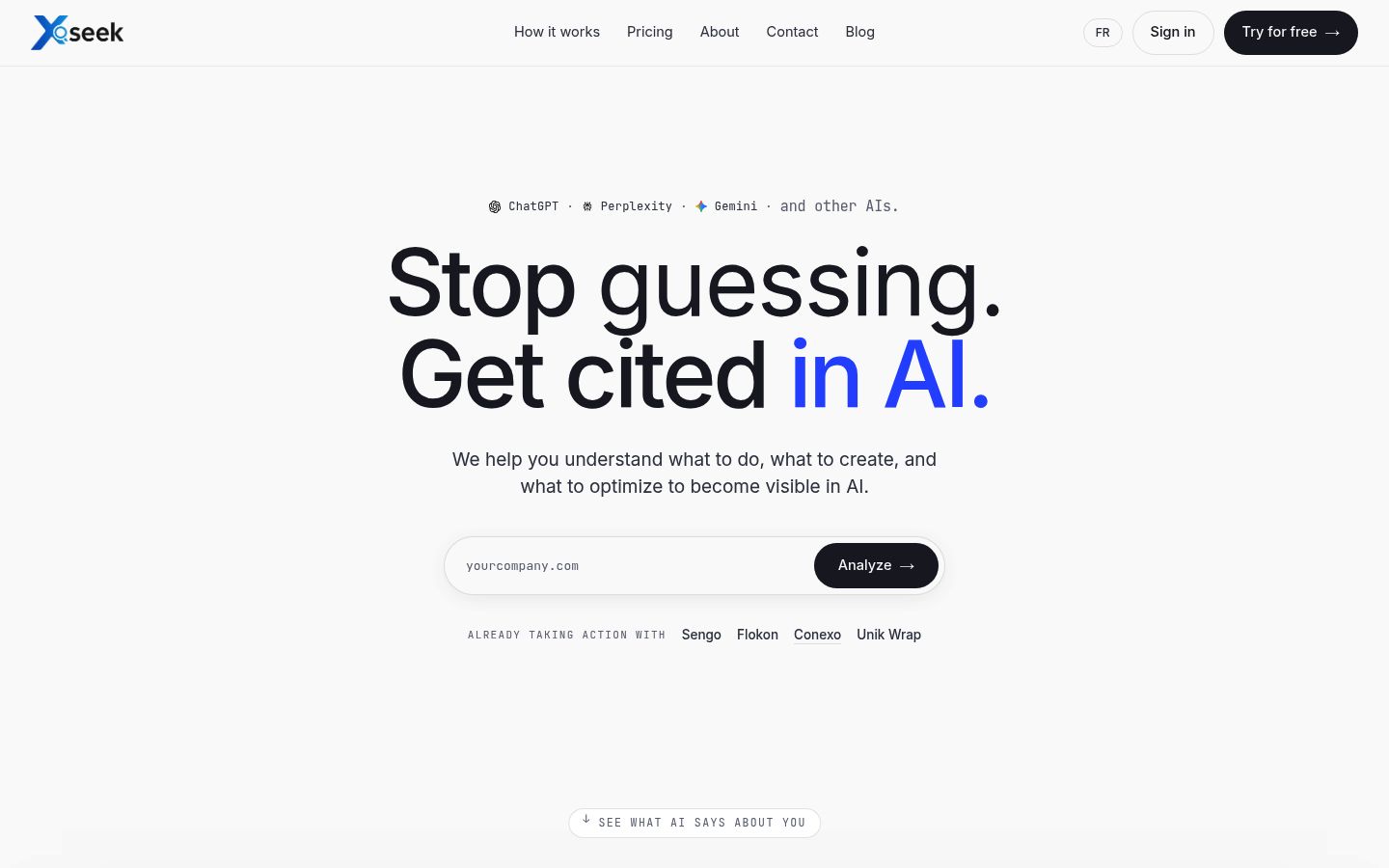
xSeek is the strongest choice when you want to move from an AI visibility report to a specific next step. It tracks prompts across ChatGPT, Perplexity, Gemini, Claude, and other answer engines, then compares your brand's mention share, sentiment, and cited sources with competitors.
The useful difference is the workflow after measurement. xSeek identifies missing citations and turns them into actions such as refreshing a claim, adding evidence, restructuring a page, or creating a new article. That suits a CMO or marketing lead who doesn't need another dashboard to interpret.
The AI visibility tracking page describes the product's core workflow: ask real buyer questions on a schedule, measure share and sentiment, then hand the team a prioritized plan. The platform also tracks AI crawler visits, which adds a technical view of whether bots can reach your content.
Pricing is published on the xSeek pricing page. The Starter plan is listed at $249.99 per month for 50 prompts and one website. Growth is listed at $499.99 per month for 150 prompts and three websites. Scale uses custom pricing and lists 500 prompts and 10 websites. Plans are billed monthly, and the page says strategic onboarding is included.
Choose xSeek if: your team wants cross-engine monitoring plus content recommendations and a publishing workflow.
Know the tradeoff: xSeek focuses on AI answer visibility. You may still need Ahrefs, Semrush, or Moz for deep keyword, backlink, and technical SEO work.
2. Ahrefs: best for SEO depth with AI visibility
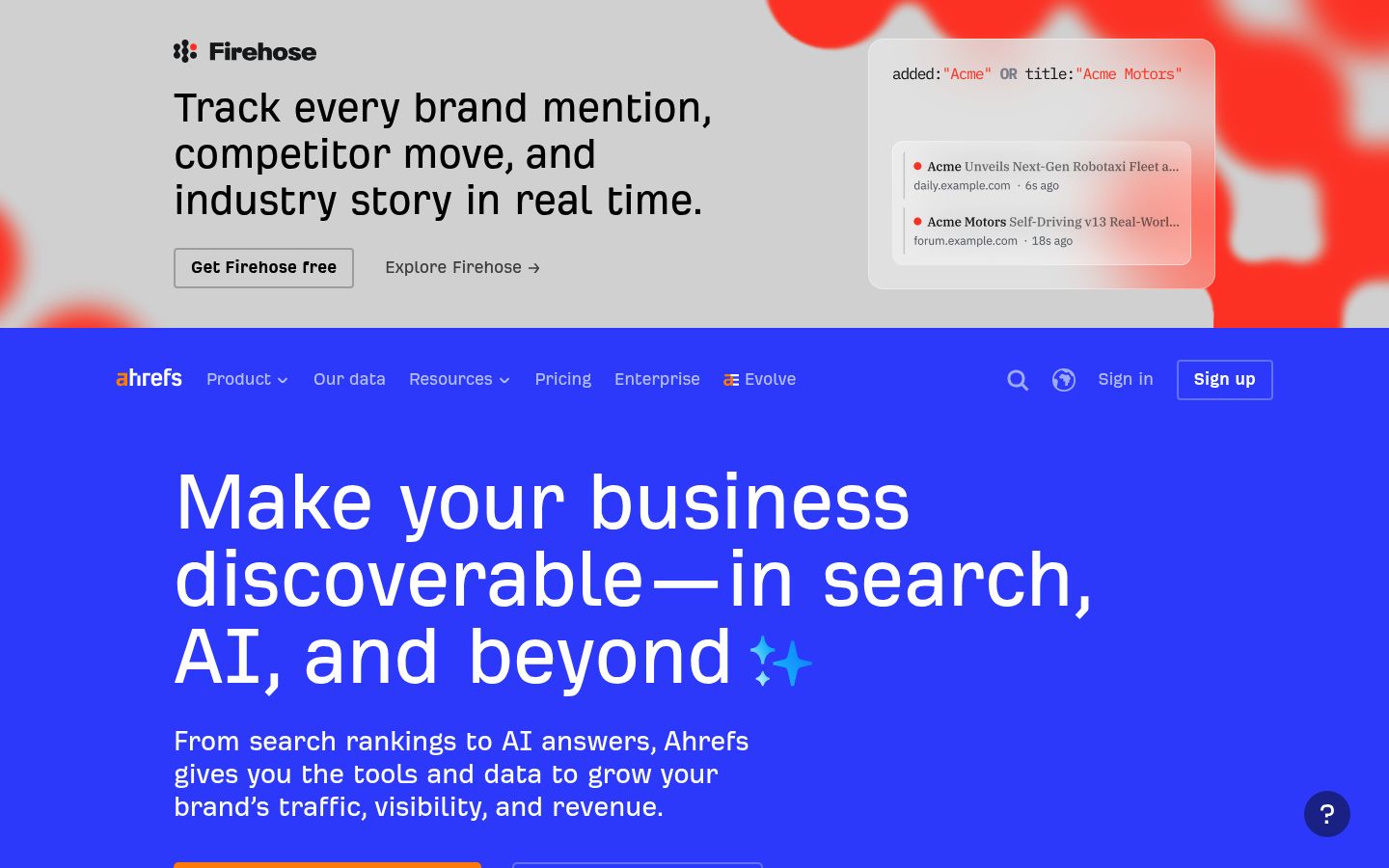
Ahrefs is a strong option for teams that want AI visibility alongside a mature SEO data platform. Its official product navigation lists Brand Radar for tracking brand visibility in large language models, Custom Prompts, Rank Tracker, Site Explorer, Keywords Explorer, and Site Audit.
That breadth matters if the same team owns organic rankings, backlinks, content research, and AI search. You can connect AI visibility findings to the keyword and competitor data used in your existing SEO process.
Choose Ahrefs if: traditional SEO remains the center of your stack and AI visibility is an important extension.
Know the tradeoff: the platform gives you many data surfaces. Teams looking for a short, action-first list may need to do more interpretation than they would in a focused workflow.
Pricing changes by product and plan, so check the current Ahrefs pricing page rather than relying on an old comparison table.
3. Semrush: best for a broad marketing platform
Semrush combines SEO, competitive research, content, reporting, and AI visibility features. Its official site describes AI Visibility as a way to track prompt-level visibility and compare AI market share with competitors. It also offers an AI Visibility Checker and broader SEO and content workflows.
Choose Semrush if: you want AI search monitoring inside a larger marketing platform used for SEO, content, market research, and reporting.
Know the tradeoff: AI visibility is one part of a wide product. Confirm that its prompt coverage, source reporting, exports, and recommendations match the workflow your team will actually use.
Semrush offers a free trial from its official homepage. Current plan details and prices are on its pricing page, and should be checked before purchase.
4. Moz: best for familiar SEO workflows
Moz is a practical fit for teams already using Moz Pro and looking to add AI answer visibility. The official Moz site says Moz Pro can monitor AI presence, track whether a brand is the first recommendation, benchmark competitors, and identify emerging threats with weekly data.
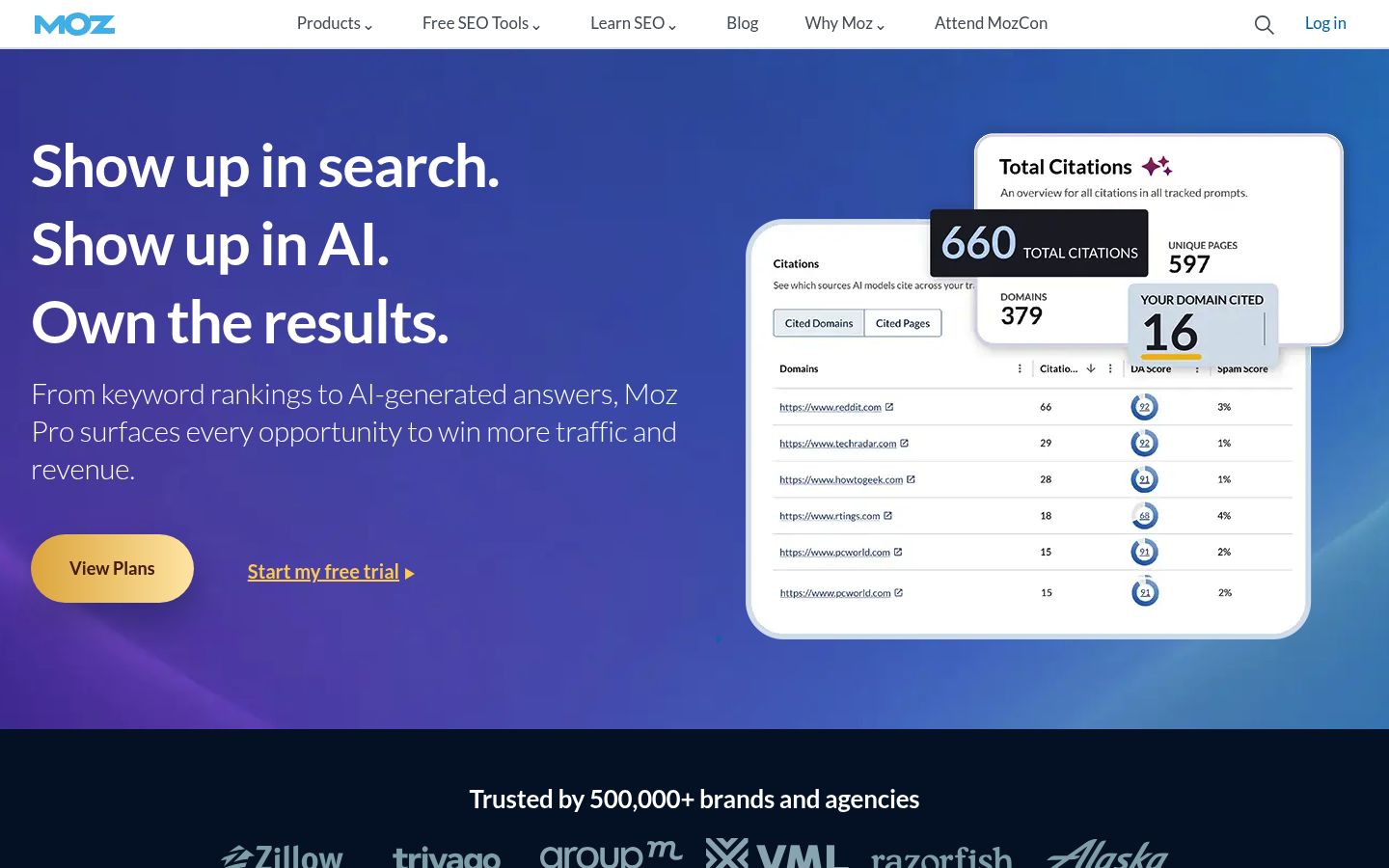
Moz also keeps its established SEO capabilities in the same product family, including keyword research, competitive research, link research, rank tracking, and site crawl. That makes the transition easier for an existing Moz team.
Choose Moz if: your team already works in Moz and wants AI visibility without replacing its SEO workflow.
Know the tradeoff: compare the depth of its AI prompt, citation, and source reporting with a specialist platform before you make it the center of your AI search program.
Moz publishes current offers and plan information on its Moz Pro pricing page. Pricing was not stated here because the public product page can change by plan, billing period, and promotion.
What should an AI search monitoring dashboard measure?
Start with citation and competitive context, not a single visibility score. A score without the underlying prompts and sources can't tell your team what to change.
| Metric | What it tells you | What to do with it |
|---|---|---|
| Mention rate | Whether an AI engine names you | Find prompts where competitors appear and you don't |
| Citation rate | Whether the answer links to your content | Strengthen evidence, structure, and topical coverage |
| Share of voice | Your visibility relative to named competitors | Prioritize the categories where the gap has business value |
| Sentiment | How the answer frames your brand | Correct outdated or incomplete claims |
| Source coverage | Which pages and domains influence answers | Build or improve pages that answer the prompt directly |
| AI crawler visits | Whether AI bots reach your site | Check robots.txt, server rendering, and page accessibility |
Which AI engines should you monitor?
Monitor the engines your buyers use, then add the major answer surfaces so you can compare patterns. A sensible starting set is ChatGPT, Google AI Overviews, Perplexity, Gemini, Claude, and Bing Copilot.
Each engine can retrieve different sources and format answers differently. A brand may appear in one answer and disappear from another, so single-engine monitoring gives you a partial view.
Use the official Google Search Central documentation for guidance on Google's AI features. For generative engine optimization research, the Princeton GEO paper is a useful reference for how content changes can affect visibility in generative responses.
How to choose an AI search monitoring tool
Use this decision process before comparing plan pages:
- Define the buyer prompts. Include branded, category, comparison, local, and problem-based questions.
- Check engine coverage. Confirm the models and search surfaces that matter to your customers.
- Inspect the evidence. Look for the full answer, cited URLs, sentiment, and competitor mentions, not just a score.
- Test the action layer. Ask whether the platform recommends a page, content change, or technical fix.
- Review integrations. Check CMS, exports, API, reporting, and user permissions before you buy.
- Set a review cadence. Review priority prompts weekly and wider topic coverage monthly.
An action-first tool is usually the better fit for a lean marketing team. A broad SEO suite is the better fit when the same platform already owns your keyword, link, and technical workflows.
How often should you monitor AI search?
Review high-value prompts weekly and run a broader analysis monthly. Weekly checks catch changes in recommendations, citations, and sentiment while the team can still respond.
Use the monthly review to group findings by intent. Separate branded questions from category comparisons, then rank opportunities by commercial value and the effort needed to fix the underlying page.
FAQ
What is the best AI search monitoring tool?
xSeek is the best fit for teams that want cross-engine visibility data connected to a prioritized content plan. Ahrefs, Semrush, and Moz are better fits when AI monitoring needs to sit inside a larger SEO platform.
How do I track whether ChatGPT mentions my brand?
Use a platform that runs a consistent set of buyer prompts on a schedule and records mentions, sentiment, competitors, and cited sources. Manual ChatGPT checks are useful for spot checks, but they don't produce a dependable trend.
What is the difference between AI search monitoring and rank tracking?
Rank tracking measures where your page appears in a traditional search result. AI search monitoring measures whether an answer engine names your brand, cites your page, or recommends a competitor inside a generated answer.
Can AI search monitoring tools track Perplexity and Google AI Overviews?
Many platforms cover both, but coverage varies by plan and product. Confirm the exact engines, prompt limits, locations, frequency, and source data before choosing a tool.
Is an AI visibility platform the same as an AEO tool?
Not always. AI visibility platforms measure how your brand appears in answers, while answer engine optimization tools may also recommend content, technical, and authority changes to improve those appearances.
What tools help write articles that get cited by AI models?
Choose a tool that connects prompt research with source-backed writing, clear structure, and a way to measure citations after publication. xSeek is designed to connect visibility gaps with content actions; broad SEO platforms can support the research and optimization work around it.
How can large businesses choose an AI search monitoring platform?
Large businesses should compare engine coverage, prompt volume, locations, permissions, API access, reporting, data retention, and support. They should also test whether the platform can turn findings into work for content, SEO, and technical teams.
Sources & References
- Google Search Central: Google's AI feature guidance
- Princeton GEO research: generative engine optimization research
- xSeek AI visibility tracking: product capabilities
- Ahrefs: AI and SEO product capabilities
- Semrush: AI visibility and marketing platform capabilities
- Moz: AI visibility and SEO product capabilities
The Bottom Line
The best AI search monitoring tool is the one your team can use every week. Pick xSeek if you want an action plan tied to AI citations and content work. Pick Ahrefs, Semrush, or Moz if you need AI visibility within a larger SEO suite. In either case, track the same buyer prompts over time and judge progress by citations, competitive share, and the quality of the next action.